
DND Report: In Pakistan, the discourse on ‘structural reforms’ is always present in newspapers and public discussions, but such reforms have never actually taken place, although everybody, even those running the country has confessed that the governance system has collapsed.
Delaying structural reforms suits those who benefit from the status quo because the powerful do not want to share the means (sources) of ‘prosperity’ with the public. The second most popular term in this discourse is ‘corruption’. Political scientists believe that a structural status quo always helps ‘structural corruption’ to flourish. Pakistan is caught between the need for structural reforms and the prevalence of structural corruption.
Whatever is appearing in the media about JUI-F and its chief, Fazl-ur-Rehman, and the allegations of corruption against them is a textbook example of how structural corruption enables people in Pakistan to amass fortunes, while nobody dares to raise a finger until a certain saturation point is reached.
Despite a long history of alleged involvement in corruption, JUI-F had never been seriously questioned in the past because it remained an ingredient of power politics, enjoyed the support of half a million students of religious schools, and maintained deep-rooted connections in Afghanistan and certain Middle Eastern countries. The most lethal tool JUI-F possesses is its religious smokescreen. In Pakistan, the misuse of blasphemy laws makes everybody afraid to question religious parties and religious personalities. Although the media is now digging into allegations of corruption involving JUI-F, political parties and their leaders are avoiding commenting on the alleged corruption involving Fazl-ur-Rehman’s family. The Mufti Mahmood Markaz, which is accused of encroaching on the Ring Road in Peshawar, remains untouched because demolishing or even touching a religious building in Pakistan, even when it involves an encroachment, requires a lion’s heart.
The majority of alleged corruption cases involving Fazl-ur-Rehman’s family are linked to the period when JUI-F was sharing power with the PPP and PML-N. Most of these cases reportedly relate to the Pakistan Democratic Movement (PDM) era. During 2022–23, some investigative journalists tried to dig into alleged corruption in ministries led by JUI-F, PPP and PML-N, but these journalists were made ‘silent’.
The latest news concerning alleged corruption within JUI-F is linked to allegations of selling party tickets. A serious issue has come to light: political party tickets are allegedly being distributed in exchange for large financial payments rather than being awarded on the basis of ideological commitment or political service.
According to available information and emerging details, a systematic practice of buying and selling tickets for the Senate, as well as the National and Provincial Assemblies, allegedly took place under the leadership of Jamiat Ulema-e-Islam (F) chief Fazl-ur-Rehman—a process that reportedly involved the collection of billions of rupees as financial kickbacks.
Several individuals have been identified in this regard, including contractors, business figures and others associated with political circles.
Details indicate that a Senate ticket from Balochistan was awarded to a contractor named Ahmed Khan in exchange for a payment of one billion rupees. It has also been alleged that Asad Mahmood (son of Faxul Rehman) played a role in brokering this deal. Similarly, a contractor named Abdul Shakoor is accused of securing a Senate ticket in return for facilitating a cross-border trade project with Iran.
In Khyber Pakhtunkhwa, the name of Fazl-ur-Rehman’s brother, Atta-ur-Rehman, has surfaced in connection with the alleged sale of National and Provincial Assembly tickets. According to reports, the price of a ticket was determined by a candidate’s prospects of winning in a particular constituency: the higher the likelihood of victory, the larger the amount demanded.
A serious revelation has also emerged concerning Usman Badini, a contractor hailing from Nushki. Usman Badini had reportedly already made a payment to secure a National Assembly seat; however, he was subsequently asked to pay an additional one billion rupees to finalise the allocation of the ticket.
This instance of alleged grave corruption is not merely a political irregularity; rather, it casts a serious shadow over the democratic system, the electoral process and the credibility of Jamiat Ulema-e-Islam (JUI-F).
Several critical questions demand immediate answers:
- Have tickets for an ideologically driven Islamic political party been awarded to wealthy contractors and business figures making substantial financial payments instead of being given to the party’s own ideological workers?
- To whom, and through what mechanism, was the one-billion-rupee payment made in exchange for a Senate ticket from Balochistan?
- What was Asad Mahmood’s role in this deal?
- Was Atta-ur-Rehman responsible for setting the prices and managing the arrangements for National and Provincial Assembly tickets in Khyber Pakhtunkhwa?
- Who demanded an additional one billion rupees from Usman Badini, and on what grounds?
The time has come for an impartial investigation into all these allegations and for the individuals involved to come forward and clarify their positions. Accountability institutions must immediately investigate these serious revelations.
These allegations raise fundamental questions about the kind of democracy being practised in Pakistan, where seats in Parliament can allegedly be bought with money. Interestingly, Pakistan’s parliamentary system has also witnessed a situation in which one sister is a senator, another is an MNA through a reserved seat for women, and daughter of female MNA is also a member of Parliament through a reserved seat in a provincial assembly. This is the kind of democracy Pakistan is living with.
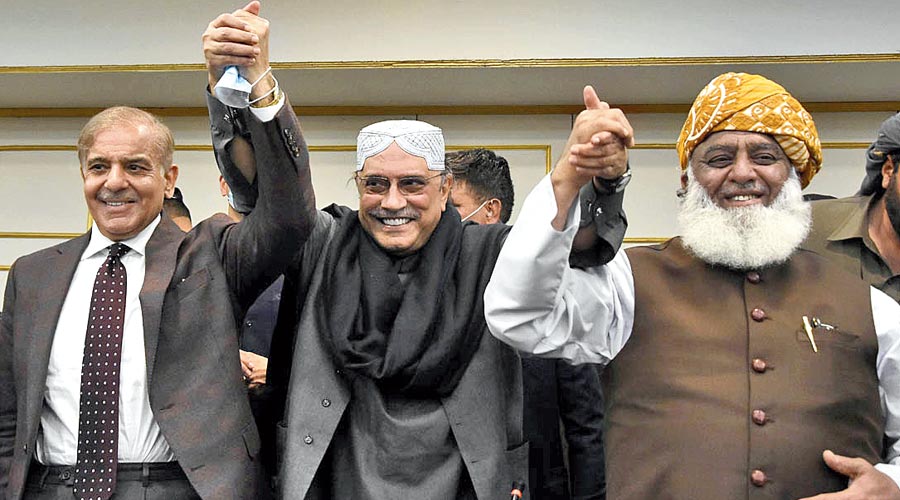
The majority of journalists believe that PML-N supreme leader Mian Nawaz Sharif and PPP’s political godfather, President Asif Ali Zardari, would prefer to distance themselves from the information and allegations concerning how JUI-F allegedly played havoc with the rule of law. They may need Fazl-ur-Rehman tomorrow, so why should they risk their cordial relations with Fazl-ur-Rehman and his political associates today? One should understand broader pattern of elites across parties using political power and religious influence to shield systemic corruption in Pakistan before demanding structural reforms that can block pathway for corrupt politicians.

