
DND Report
A number of impartial academicians and communication experts are raising the alarm that PTI is dividing society further by continuously injecting the concept of “othering.”
This concern has existed since the time PTI rose to power. In the past, PTI had instructed its followers not to attend weddings or even funerals of opponents, not to invite neighbours who criticized founding chairman Imran Khan, and to avoid anyone who disagreed with their narrative. Such directives played a pivotal role in promoting slurring, intolerance, and hate-mongering among different social groups.
Othering is a process of defining and labeling individuals or groups as different from the dominant social norm. It involves creating boundaries between groups, leading to the dehumanization of those perceived as “others,” and it often manifests in various forms of discrimination and prejudice.
Since 2014, PTI launched deliberate hate-driven campaigns to undermine Pakistan’s political system by portraying all politicians and institutions as corrupt except for one “saviour” figure. This strategy caused people to lose trust in democracy and fueled the rise of “Naya Pakistan.” After ruling the country for 42 months, Imran Khan continued to raise public expectations through constant promises of a better tomorrow while blaming failures on the Pakistan Army, claiming he was not allowed to work for the public’s welfare by the then military leadership. He applied the same “othering” tactic to the Army that he had previously used against political opponents. This semiotic tool helped dehumanize or delegitimize individuals and institutions that did not support his narrative.
This “othering” has deeply damaged societal norms and weakened state institutions, creating a toxic “us vs. them” mindset. Yet the state has not taken decisive action or imposed exemplary punishment on those who perpetuate hate against national institutions. Continued weak responses will only worsen the situation.
Those who helped PTI rise to power did not pay attention to the dangerous trend Imran Khan was introducing into society. Even after being rejected by the majority of voters, the cult-like structure of the party and its leader have learned nothing from past mistakes and continue to promote othering. This deliberate polarization now places PTI on one side and the state institutions and the state itself on the other.
PTI’s official social media accounts continue to spread confrontational messages that highlight one undeniable fact: PTI has not moved an inch from its anti-state posture. This is not politics; it is a deliberate continuation of hostility against the state. The repetitive messaging is not accidental it proves PTI’s social media command structure operates from abroad, primarily in the USA under Jibran Ilyas, detached from ground realities and far removed from its own local leadership. Their foreign handlers recycle the same narrative to manufacture artificial chaos.
PTI’s behavior validates every point highlighted by the Pakistan Army in its recent press briefing by the DG ISPR: PTI’s digital operations are coordinated from abroad, driven by a hostile agenda, and designed to attack the state’s narrative. The facts speak for themselves.
By repeating the same tweet again, PTI has unintentionally exposed its internal fractures: local leaders are powerless, while offshore operators dictate content, timing, and messaging. This is not a political party; it is an externally managed propaganda outfit.
The reposted tweet further confirms that PTI’s objective is not national stability or political engagement but manufactured confrontation. Even after being exposed with evidence, they have doubled down, showing they remain on a collision course with Pakistan’s institutions.
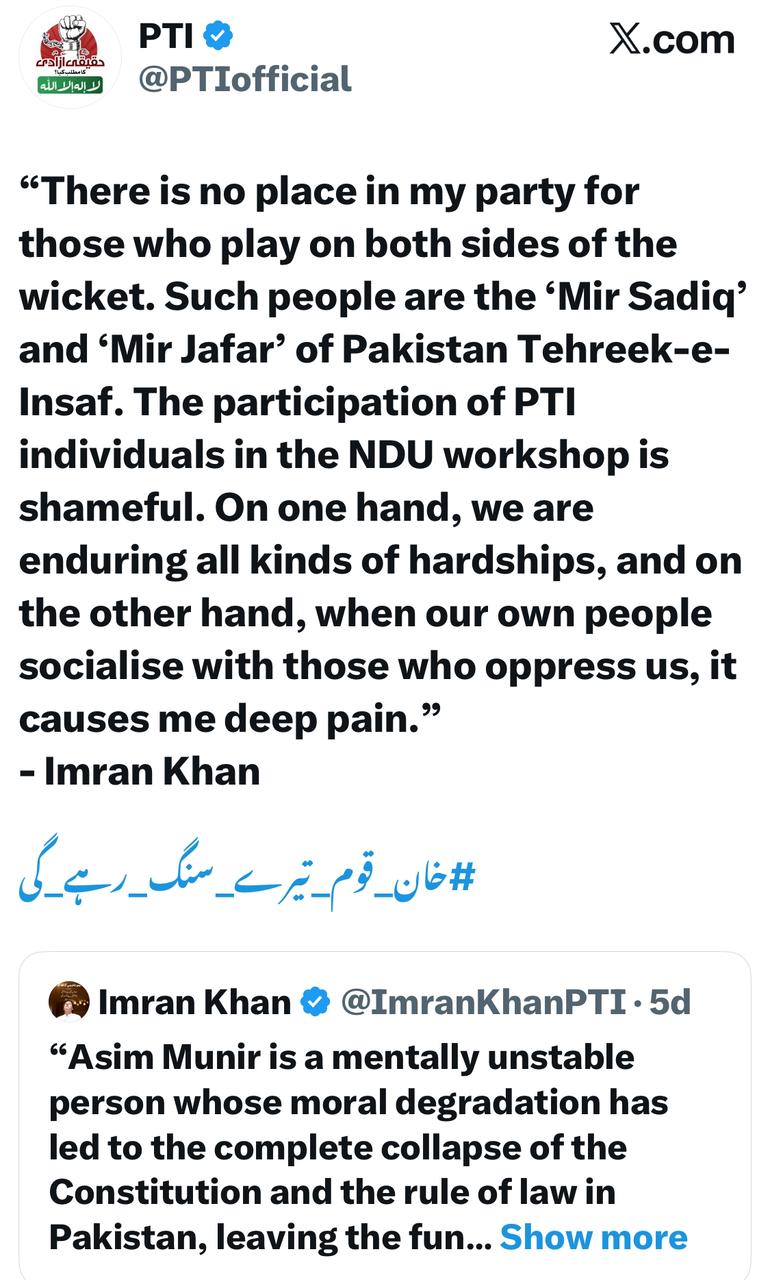
Most importantly, PTI’s repetitive messaging pattern proves that this is a centrally programmed propaganda loop, not organic political communication. It strengthens the case that PTI’s foreign-based network is working against Pakistan’s internal cohesion.
In trying to show defiance, PTI has only confirmed that the state’s assessment of their foreign-controlled, anti-institution operations was accurate, timely, and based on facts not speculation.

