
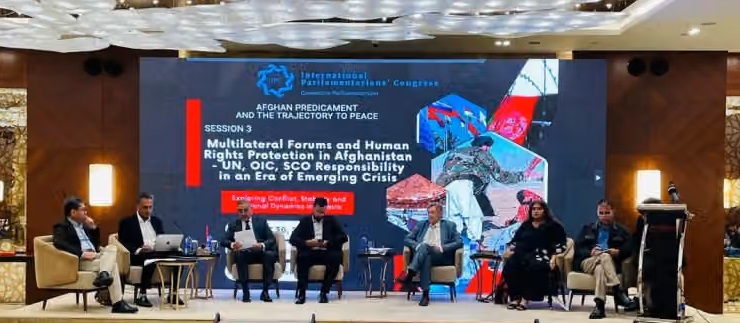
DND Special Report: The international conference titled “Afghan Predicament and the Trajectory to Peace,” held in Islamabad on September 29–30, concluded with a joint statement observing that the Afghan Taliban had failed to act as a responsible regional actor, were spreading terrorism and violence in the region, and had not fulfilled their promises regarding the establishment of an inclusive government and a country that would not spread terrorism to neighboring countries.
The conference also documented a perceivable change in Pakistan’s Afghan policy, which Pakistan had been following for the last 50 years as Islamabad’s policy had been Pashtun-centric since the Afghan Soviet War, thereby not inviting other ethnic groups such as Tajiks, Hazaras, Uzbeks and Turkmens to discuss Afghanistan as a threat or as an opportunity for the region. For the first time, non-Pashtun Afghan figures were given representation to discuss the future of Afghanistan in Islamabad. Amanullah Paiman and Mohammad Tahir Zuhair were invited to the conference and spoke in favour of Pakistan. Paiman served as a lawmaker representing Badakhshan in the Wolesi Jirga, the lower house of the former Afghan Parliament, after being elected in 2005 and re-elected in 2010 and had been the Second Deputy Speaker of the Wolesi Jirga said that Pakistan is facing serious threats from Afghan Taliban who lived, got education and raised their families inside Pakistan for decades. He claimed that Afghan Taliban do not respect anybody and speaks only the language of revenge, hate and violence. Mohammad Tahir Zuhair, former Afghan Minister of Information and Culture, was of the view that the ethnic exclusion of Tajiks, Hazaras, Uzbeks and Turkmens from the Afghan Taliban regime was deliberate. He urged regional neighbors and the international community to back efforts aimed at dismantling the current system and establishing a legitimate and inclusive governance framework. Amanullah Paiman said Taliban opponents would use every opportunity to defeat the group and would cooperate with any country supporting what he called the Afghan people’s just struggle.
Another extraordinary development was the conference’s declaration that Pashtuns, who make up 42% of the population, hold power, while the remaining 58%, including Tajiks, Hazaras, Uzbeks and Turkmens, are excluded.
The joint statement released at the end of the conference said the Taliban administration was neither inclusive nor legitimate, adding that excluding a large part of society from power created conditions for structural instability. Maria Sultan, president of the South Asian Strategic Stability Institute, presented the conference’s final statement.
The statement said Afghanistan was facing a dual crisis involving a non-inclusive and unrepresentative government, while also alleging that the Taliban administration provided safe havens for terrorist groups.
The statement said Afghanistan was now facing three fundamental challenges concerning legitimacy, capacity and inclusion. It said excluding different groups from government created structural instability. The statement added that cohesion within the Taliban regime did not amount to national cohesion and argued that the Taliban system was illegitimate not merely because it lacked recognition, but because of its structure.
The Taliban have described their government as inclusive, saying people from different ethnic groups are represented within its institutions. However, the conference statement argued that the presence of individuals from different ethnic backgrounds does not necessarily amount to political participation by ethnic and social groups in major decision-making.
The document said that control does not mean legitimacy; the absence of war does not mean peace; and regime cohesion does not mean national cohesion.
The declaration also said genuine change was not possible within the Taliban’s current framework and argued that a government excluding women and minorities could not guarantee stability, development or respect for human rights.
Participants called for power to be returned to the Afghan people through the establishment of an inclusive, balanced and modern government.
Another section of the statement focused on Taliban restrictions on women and girls.
The document said depriving women and girls of education, employment and participation in parts of public life was among the factors weakening Afghanistan’s capacity.
It also warned about the expansion of religious schools, saying their number had risen to around 22,000 over the past five years, compared with about 18,000 regular schools.
Participants said Afghanistan’s education system should provide religious education alongside science, technology, vocational training and critical thinking.
The declaration described the exclusion of women, who make up roughly half of Afghanistan’s population, as “strategic suicide,” saying that without women’s participation and an inclusive political system, the younger generation could not be protected from poverty, extremism and violence.
The statement said more than 20 groups had safe havens in Afghanistan and that their continued activities could have security consequences for Pakistan, Iran, Central Asia, Russia, China and other countries.
The declaration called for the establishment of a joint monitoring mechanism involving the United Nations, the Organisation of Islamic Cooperation (OIC) and the Shanghai Cooperation Organisation (SCO) to assess commitments related to preventing safe havens, recruitment and financing for armed groups.
The statement said there was a contradiction between the principles set out in the charters of the United Nations, the Organisation of Islamic Cooperation and the Shanghai Cooperation Organisation and the “tolerance” of Afghanistan’s current situation.
It said engagement with the Taliban without clear benchmarks had failed and argued that any future engagement should be linked to criteria concerning women’s education and employment, political participation, citizens’ rights and efforts against armed groups.
The declaration also called for greater transparency in international aid, saying assistance should reach families directly, particularly women and children.
The Islamabad Declaration 2026 concluded that Afghanistan’s crisis was not solely a matter concerning the government in Kabul but was also linked to what it described as unfulfilled responsibilities of the region and the international community.
The statement added that ignoring Afghanistan’s non-Taliban majority could become a strategic failure, with security and humanitarian consequences extending beyond Afghanistan’s borders.
Using the phrase “Kabul governs, Kandahar commands,” the statement said key decision-making within the Taliban structure was concentrated under the group’s leader in Kandahar.
A critical review of the statement indicates that Pakistan has successfully raised the issue globally that terrorism emanating from Afghanistan against Pakistan is not merely a bilateral issue and must be addressed by international forums such as the UN, SCO and OIC. Ambassador of Pakistan to Russia Faisal Niaz Tirmizi, who had previously dealt with the SCO and the Afghan desks in Ministry of Foreign Affairs, called on neighboring countries, including Iran, Turkmenistan, Uzbekistan, Tajikistan and China, to collectively put pressure on the Afghan Taliban to behave responsibly and stop spreading terrorism in the region. His address to the conference conveyed the message that unless there is a collective effort by the UN, SCO, OIC and neighboring countries to stop the Afghan Taliban from spreading terrorism, the fire of terrorism could spread beyond the region.
Maria Sultan, president of the South Asian Strategic Stability Institute, raised an important question about why the Afghan Taliban were receiving funds from the United States that had been marked for the Afghan National Army, despite the fact that no such institution remained in Afghanistan.
She questioned whether international support money was going into the pockets of the Afghan Taliban instead of reaching the people of Afghanistan, who, according to her, were not receiving basic and fundamental services from the government, including healthcare, clean drinking water and education.
Pakistan’s Federal Minister for Information and Broadcasting Attaullah Tarar stated that the Afghan interim Taliban government needed to “move out of its militant mindset into a mindset of a statesman or a state.” He identified this mindset as the root cause of the current bilateral friction.
He emphasized that Pakistan believes in peaceful coexistence but warned that its desire for peace must not be misconstrued as weakness. Any cross-border attempt to destabilize Pakistan, he said, would continue to face direct retaliation.
He said the Taliban were living in denial regarding two major issues: the existence of terrorist safe havens on Afghan soil and the denial of basic human rights to its citizens.
Mohammad Sadiq, who had served as Pakistan’s Special Envoy for Afghanistan, stated that the core challenges facing Afghanistan were the absence of an inclusive governing framework and the presence of militant groups. These issues, he said, could not be treated merely as a bilateral problem between Kabul and Islamabad. He called for a joint and coordinated response and a monitoring mechanism mandated by the United Nations (UN), Organisation of Islamic Cooperation (OIC) and Shanghai Cooperation Organisation (SCO) to track counterterrorism and governance commitments.
Central Asian representatives, specifically from Tajikistan, Kyrgyzstan and Kazakhstan, raised “legitimate, serious concerns” regarding border vulnerability. They noted that the vacuum created by non-inclusive governance allowed militant groups to exploit border areas easily, posing a direct threat to the Central Asian republics.
Delegates from the region highlighted the immense economic cost of the current predicament. They emphasized that a stable and peaceful Afghanistan holds the key to opening highly anticipated trade routes from landlocked Central Asian states through Afghanistan to Pakistan’s warm-water ports, including Karachi and Gwadar. Representatives from China and Russia aligned with the sentiment that the propagation of violent extremism from Afghan territory could quickly become “unmanageable” for the region if left unchecked. They emphasized that regional security frameworks such as the SCO must take a proactive stance.

