
Monitoring Desk: Three billion people that is almost 40 per cent of the world’s population face inadequate housing facilities, reports Azertac News Agency.
A UN report that was discussed in WUF13 that is being held in capital city of Azerbaijan—Baku further indicates that cities are expected to absorb 2 billion additional residents by 2050, intensifying pressure on housing systems already strained by rapid urbanization, rising land values, widening inequality, and climate impacts.
UN-Habitat, the UN agency for sustainable housing and urban development, in its World Cities Report 2026, Global Housing Crisis: Pathways to Action released today finds that the global housing crisis is multidimensional and underpinned by structural drivers. This report shows that the manifestation of the crisis is compounded further by demographic change, environmental pressures, and evolving economic conditions, further exacerbating broader human development gaps, including inequality, poverty, and vulnerability to climate shocks.
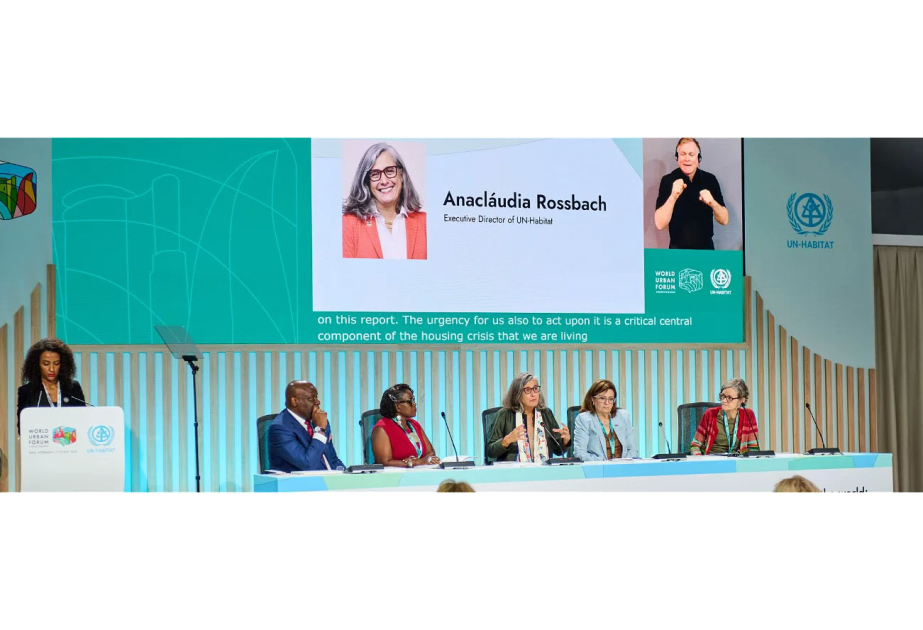
The World Cities Report 2026: Global Housing Crisis: Pathways to Action however also finds that the housing crisis can be solved. It urges that it is time to stop treating informal settlements as an insolvable problem as informality has been the norm rather than the exception across cities. Policy responses must therefore shift from eradication and exclusion to leveraging informality to improve livelihoods and address the housing crisis. It also highlights that domestic finance, across governance levels at the national, regional and local levels, needs to be scaled up and better targeted with effective demand and supply side subsidies to bridge affordability gaps.
The report therefore urges a substantial expansion of domestic public investment in social and affordable housing, while also incentivizing private housing investment that increases housing supply, especially in the affordable housing segment. Community participation and co-production, with special attention to the inclusion of marginalized groups, are central to adequate housing at the policy formulation stage, as well as in projects that must be co-designed and implemented alongside residents, ensuring that communities are involved in both the pre- and post-occupation phases.
“A new social contract for adequate and affordable housing is required – a sense of shared responsibility among governments, the private sector and communities to mobilize investment and align the social and economic functions of housing,” said Anacláudia Rossbach, Executive Director of UN-Habitat.

