
DND Interview
Pakistan and Russia are preparing to take their bilateral relationship into a new phase of economic, commercial, educational, cultural and people-to-people cooperation, with trade, regional connectivity and business-to-business engagement expected to dominate Prime Minister Muhammad Shehbaz Sharif’s three-day official visit to Moscow.
Pakistan’s Ambassador to the Russian Federation, Faisal Niaz Tirmizi, has said that the visit will provide an important opportunity to translate decades of discussions into practical cooperation through agreements covering trade, connectivity, education and cultural exchanges.
“140 Pakistani companies are travelling to Russia in connection with the prime minister’s visit”
Having completed almost one year in Moscow at the end of October, Ambassador Tirmizi said he had witnessed a strong desire among Russian political leaders, business circles, academia and media organisations to establish wider channels of communication and engagement with Pakistan.
He expressed confidence that the meeting between Prime Minister Shehbaz Sharif and President Putin would help unlock important bilateral linkages that had remained dormant for decades.
The prime minister’s visit, with its emphasis on business engagement, regional connectivity and institutional cooperation, is expected to provide an important opportunity to advance this broader agenda.
In an interview with DND News Agency, Ambassador Tirmizi said Prime Minister Shehbaz Sharif had specifically directed that Pakistan’s engagement with Russia should move beyond the already strong political relationship and focus on business-to-business, people-to-people, education-to-education and cultural contacts.
He identified connectivity as another central priority, stressing that both countries need efficient, affordable and reliable logistical arrangements to facilitate trade and transportation. He maintained that stronger economic foundations were essential for the long-term sustainability of bilateral relations.
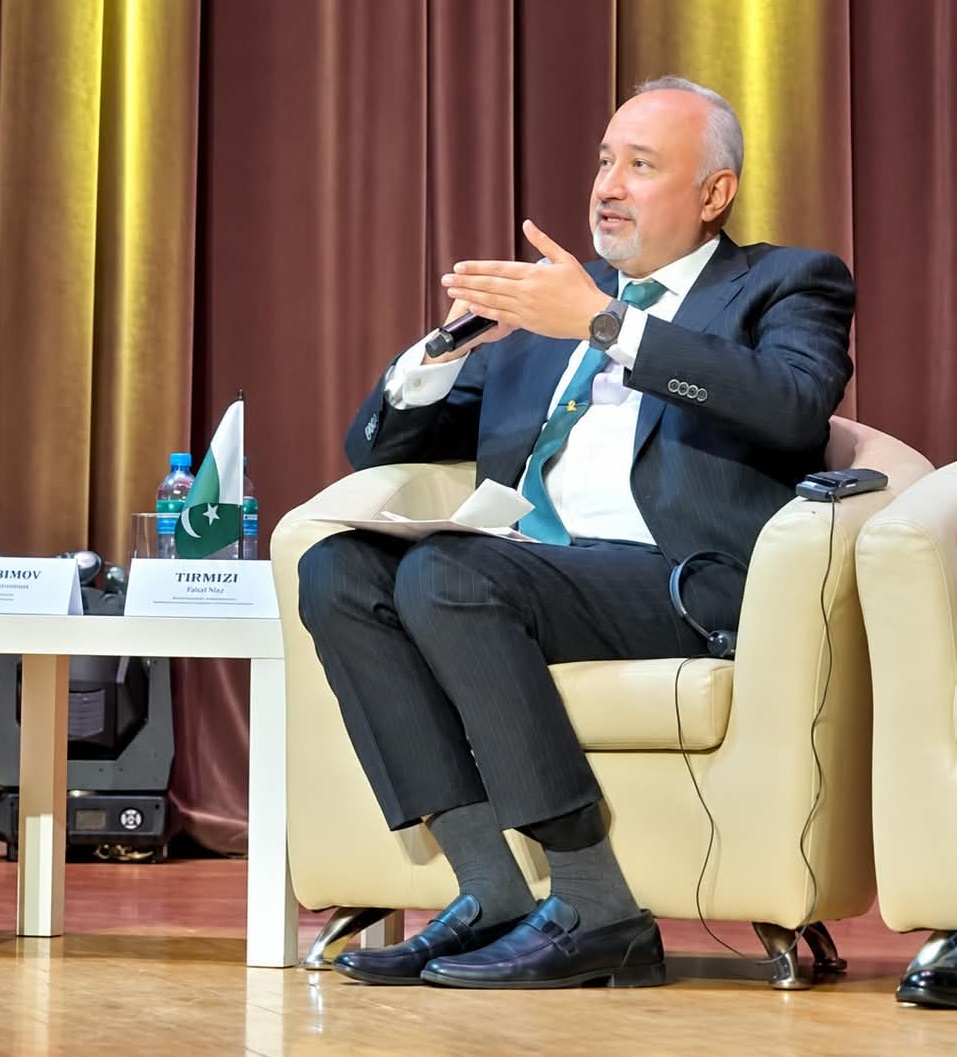
The ambassador said more than 140 Pakistani companies are travelling to Russia in connection with the prime minister’s visit. Business-to-business online meetings had already been arranged between Pakistani companies and their prospective Russian partners, while the visit would provide opportunities to establish further commercial connections.
He emphasised that bilateral relations could only become sustainable when supported by economic cooperation and commercially viable partnerships.
Ambassador Tirmizi said Pakistan would initiate negotiations with the Eurasian Economic Union (EAEU), comprising Russia, Belarus, Kazakhstan, Kyrgyzstan and Armenia, opening new opportunities for Pakistani exporters to access a wider regional market.
He explained that once Pakistani goods entered any member country of the union, they could enjoy customs-free access across the EAEU market, subject to the applicable arrangements.
The ambassador linked the importance of regional connectivity with vulnerabilities in international maritime trade routes, particularly the Bab el-Mandeb Strait and the Strait of Hormuz, which had come under serious pressure following the recent Gulf conflict. He also identified the Strait of Malacca, near Indonesia, as another potential strategic chokepoint in a future conflict.
Against this backdrop, Ambassador Tirmizi said countries across the Eurasian region were increasingly interested in developing extensive road, railway and air connections to ensure alternative and reliable trade routes. Pakistan, he added, intended to make regional connectivity one of the important achievements of its chairmanship of the Shanghai Cooperation Organisation (SCO).
Expressing his long-standing vision of regional integration, Ambassador Tirmizi said he hoped a time would come when people could travel by road from Karachi, Gwadar, Quetta, Islamabad and Peshawar to Moscow, and vice versa.
The ambassador described the participation of more than 140 Pakistani companies as one of the significant features of the prime minister’s visit. He said the business-to-business arrangements already initiated between companies of the two countries would help establish direct commercial contacts and identify opportunities for cooperation.
Ambassador Tirmizi also referred to the emerging global political and security environment, including the recent trilateral engagement involving Russia, China and the United States in Shenzhen, which he said reflected a new direction in international politics and the global security architecture. He viewed Pakistan’s high-level engagement with Russia in this changing international environment as an opportunity to further strengthen bilateral ties. According to the ambassador, the political, security, economic, financial and trade arrangements established after the Second World War were undergoing reassessment.
Describing Pakistan as a significant middle power, Ambassador Tirmizi termed the country a diplomatic superpower, referring to its historical diplomatic contributions and historic recent role in international developments.
He recalled Pakistan’s diplomatic role since 1948, including its support for the independence of North African Muslim countries such as Algeria, Morocco and Tunisia, its involvement in the Boston and Cuban crises, and its contribution to the opening of diplomatic relations between China and the United States.
He also referred to Pakistan’s military capabilities, saying that its brief engagement with India in May 2025 had demonstrated its capabilities and prompted international attention towards the existing global power structure. He said Pakistan, particularly in its capacity as SCO chair, believed that the importance of regional blocs was increasing in trade, connectivity and education.
Pakistan would therefore seek to advance regional cooperation during the next SCO summit, while its engagement with Russia represented an important step in that direction.
Ambassador Tirmizi also appreciated Russia’s recognition of Pakistan’s principled positions in discussions at the United Nations Security Council, where Pakistan was serving as a non-permanent member.
He said the forthcoming engagement between the two countries’ leaderships would provide an opportunity to further consolidate bilateral relations at the highest level.
While expressing optimism about the future of bilateral relations, Ambassador Tirmizi acknowledged that significant challenges remained, particularly for businesses in both countries.
Ambassador Tirmizi was of the opinion that the absence of effective logistical connections between Pakistan and Russia through maritime, road and railway networks is being fixed. He particularly emphasised the importance of railway transportation, describing it as the cheapest mode of land transportation and an important source of economic benefits for countries with regular rail traffic.
While responding a question regarding educational and cultural connectively between Russia and Pakistan, Ambassador Tirmizi said education and cultural exchanges would be important components of the new phase of Pakistan-Russia relations.
He highlighted Russia’s strong academic and scientific traditions, observing that major Russian universities had produced numerous Nobel laureates, particularly in scientific disciplines such as chemistry, mathematics and physics.
He also referred to Russia’s contribution to scientific discoveries, including the development of the periodic table, as an example of the country’s academic and research capabilities.
He said Pakistan and Russia were working towards establishing regular institutional contacts between universities and scholars, creating opportunities for academic collaboration and knowledge exchange. He was of the view that Tourism sector represented one of the most accessible areas for cultural connection and stated that Russia had considerable outbound tourism potential and Pakistan could offer an attractive destination because of its beautiful coastline, natural attractions and rich historical heritage. He recalled that whenever he visited Russian museums and universities, people frequently asked him about Mohenjo-daro and Harappa, demonstrating the interest in Pakistan’s ancient civilisation and historical heritage. He also said the number of tourists travelling between Pakistan and Russia had increased significantly over the preceding year, and both countries wanted to expand these exchanges further.
Responding on a question regarding media to media connection between Russia and Pakistan, he cited the launch of Radio Sputnik’s Urdu-language service after several decades and said that the service would enable Russian news and perspectives to reach audiences in Pakistan and other Urdu-speaking communities, while also providing greater coverage of Pakistan in Russian media.
He described media engagement as an important instrument for strengthening mutual understanding and public contacts between the two countries.
Ambassador Tirmizi concluded that Pakistan-Russia relations were already supported by strong political foundations, but the priority now was to build equally strong economic, commercial, cultural, educational and people-to-people connections.

