
Afghanistan Files: Taliban altering ethnic demography through resettling Pashtun population in non-Pashtun regions

AfghanistanAfghanistan Files: Taliban altering ethnic demography through resettling Pashtun population in non-Pashtun...

Monitoring Desk

KABUL: The Afghan Taliban administration is facing mounting criticism from local communities, political observers, and regional analysts over allegations that it is attempting to reshape Afghanistan’s ethnic demography through large-scale resettlement policies in several strategically important provinces.

According to local sources and critics of the Taliban government, the authorities have reportedly accelerated the relocation and settlement of Pashtun families into provinces historically dominated by other ethnic groups, including Tajiks, Uzbeks, Turkmens, and Hazaras. The provinces most frequently cited in these allegations include Farah, Herat, Badghis, Faryab, and Takhar.
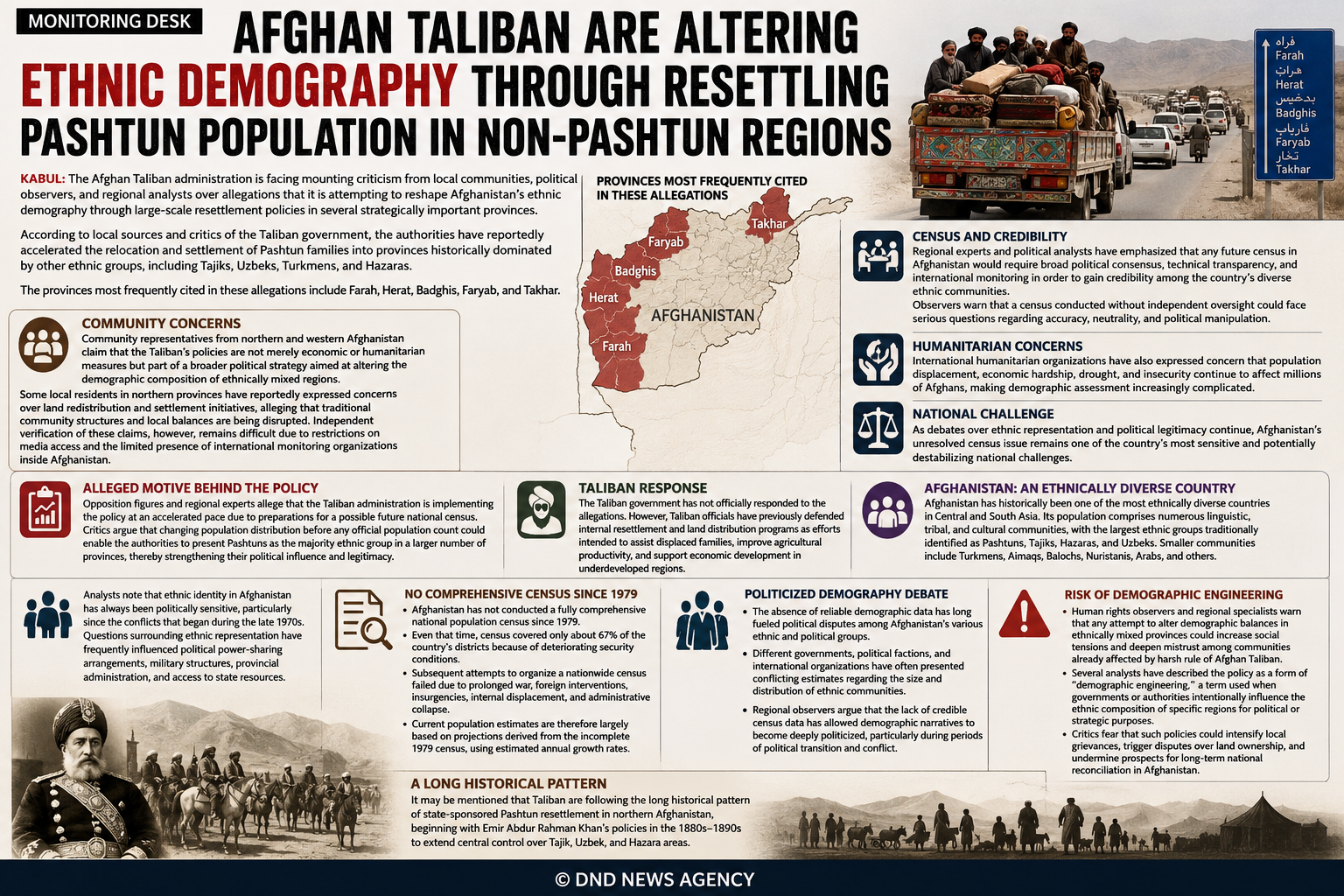
Forced demographic change in Afghanistan

Community representatives from northern and western Afghanistan claim that the Taliban’s policies are not merely economic or humanitarian measures but part of a broader political strategy aimed at altering the demographic composition of ethnically mixed regions.

Some local residents in northern provinces have reportedly expressed concerns over land redistribution and settlement initiatives, alleging that traditional community structures and local balances are being disrupted. Independent verification of these claims, however, remains difficult due to restrictions on media access and the limited presence of international monitoring organizations inside Afghanistan.

Regional experts and political analysts have emphasized that any future census in Afghanistan would require broad political consensus, technical transparency, and international monitoring in order to gain credibility among the country’s diverse ethnic communities.

Observers warn that a census conducted without independent oversight could face serious questions regarding accuracy, neutrality, and political manipulation.

International humanitarian organizations have also expressed concern that population displacement, economic hardship, drought, and insecurity continue to affect millions of Afghans, making demographic assessment increasingly complicated.

As debates over ethnic representation and political legitimacy continue, Afghanistan’s unresolved census issue remains one of the country’s most sensitive and potentially destabilizing national challenges.

Opposition figures and regional experts allege that the Taliban administration is implementing the policy at an accelerated pace due to preparations for a possible future national census. Critics argue that changing population distribution before any official population count could enable the authorities to present Pashtuns as the majority ethnic group in a larger number of provinces, thereby strengthening their political influence and legitimacy.

The Taliban government has not officially responded to the allegations. However, Taliban officials have previously defended internal resettlement and land distribution programs as efforts intended to assist displaced families, improve agricultural productivity, and support economic development in underdeveloped regions.

Afghanistan has historically been one of the most ethnically diverse countries in Central and South Asia. Its population comprises numerous linguistic, tribal, and cultural communities, with the largest ethnic groups traditionally identified as Pashtuns, Tajiks, Hazaras, and Uzbeks. Smaller communities include Turkmens, Aimaqs, Balochs, Nuristanis, Arabs, and others.

Analysts note that ethnic identity in Afghanistan has always been politically sensitive, particularly since the conflicts that began during the late 1970s. Questions surrounding ethnic representation have frequently influenced political power-sharing arrangements, military structures, provincial administration, and access to state resources.

Experts emphasize that Afghanistan’s ethnic boundaries are often fluid and shaped by language, tribal affiliations, regional identities, and self-identification rather than fixed classifications. As a result, demographic figures have remained highly contested for decades.

Afghanistan has not conducted a fully comprehensive national population census since 1979. Even that time, census covered only about 67 percent of the country’s districts because of deteriorating security conditions at the time.

Subsequent attempts to organize a nationwide census failed due to prolonged war, foreign interventions, insurgencies, internal displacement, and administrative collapse. Current population estimates are therefore largely based on projections derived from the incomplete 1979 census, using estimated annual growth rates.

The absence of reliable demographic data has long fueled political disputes among Afghanistan’s various ethnic and political groups. Different governments, political factions, and international organizations have often presented conflicting estimates regarding the size and distribution of ethnic communities.

Afghan Taliban are altering ethnic demography through resettling Pashtun population in non-Pashtun regionsMonitoring Desk KABUL: The Afghan Taliban administration is facing mounting criticism from local communities, political observers, and regional analysts over allegations that it is attempting to reshape Afghanistan’s ethnic demography through large-scale resettlement policies in several strategically important provinces. According to local sources and critics of the Taliban government, the authorities have reportedly accelerated the relocation and settlement of Pashtun families into provinces historically dominated by other ethnic groups, including Tajiks, Uzbeks, Turkmens, and Hazaras. The provinces most frequently cited in these allegations include Farah, Herat, Badghis, Faryab, and Takhar. Community representatives from northern and western Afghanistan claim that the Taliban’s policies are not merely economic or humanitarian measures but part of a broader political strategy aimed at altering the demographic composition of ethnically mixed regions. Some local residents in northern provinces have reportedly expressed concerns over land redistribution and settlement initiatives, alleging that traditional community structures and local balances are being disrupted. Independent verification of these claims, however, remains difficult due to restrictions on media access and the limited presence of international monitoring organizations inside Afghanistan. Regional experts and political analysts have emphasized that any future census in Afghanistan would require broad political consensus, technical transparency, and international monitoring in order to gain credibility among the country’s diverse ethnic communities. Observers warn that a census conducted without independent oversight could face serious questions regarding accuracy, neutrality, and political manipulation. International humanitarian organizations have also expressed concern that population displacement, economic hardship, drought, and insecurity continue to affect millions of Afghans, making demographic assessment increasingly complicated. As debates over ethnic representation and political legitimacy continue, Afghanistan’s unresolved census issue remains one of the country’s most sensitive and potentially destabilizing national challenges. Opposition figures and regional experts allege that the Taliban administration is implementing the policy at an accelerated pace due to preparations for a possible future national census. Critics argue that changing population distribution before any official population count could enable the authorities to present Pashtuns as the majority ethnic group in a larger number of provinces, thereby strengthening their political influence and legitimacy. The Taliban government has not officially responded to the allegations. However, Taliban officials have previously defended internal resettlement and land distribution programs as efforts intended to assist displaced families, improve agricultural productivity, and support economic development in underdeveloped regions. Afghanistan has historically been one of the most ethnically diverse countries in Central and South Asia. Its population comprises numerous linguistic, tribal, and cultural communities, with the largest ethnic groups traditionally identified as Pashtuns, Tajiks, Hazaras, and Uzbeks. Smaller communities include Turkmens, Aimaqs, Balochs, Nuristanis, Arabs, and others. Analysts note that ethnic identity in Afghanistan has always been politically sensitive, particularly since the conflicts that began during the late 1970s. Questions surrounding ethnic representation have frequently influenced political power-sharing arrangements, military structures, provincial administration, and access to state resources. Experts emphasize that Afghanistan’s ethnic boundaries are often fluid and shaped by language, tribal affiliations, regional identities, and self-identification rather than fixed classifications. As a result, demographic figures have remained highly contested for decades. Afghanistan has not conducted a fully comprehensive national population census since 1979. Even that time, census covered only about 67 percent of the country’s districts because of deteriorating security conditions at the time. Subsequent attempts to organize a nationwide census failed due to prolonged war, foreign interventions, insurgencies, internal displacement, and administrative collapse. Current population estimates are therefore largely based on projections derived from the incomplete 1979 census, using estimated annual growth rates. The absence of reliable demographic data has long fueled political disputes among Afghanistan’s various ethnic and political groups. Different governments, political factions, and international organizations have often presented conflicting estimates regarding the size and distribution of ethnic communities. Regional observers argue that the lack of credible census data has allowed demographic narratives to become deeply politicized, particularly during periods of political transition and conflict. Human rights observers and regional specialists warn that any attempt to alter demographic balances in ethnically mixed provinces could increase social tensions and deepen mistrust among communities already affected by harsh rule of Afghan Taliban. Several analysts have described the policy as a form of “demographic engineering,” a term used when governments or authorities intentionally influence the ethnic composition of specific regions for political or strategic purposes. Critics fear that such policies could intensify local grievances, trigger disputes over land ownership, and undermine prospects for long-term national reconciliation in Afghanistan.
Afghan Taliban are altering ethnic demography through resettling Pashtun population in non-Pashtun regions

Regional observers argue that the lack of credible census data has allowed demographic narratives to become deeply politicized, particularly during periods of political transition and conflict.

Human rights observers and regional specialists warn that any attempt to alter demographic balances in ethnically mixed provinces could increase social tensions and deepen mistrust among communities already affected by harsh rule of Afghan Taliban.

Several analysts have described the policy as a form of “demographic engineering,” a term used when governments or authorities intentionally influence the ethnic composition of specific regions for political or strategic purposes.

Critics fear that such policies could intensify local grievances, trigger disputes over land ownership, and undermine prospects for long-term national reconciliation in Afghanistan.

It may be mentioned that Taliban are following the long historical pattern of state-sponsored Pashtun resettlement in northern Afghanistan, beginning with Emir Abdur Rahman Khan’s policies in the 1880s-1890s to extend central control over Tajik, Uzbek, and Hazara areas.

Must read

Advertisement