
By Agha Iqrar Haroon
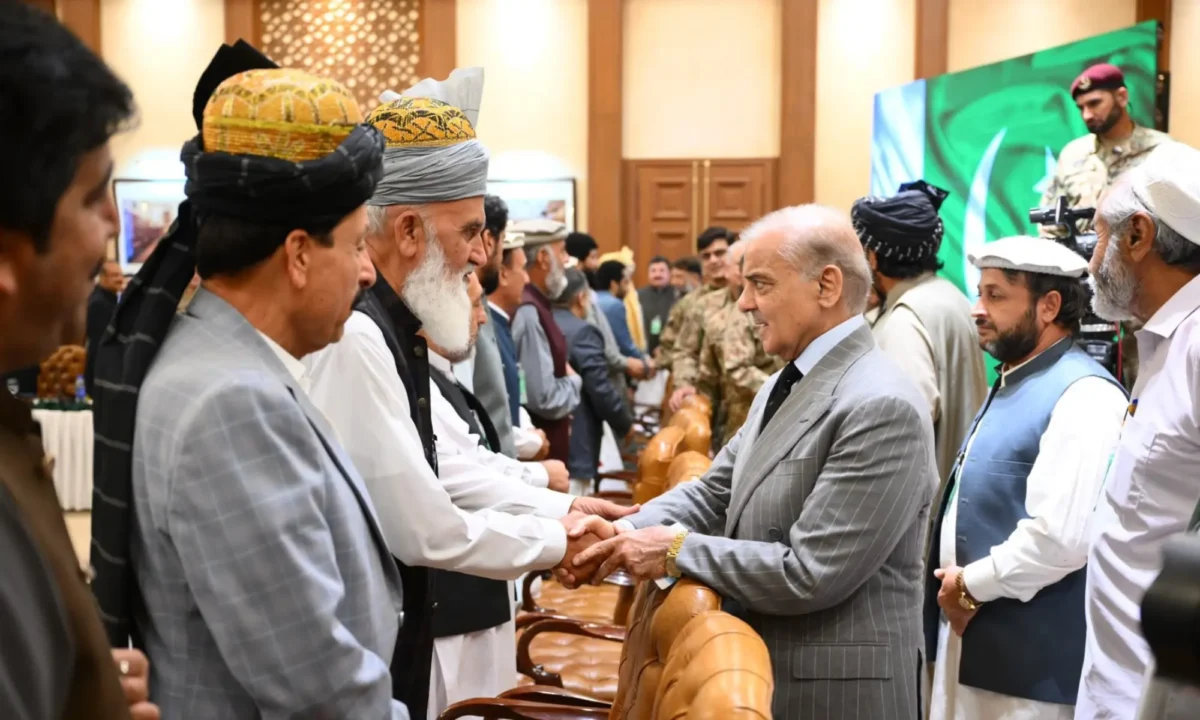
The Apex Committee meeting, attended by Chief of Defence Forces and Chief of Army Staff Field Marshal Syed Asim Munir, Prime Minister Shehbaz Sharif and KP Governor Faisal Karim Kundi, reviewed KP’s overall security situation held on October 22 in Peshawar.
Though the minutes of the meeting were not officially shared with the media, information emerging from the meeting of the Area Representative and Development Council (ARDC) headed and attended by same participants of Apex Committee suggests that zero tolerance for terrorism, a development-focused strategy and collective action were the three main decisions taken to pull KP out of the dark well of terrorism.
It is pertinent to mention that the ARDC was constituted for 12 districts of KP that face serious security challenges. The council covers Dera Ismail Khan, Tank, Lakki Marwat, Bannu, Bajaur, Mohmand, Khyber, Kurram, Orakzai, North Waziristan, South Waziristan Upper and South Waziristan Lower. It includes 48 elders and prominent personalities from these districts to ensure local representation. Technically speaking, the formation of the ARDC recalls the previous administrative structure that was in place before the former tribal areas were merged into KP province.
Addressing the ARDC, Prime Minister Shehbaz Sharif announced that the federal government would provide KP with Rs160 billion for development projects. These funds would be channelled through the ARDC structure and utilised to address the immediate developmental needs of the 12 districts, which have been ignored by the PTI government during its 13-year rule. Food security in these areas would also be a top priority for the federal government, while ARDC members would be responsible for ensuring that wheat and other food items were not smuggled out of Pakistan into Afghanistan—a country that was discussed in detail at the Apex Committee meeting.
Available information suggests that the Apex Committee participants clearly outlined a future plan for Pakistan-Afghanistan relations under which no extraordinary support for Afghanistan in general, or the Afghan Taliban in particular, would be available. Pakistan had been feeding Afghanistan in the past, sometimes even at the cost of its own people, while ensuring Afghanistan’s food security. However, in return, Pakistan received only terrorism, Afghans’ hate-mongering against Pakistan and Afghan-Indian collaboration to bleed Pakistan.
Empowering locals through the ARDC in Pakistan-Afghanistan border areas would definitely help counter terrorism and the influence of Afghan society in Pakistan. The committee observed that the Afghan government deliberately creates law-and-order problems in Pakistani areas where development work is needed, while TTP terrorists, who are the foot soldiers of the Afghan Taliban, particularly target sites where development projects are underway.
The committee assured ARDC members that difficulties in completing the federal government’s projects in KP would be resolved on a top-priority basis and that tribal elders would oversee the law-and-order situation around development projects alongside security forces. The ARDC would serve as the focal body for dealing with troubled areas and would have an “immense responsibility” to safeguard these regions in the future.
The central point of discussion at the Apex Committee meeting, according to available information, was when and how terrorism would be brought to an end and development ensured in the bordering regions.
There was lengthy deliberation on how and why terrorism had re-emerged in Pakistan when security forces had eliminated terrorists under Operation Zarb-e-Azb in 2017. It may be recalled that security forces cleared the region and handed it over to the provincial government led by the PTI. The provincial government was tasked with implementing the National Action Plan (NAP) and fostering an environment that would prevent the emergence of new terrorists. However, this did not happen. Instead, the PTI and its government at the federal level, following the 2018 elections, showed support for TTP terrorists and allowed them to re-establish their hideouts in the bordering regions.
The PTI actually facilitated the return and resettlement of TTP terrorists, while TTP members who had been imprisoned were released from jails. These terrorists re-established their foothold in the region and resumed their operations. The perceived PTI-TTP collaboration provided shelter and facilitation to the TTP through local networks because KP’s political leadership continued to issue statements in favour of terrorists. Some corrupt religious scholars in KP also provided terrorists with religious cover by referring to them as “Talib” (students of religious jurisprudence). These corrupt religious scholars even created confusion about the martyrdom of those men in uniform who had been sacrificing their lives for the future of the children of their motherland. Many religious scholars even refrained from attending the funeral prayers of martyrs who had laid down their lives fighting terrorists.
I believe that the Apex Committee’s decisions would have far-reaching implications for correcting the faulty narrative in KP. However, I am of the view that national politicians should also come forward to correct the political narrative because politicians such as Mehmood Khan Achakzai, who sits in Parliament, also act as a kind of facilitator for the Afghan regime, which is as much an enemy of Pakistan as India is. People such as Achakzai call terrorists their “brothers” and identify themselves as “Afghani”. Achakzai has called himself Afghani instead of Pakistani on several occasions, despite enjoying not only Pakistani nationality but also public funds paid by Pakistani citizens as a member of the National Assembly. Such politicians spread confusion about who is Pakistani and who is Afghani, and blurring this distinction has been lethal for Pakistan. This is the time for Pakistan’s politicians to maintain a vigilant, hawk-eyed watch over what politicians such as Achakzai are spreading. They must isolate those who provide moral support, shelter or facilitation to terrorists and come to regard individuals as Achakzai with contempt. Only when this facilitation from within society is brought to an end will terrorism itself be eliminated.
Why do politicians such as Achakzai refuse to accept that the Afghan Taliban and the TTP (Tehrik-i-Taliban Pakistan) are two sides of the same coin? They share the same ideology—one in which the killing of a Pakistani is considered an act of religious merit (sawab). The modern American weaponry used by the TTP in attacks within Pakistan is supplied to it by the Afghan Taliban.
There is no doubt 80 per cent of the suicide bombers involved in recent attacks are Afghan nationals. If we continue to regard the Afghan Taliban as our “brothers”, as Achakzai says and believes, and support the settlement of Afghans within Pakistan, the roots of terrorism can never be severed. One cannot simultaneously sympathise with both the killer and the victim.
Now, the question arises: who among us supports the Afghan Taliban—or, in other words, supports terrorism? Who supports these Afghans? Who are the people who declare Pakistan to be a homeland for Afghans as well and refuse to recognise the Pakistan-Afghanistan border? Any leader or cleric who refers to a murderer or terrorist as a “brother” is equally complicit in every such killing. Any political leader who does not recognise Pakistan’s borders is an enemy of Pakistan.
If Pashtun nationalism is parameter to settle demarcation of Pak-Afghan border, then there are 40 million Pashtuns living in Pakistan, compared with only 15 million in Afghanistan so if the matter is to be decided on the basis of nationality, then Pakistan should have a claim to territory extending all the way to Kabul. If the Pakistan-Afghanistan international border (the Durand Line) is not accepted, then should Pakistan redraw the border based on the Pashtun population majority, extending as far as Kabul?
For the sake of their popularity and political survival, Achakzai and the PTI have cultivated two distinct narratives: one at the national level and another at the provincial level. At the national level, the narrative was that the country could not function without Imran Khan—that he alone was honest, while everyone else was a thief or a looter. This national-level narrative failed. The country is functioning better without Imran Khan, and Imran Khan himself has been exposed as a thief.
At the provincial level, the PTI’s narrative was that the security situation in the province was poor and that security forces should withdraw, leaving the PTI to handle matters itself. In reality, the PTI and its Leader of the Opposition in the National Assembly, Mehmood Khan Achakzai, deliberately allowed terrorists to flourish to create the impression that security forces were incapable of controlling terrorism. They sought the withdrawal of security forces to conceal their own corruption, multi-billion-rupee financial scandals, smuggling activities and the cultivation of narcotics.
The subject of terrorism is not merely a provincial concern for Khyber Pakhtunkhwa; it is a national issue because it is hampering national security and must therefore be addressed at the national level.
Another problem, in my understanding, is Pakistan’s overall governance failure, which is also one of the reasons the public buys into anti-Pakistan narratives. Pakistan has a youth population of nearly 170 million, and young people desire peace and good governance. In Nepal, Sri Lanka, India and Bangladesh, young people have risen up specifically against poor governance. If we wish to avoid a similar outcome, we must improve our governance.
The current system which fosters dynastic politics, bureaucratic nepotism, favouritism and corruption must be dismantled without delay. As long as this administrative and political system persists, expecting any positive change is nothing more than living in a fool’s paradise. In villages, people say that children are fortunate if they do not inherit a legacy of enmity. Yet here, you are bequeathing a legacy of terrorism and failed administrative system to 17 million young people who have inherited nothing but the bad governance.
The time had ended—the deadline of fixing problems had already expired— Are we ready to act swiftly?

