
DND News
ISLAMABAD, October 15: Russian Interior Minister Vladimir Kolokoltsev’s four-day visit to Pakistan has triggered a counternarrative in sections of Indian and Afghan-sponsored media, where commentaries have sought to portray differences over Afghanistan as a potential obstacle to growing Pakistan-Russia relations while overlooking the significance of the high-level security engagement between the two countries.
Kolokoltsev departed for Moscow on Thursday after concluding his landmark visit, the first-ever visit to Pakistan by a Russian interior minister. The visit was significant for strengthening bilateral security cooperation, building mutual trust and exploring avenues for joint efforts against terrorism and other transnational security threats.
During his stay, Kolokoltsev held meetings with President Asif Ali Zardari, Prime Minister Shehbaz Sharif, Field Marshal Syed Asim Munir, Chief of Army Staff and Chief of Defence Forces, Deputy Prime Minister and Foreign Minister Ishaq Dar, and Federal Interior Minister Mohsin Naqvi, whose invitation paved the way for the visit.
The extensive high-level engagement demonstrated the importance both countries attach to their bilateral relationship, particularly in internal security and counterterrorism. Against this backdrop, sections of Indian and Afghan sponsored media have attempted to frame the visit primarily through the prism of disagreements over Afghanistan, thereby seeking to undermine its wider diplomatic and security significance.
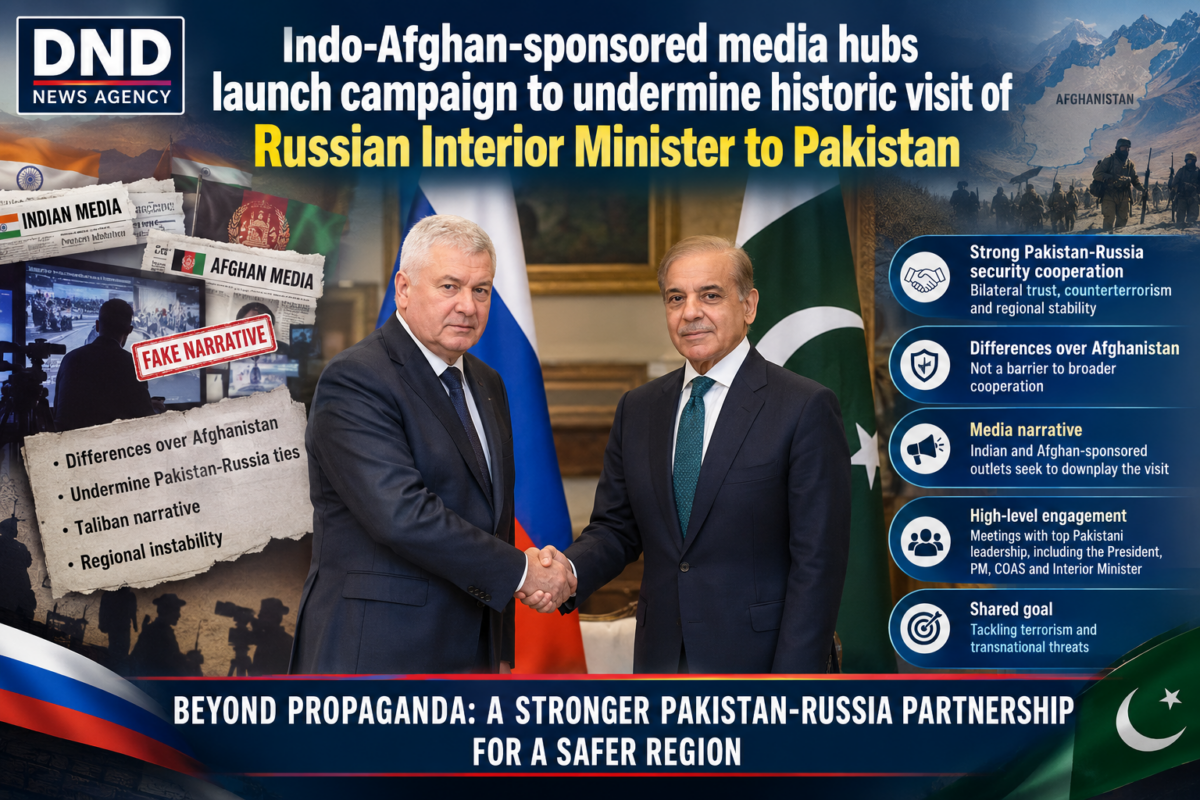
Commentaries appearing in Indian and Afghan sponsored media have portrayed the visit as an effort to ease differences between Moscow and Islamabad over the Afghan Taliban, which reportedly surfaced during the Moscow Format meeting. However, these narratives overlook a crucial fact: Kolokoltsev’s visit had been planned and scheduled months before the Moscow Format meeting took place on October 5, 2026. Indian and Afghan media outlets have suggested that these differences could undermine recent progress in Pakistan-Russia relations. Nevertheless, such interpretations do not, in themselves, establish that bilateral security cooperation is at risk. Differences in regional security assessments are not unusual between states, nor do they necessarily prevent countries from pursuing shared interests through diplomatic engagement and institutional cooperation.
One of the central arguments advanced in critical commentaries in Indian and Afghan media concerns the contrasting approaches of Pakistan and Russia towards Afghanistan. Russia views engagement with the Taliban authorities as an important component of its regional strategy, including efforts to counter the threat posed by the Islamic State Khorasan Province (ISKP) that is present in Afghanistan. Pakistan, meanwhile, has repeatedly expressed security concerns over terrorist organisations such as BLA, BLM, TTP, Al-Qaeda and many others operating from Afghan territory and their attacks inside Pakistan.
Ironically, the narratives advanced by Indian and Afghan media appear to undermine their own arguments when they acknowledge, albeit with qualifications such as “allegedly,” that terrorist organisations are operating from Afghanistan. This acknowledgment is significant because the presence and activities of such groups constitute a major regional security concern, including for Russia. By recognising this issue, these commentaries implicitly concede that terrorism originating from Afghan territory remains a matter requiring serious attention rather than a dispute that can simply be dismissed as a bilateral political disagreement.
The same commentaries refer to the security conference scheduled to take place in Moscow on October 15–16, suggesting that Afghanistan will remain an important subject of discussion. This argument, too, reinforces the significance of Afghanistan-related security challenges for regional peace and stability. However, presenting these discussions as evidence of an impending deterioration in Pakistan-Russia relations requires substantiation. The fact that the two countries may hold differing assessments of the situation in Afghanistan does not automatically translate into a strategic rupture, particularly when both continue to engage at the highest levels.
Moreover, the critical commentaries do not provide verifiable evidence that Russia and Pakistan are unwilling to cooperate in addressing the threat posed by terrorist organisations operating from Afghanistan. Rather, their (commentaries) arguments rely heavily on the existence of differences over regional policy without demonstrating how those differences have translated into a concrete breakdown in bilateral security cooperation.
Similarly, attempts to link Kolokoltsev’s visit directly to alleged Russian concerns about Pakistan’s position on Afghanistan remain speculative in the absence of documentary evidence or attributable statements from Russian officials. The timing of a diplomatic visit, combined with the existence of regional disagreements, is insufficient to establish a causal relationship between the two.
The critical narrative being advanced in sections of Indian and Afghan media also gives insufficient weight to the broader momentum in Pakistan-Russia relations and the continued engagement between the two countries at the highest levels. By focusing predominantly on alleged differences over Afghanistan, these commentaries risk overlooking the wider diplomatic context in which the visit took place.
Kolokoltsev’s meetings with Pakistan’s civilian and military leadership provided an opportunity to discuss shared security concerns and explore avenues for practical cooperation. His visit was itself a significant diplomatic development, reflecting the willingness of both sides to engage directly on matters of mutual interest, particularly regional security dynamics. The range of senior Pakistani officials with whom he held meetings further demonstrated that the engagement was not confined to a single institution or a narrow policy issue.
Although differences over Afghanistan may remain part of bilateral discussions, their significance should be assessed alongside the concrete areas of cooperation and the diplomatic channels available to address them. Counterterrorism, internal security and other transnational threats provide important areas in which cooperation can continue even when the two countries do not hold identical views on every regional issue.
The broader question is whether Pakistan and Russia can maintain and expand their cooperation despite differing regional assessments. The minister’s visit demonstrated that high-level engagement continues even as regional security challenges remain complex. It also provided an opportunity for both sides to maintain direct communication, exchange perspectives and explore ways to address shared concerns.
Portraying Pakistan-Russia relations primarily through alleged disagreements over Afghanistan risks producing an incomplete assessment of a relationship that has continued to develop through diplomatic engagement. Bilateral relations cannot be accurately evaluated solely by identifying differences between the two countries; they must also be assessed in light of ongoing contacts, institutional cooperation and the willingness of both sides to pursue common interests.
Likewise, assertions that disagreements over the Taliban threaten bilateral relations should be supported by demonstrable policy changes, official statements or other reliable indicators rather than speculation. Without such evidence, claims of an impending deterioration in relations remain interpretations rather than established facts.
Kolokoltsev’s historic visit should therefore be evaluated on the basis of its diplomatic significance, the discussions held with Pakistan’s leadership and the prospects for practical cooperation in internal security and counterterrorism. Its importance cannot reasonably be dismissed merely by highlighting differences over Afghanistan, particularly when those differences have not been shown to have halted high-level engagement.
There are challenges for Islamabad and Moscow, but they do not, in themselves, negate the importance of their bilateral engagement and propaganda campaign launched by Afghanistan-Indian sponsored media confirm again that Afghanistan is a constant threat for regional peace, particularly for Russia and Pakistan.

