
By Agha Iqrar Haroon
Tightening the grip on northern Afghanistan, Taliban have opened a 121-kilometer gravel road through the isolated Wakhan Corridor in Badakhshan province that now connects Afghan road network with China Zero Point. Completed in two years and funded domestically with 365 million Afghanis, the route includes four bridges, 66 culverts, and retaining walls, aiming to extend the ring road network for better regional trade links to China, Iran, and Central Asia.
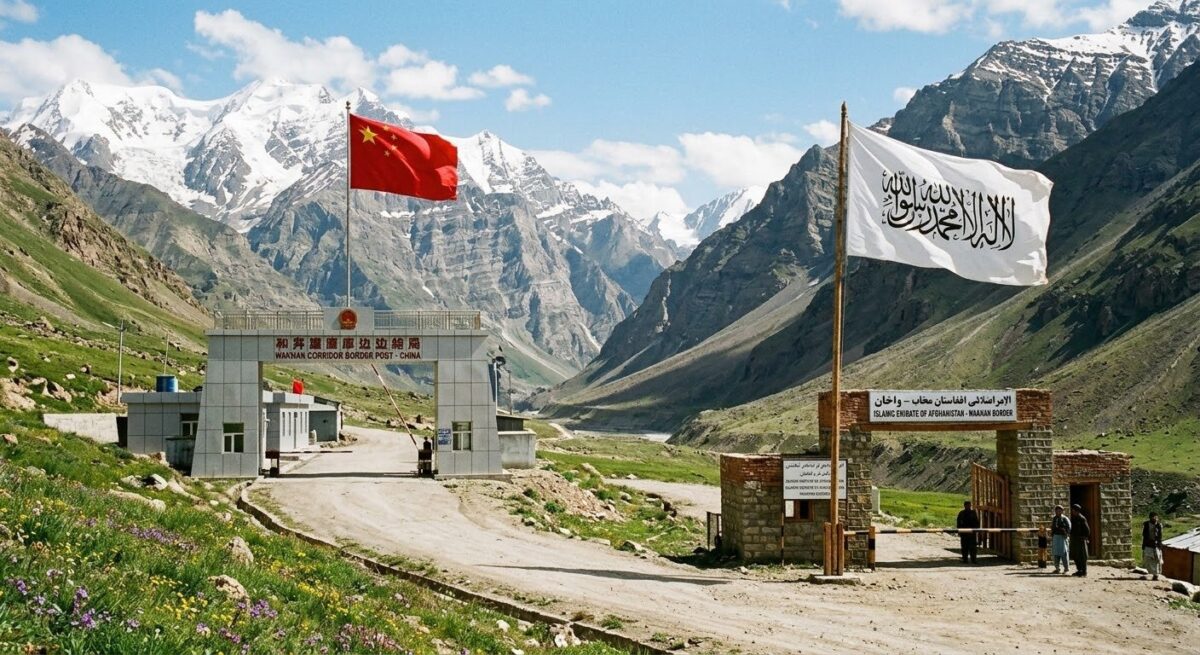
The road is strategically important not for Afghanistan only but for Turkmenistan, Iran and Uzbekistan as well for a direct link through Afghanistan to China. The road is much easier to drive than the zigzag KKH link of China to Pakistan. Babusar Pass link to KKH has already been rejected by long-vehicle drivers due to its extreme turns and steepness, while Havalian to Chilas Zero Point KKH is still under heavy remodelling and redesigning due to Dasu Dam construction. Chilas, being a turbulent point for security reasons, is still on the way from Havalian to Gilgit. If relations between Pakistan and Afghanistan become normal in future, Pakistani drivers of long vehicles would prefer to drive between Pakistan and China through this newly built Wakhan Corridor Road. It does not mean that CPEC would be of no use, but it may be the second option now instead of the only option that had been before the opening of this Wakhan Corridor Road.
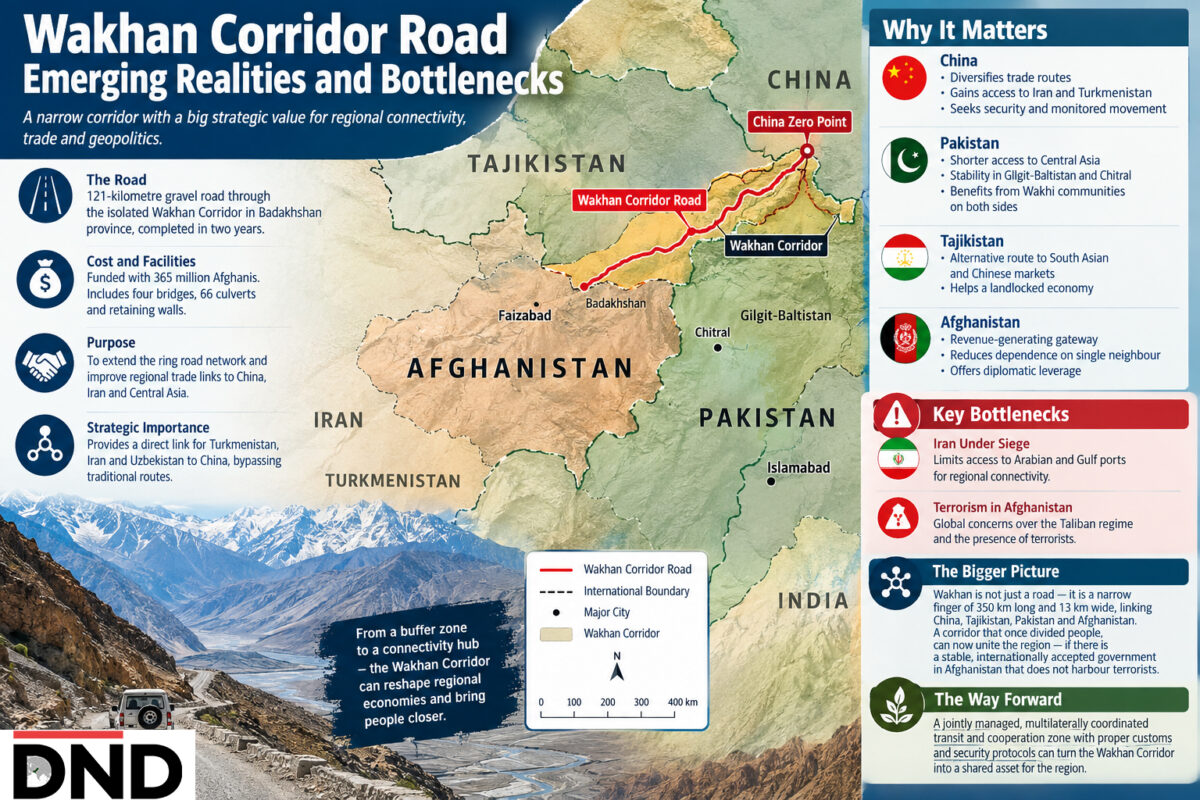
Reports suggest that China has not yet agreed to open the Wakhjir crossing for commerce and trade due to security concerns in Xinjiang region, but the road is ready for future trade and transport. The Chinese economy is too big and it can invest in this new corridor also if terrorist Afghan Taliban regime is over. China invested on China Pakistan Economic Corridor (CPEC) but this project had been too slow to provide desirable results to China as well as to Pakistan due to political instability, change of decisions and bureaucratic hitches in Pakistan. This new road link is a great opportunity for China to reach Iran and Turkmenistan and even to Uzbekistan without spending a single penny on Chinese vision of connectivity while total investment of CPEC was from China. The only need is a moderate and stable government in Afghanistan that would not host and harbour global terrorists. Afghan Taliban have lost their credibility globally for being a normal state that does not host terrorists. Uzbekistan is doing trade with Afghanistan with strict rules, such as that no Afghan driver/assistant would ply vehicles inside Uzbekistan and no access to Afghans from Friendship Bridge onward. Such arrangements can be done by China also if it shows interest in using this route for trade in the near future under the Taliban regime. Two bottlenecks—Iran under siege and Afghanistan under the rule of terrorists—hamper the linkage of Wakhan Corridor with the hot waters of Arabian and Gulf ports because any road network that comes from Afghanistan has to go either through Pakistan or from Iran to reach seawaters. Wakhan Corridor is one of the most interesting but strategically important places in Asia—a narrow finger of 350 kilometres long and 13 kilometres wide that links China, Tajikistan, Pakistan and Afghanistan. It reaches out from Badakhshan Province to touch China’s Xinjiang region, separating Tajikistan to its north from Pakistan’s Gilgit-Baltistan to its south.
This Corridor was drawn by the Pamir Boundary Commission of 1895 for a single purpose: to ensure that Czarist Russia and British India would never share a common frontier when the British were crafting today’s modern Afghanistan under the British-backed rule of Emir Abdur Rahman Khan. Strangely, Pakistan has never challenged Afghanistan’s sovereignty over the Wakhan, but Afghanistan has always challenged the Durand Line between Pakistan and Afghanistan, although both demarcations are part of the 1919 Treaty of Rawalpindi and the 1921 Anglo-Afghan Treaty.
The corridor’s creation did split people. Wakhi communities—an Eastern Iranian, Ismaili Muslim ethnic group of some 50,000 to 80,000—now live divided across four states: in Afghanistan’s Wakhan district, in Pakistan’s Gojal Valley of upper Hunza and in Chitral, in Tajikistan’s Gorno-Badakhshan, and in a small corner of China’s Xinjiang. Successive border closures through the 20th century—the Soviet Union sealing the Pamir frontier in 1935, China closing its side in 1953—cut off contact between communities that had shared language, religion, and pastoral migration routes for centuries. Where those borders have loosened even slightly, as with the Kulma Pass link between Tajikistan and Pakistan, family and cultural ties have visibly reasserted themselves.
Interestingly, no government in Pakistan in since 1947 that if Afghanistan questions the Durand Line, which is an international border inheriting the boundaries at the time of the 1947 independence, then Pakistan can question the Wakhan Belt also because both demarcations are out of same treaties. Unfortunately, Pakistan’s Pashtun-centric foreign policy had been a great disadvantage for Islamabad because it did not think anything beyond Pashtun region. Islamabad never raises the issue that sovereignty over a territory (of Afghanistan) and the use to which that territory is put are two different questions, and Wakhan, which is one of the most strategic points in the region, can be used as a regional connectivity point. Pakistan never raised this issue when the so-called Islamabad-friendly government came into power after the withdrawal of the Soviet Union, nor did it raise this issue with the first government of Afghanistan in 1995-2001, although Pakistan recognized both the governments without taking any advantage of its support to Afghan Jihad and the rise of Taliban. There is a room for such a regional conversation. The purpose of the Wakhan, which was a buffer state between British and Russian empires, had gone and is dead. The question worth asking today is not who owns the corridor, but what is it for? That question is no longer hypothetical.
Kabul is smarter than Islamabad and, by opening the Wakhan Road, it has reduced dependence on Pakistani border crossings that Islamabad has, at various points, closed during disputes, and opened an alternative route north and east that answers to no third country’s leverage. Now Kabul has two exit points for trade—one is through Uzbekistan and the second is now through China, provided that China allows trade through this route. China’s response so far has been measured rather than enthusiastic but not negative. Beijing has repeatedly signalled that its interest in Wakhjir Pass is driven by security more than commerce, chiefly concern that terrorists could use an open corridor to move between Afghanistan and Xinjiang. That caution shaped Foreign Minister Wang Yi’s most recent visit to Kabul, where joint patrols along the corridor, not trade facilitation, were the headline outcome.
This route is not as rosy as Afghan media is portraying it as a ‘trade route’ because there are, as yet, no customs facilities on the Chinese side of Wakhjir Pass at all, and the terrain itself is formidable: a gravel track through some of the highest inhabited country on earth cannot carry the tonnage of a seaport or a lowland highway unless the road has blacktop, so nobody seriously claims the Wakhan will rival the Karakoram Highway and CPEC as a freight artery. What it can plausibly become is something narrower and, in some ways, more valuable: a controlled, multilaterally managed transit and cooperation zone that turns a dead-end buffer into a shared asset, and this needs a collaboration among Afghanistan, China, Tajikistan and Pakistan. Under the Taliban regime, it looks not possible because Tajikistan and Pakistan both have serious reservations over terrorism emanating from Afghanistan. Any normal and sane government in future in Afghanistan that would not harbour global terrorists would have an opportunity of a jointly administered transit regime for the Wakhan where China and even Pakistan would be interested to invest while the route would remain under Afghan sovereignty. For Afghanistan, formalising and internationalising transit rights through the Wakhan converts a chronically underdeveloped, food-insecure districts of Afghanistan and Tajikistan into a revenue-generating gateway to Central Asia and China. It will also give Afghanistan a diplomatic asset: the ability to offer transit rights as a point of leverage and cooperation with Pakistan, China, and Tajikistan simultaneously, rather than being squeezed by any one of them.
For Pakistan, a cooperative transit framework offers a shorter path north into Tajikistan and the wider Central Asian republics than the existing route through the Karakoram Highway and Kulma Pass. Pakistan has an obvious interest in the corridor’s stability, given that Gilgit-Baltistan and Chitral sit directly on its southern edge, and given that Wakhi communities live on both sides of that boundary.
For China, a transparently managed, jointly patrolled transit zone rather than an unregulated opening is arguably more attractive than the status quo, because it gives Beijing what it has said it actually wants: security cooperation and monitored movement, not an open frontier it cannot control. A multilateral framework with agreed customs and security protocols addresses China’s stated concerns.
For Tajikistan, largely absent from most Wakhan commentary, a transit arrangement offers a second route to South Asian and Chinese markets that does not run through Uzbekistan or the more congested crossings further west, relevant for a landlocked economy that has long looked for alternatives to routes it does not control.
Wakhan Corridor Road can change the regional economy and ties people that have been divided since the Great Game Era, but all that is needed is a government in Afghanistan that should be accepted by all neighbouring countries such as Pakistan, Tajikistan and China, and a government that does not host global terrorists and export terrorism to neighbouring countries as ‘diplomatic leverage’. Is it not high time that neighbouring countries look at resistance forces that want to free Afghanistan from the clutches of a terrorist regime of Afghan Taliban?

