
DND News Report
Rawalpindi, Pakistan: Director General Inter-Services Public Relations (DG ISPR) Lieutenant General Ahmed Sharif Chaudhry exposed India once again and challenged India’s claims of killing a Pakistani national in Indian-occupied Kashmir by presenting former Special Services Group (SSG) Havaldar Muhammad Asif before the media, the very individual whom India had claimed to have martyred during an operation in the Indian Occupied Kashmir.
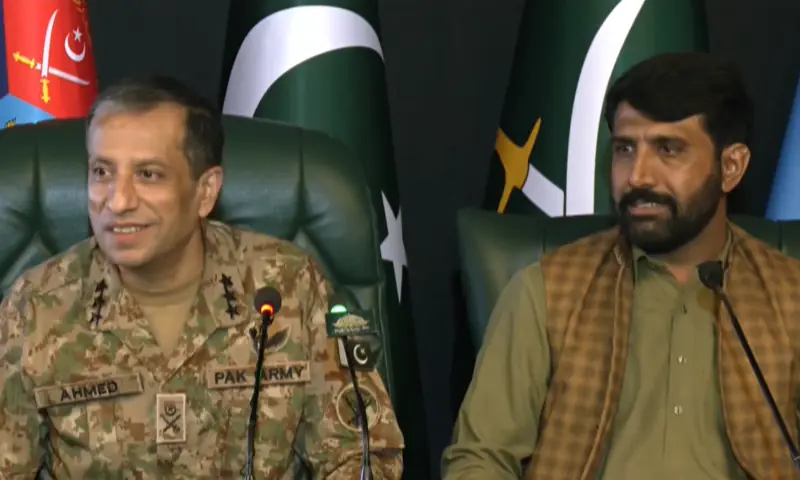
Addressing a press conference here today, the DG ISPR said that the Indian Army had claimed to have killed a terrorist and recovered the body of a Lashkar-e-Taiba (LeT) operative during a staged “false flag” operation on September 29. He stated that an Indian Army corps published a social media post on the night of September 29, claiming that a terrorist had been killed and identifying him as Muhammad Asif, alias Hashim Musa, allegedly associated with Lashkar-e-Taiba. He said an Indian news agency subsequently published further details, including a service number, while claiming that the individual had carried out attacks in various areas. However, during the press conference, the Pakistan Army spokesperson presented former SSG Havaldar Muhammad Asif before the media, challenging the Indian account.
The DG ISPR stated that India should not attempt to shift responsibility for its actions in occupied Kashmir and against minorities onto Muhammad Asif. He alleged that the Indian Army had become politicised and that its agenda was increasingly driven by Hindutva ideology
“I was surprised; how could the Indian Army have killed me when I was at home?” Muhammad Asif said.
Lieutenant General Ahmed Sharif Chaudhry stated that the person presented before the media was the same individual whom India had claimed to have killed, portraying him as Hashim Musa, alias Asif.
The DG ISPR said India sponsors terrorist organisations to carry out terrorist activities in Pakistan. He identified six reasons behind what he described as India’s “false flag” drama, adding that Pakistan was aware of India’s alleged role as a state sponsor of terrorism. Describing modern-day India as “Encounter-stan,” he said India relies on staged encounters and extrajudicial actions.
He said Indian funding of the Mukti Bahini in the past and now funding the Tehreek-e-Taliban Pakistan (TTP) is no more a secret.
Lieutenant General Ahmed Sharif Chaudhry stressed the need to understand the situation in Indian-occupied Kashmir, describing the region as the world’s largest prison.
He said more than one million Indian troops and personnel from other agencies were deployed in the region, adding that residents needed permission even to travel from one village to another.
According to the DG ISPR, India’s actions in occupied Kashmir reflected its mindset, while its attempts to blame others for its conduct were intended to conceal its own alleged acts of terrorism.
He said India believed that every issue could be resolved through terrorism and that it blamed others for its actions while using such theatrics to cover up state-sponsored terrorism.
“Pakistan has a neighbour who believes everything can be settled through lies,” Lieutenant General Ahmed Sharif Chaudhry said.
He added that if India intended to take action against Pakistan, it should come forward openly, warning that Pakistan’s response would be severe. “It is unfortunate that we are dealing with such a despicable enemy,” he said.
The DG ISPR also referred to statements by the Indian prime minister and other Indian leaders, alleging that they openly boasted about state-sponsored terrorism. He described the idea of “Shining India” as a fantasy, saying India was living in a state of delusion.
Referring to Indian national Kulbhushan Jadhav, whom Pakistan convicted of espionage, Lieutenant General Ahmed Sharif Chaudhry said Jadhav would remain a stain on the Indian Army.
“What was an Indian spy doing in Balochistan carrying bags full of cash?” he asked.
The DG ISPR reiterated that Pakistan would not compromise on national security and that all necessary measures would be taken to protect the country.
He said Pakistan was fully prepared to respond to any hostile move by India, adding that if India wished to stage another drama, it was welcome to try.
He emphasised that there would be no compromise on Pakistan’s security or the protection of its geographical borders.
He also highlighted Pakistan’s experience in combating terrorism, stating that the country was among those most affected by terrorism globally and had been fighting the menace for the past two decades.
In response to a question about the country’s counterterrorism efforts, the spokesperson said the fight against terrorism could not be compromised for anyone’s political interests.
“For us, the paramount principle is that politics exists only if the state exists,” he said.
He stressed that counterterrorism operations and national security considerations should not be compromised for political reasons.
The DG ISPR also assured that all necessary measures would be taken to ensure the safety of citizens in Khyber Pakhtunkhwa and Balochistan. He said there was no difference between the proscribed Balochistan Liberation Army (BLA) and the proscribed TTP in the context of the security threat they posed. According to the DG ISPR, both banned organisations enjoyed the support of the Afghan Taliban.
He reiterated that Pakistan’s security forces would continue taking the measures necessary to protect citizens, defend the country’s territorial integrity and counter terrorism in both provinces.
