
DND News: The misfortune of a nation or group can have several factors, but it is at its worst when it is compounded by ignorance among those who influence it. Pakistan unfortunately faces this situation, where people such as Fazlur Rahman of JUI have the power to influence thousands of their followers.
In a recent statement, Fazlur Rahman said that Pakistan should not be a “Hard State” because, according to him, a hard state means strict rule, while politics and Islam teach a softer response from the state. His statement suggested that the state should follow a “middle way” in governing the country.
One should not challenge the educational background of Fazlur Rahman because he is considered an authority on religion by his followers. However, Fazlur Rahman should review and read what the term “Hard State” means in modern statecraft because it is incorrect to suggest that a hard state refers to hardness or softness in temperament. What should one make of such statements? The funny thing is that here too, he has added the word religion to the same definition. The question is: who will teach Fazlur Rahman the meaning of a “Hard State”?
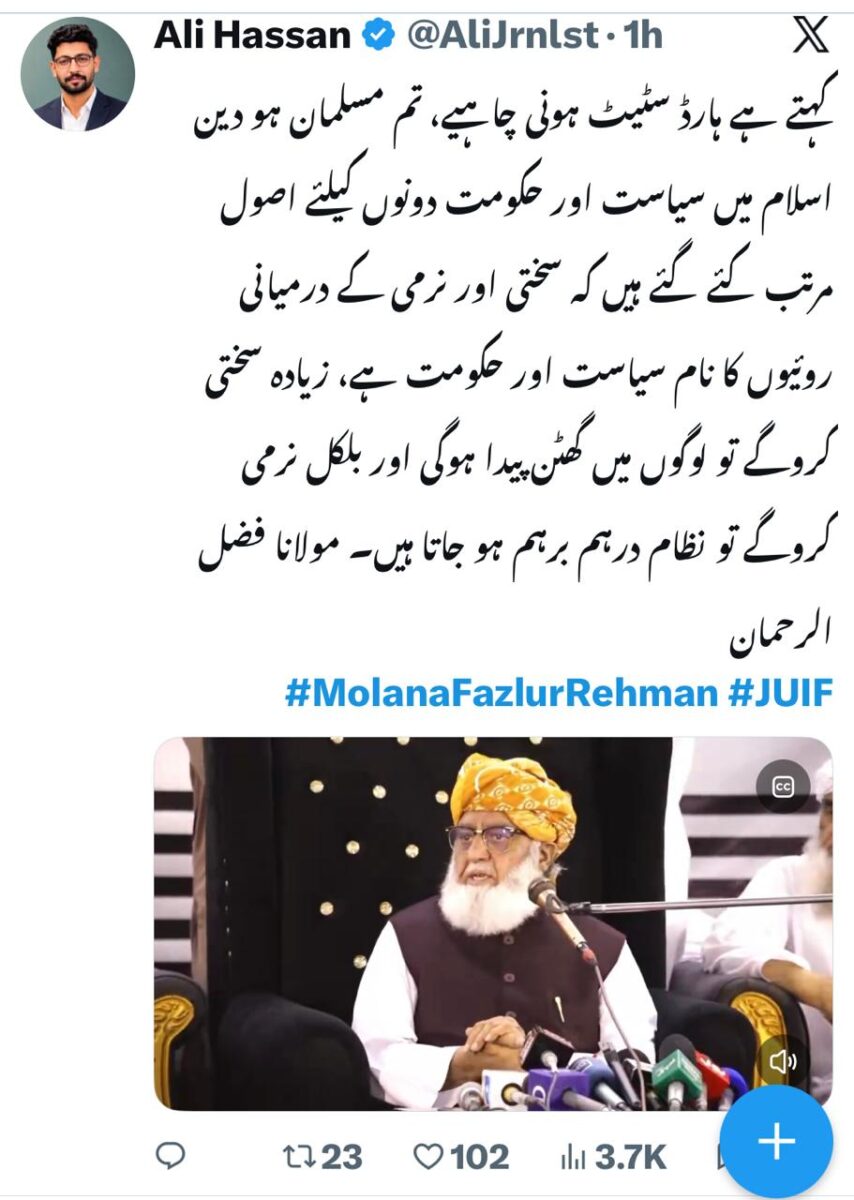
Prime Minister Shehbaz Sharif and President Asif Ali Zardari enjoy good relations with him, so they both can help explain to Fazlur Rahman—and to the nation—the true meaning of a “Hard State” under the terms of modern statecraft.
The concept of a “Hard State” describes a state that possesses a high degree of capacity, autonomy, and effectiveness in implementing its policies and maintaining order. The term was popularised by Swedish economist Gunnar Myrdal in his 1968 work Asian Drama: An Inquiry into the Poverty of Nations.
A Hard State follows a set of rules that ensure strong institutional capacity, a high degree of autonomy, and effective enforcement of laws and regulations across the entire territory. It ensures social discipline in which the population exhibits a high degree of compliance with state directives and laws. It also promotes a cohesive national identity and maintains a strong focus on development.
In the past, it is unfortunate to say, laws and rules have been fluid, and the state has provided concessions to unruly groups, offered amnesties to criminal groups and even terrorists, and molded economic laws to favour powerful groups and cartels. In a Hard State, this is not possible.

