
By Agha Iqrar Haroon
In two hours and 40 minutes’ interaction with global media at the opening ceremony of the 4th Shusha Global Media Forum President of the Republic of Azerbaijan Ilham Aliyev shared his thoughts on several global issues and answered questions from the forum participants. The forum brought together 160 guests from 53 countries, including representatives from 30 news agencies, over 60 media agencies, and 10 international organizations.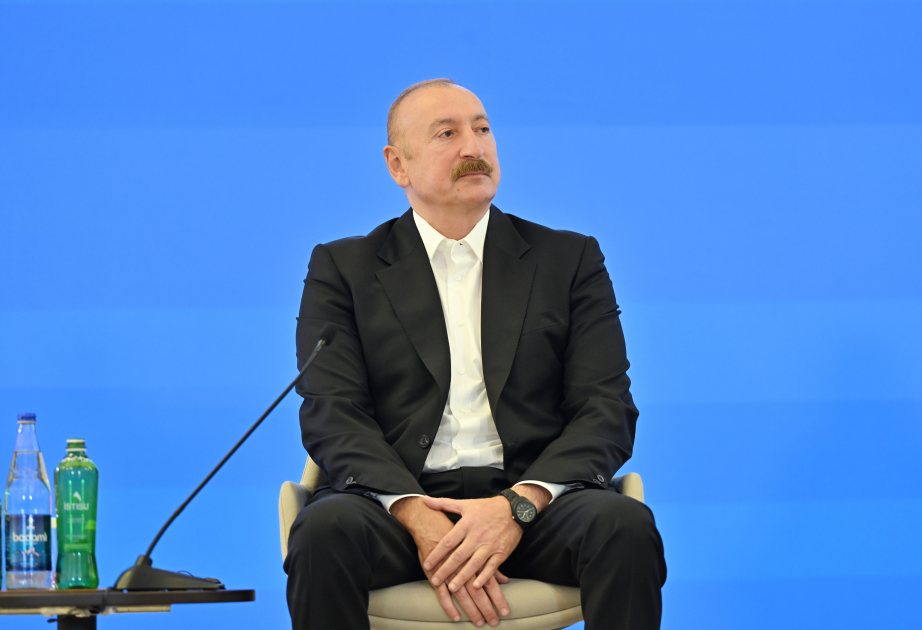
My several interactions with President Ilham Aliyev at international forums, reading his opinions and watching his talks at global platform suggest me that President Ilham Aliyev’s approach to global diplomacy is based on policy of peace, non-interference, non-aligned, respect for international law of equality and respect and his approach towards global issues is pragmatic, balanced, and focused on advancing Azerbaijan’s national interests. He pursues a multi-vector foreign policy, maintaining relationships with regional powers as well as Western countries, African Union as far as Far-East while expanding cooperation with all in areas such as energy, trade, and transportation. Azerbaijan’s active participation in international organizations, including its chairmanship of the Non-Aligned Movement, and its role in major energy and connectivity projects as evidence of growing diplomatic influence. From this perspective, President Aliyev’s diplomacy has strengthened Azerbaijan’s international profile and positioned the country as an important regional partner.
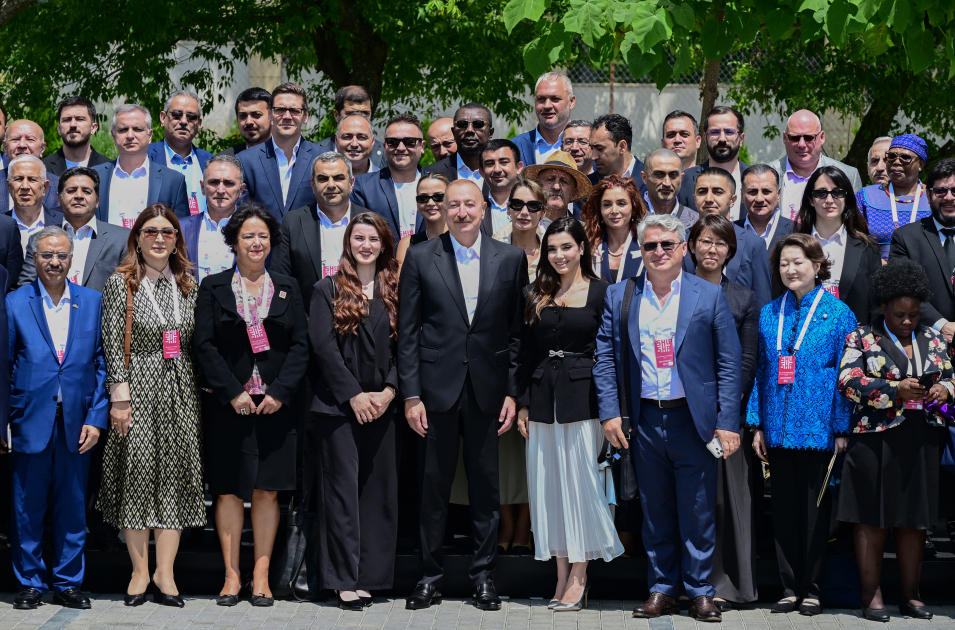
Here are features of what the writer understands as the outlines of Azerbaijan Foreign Policy that President Ilham Aliyev shared with participants of 4th Shusha Global Media Forum through interactive session.
Sharing his thoughts over United Nations reforms, President was of the view that this issue has been discussed from time to time, but without any visible progress. He said:
Azerbaijan has its own position on that. And as the Chair of the Non-Aligned Movement, we actually put forward our own variant of the reform because it must be inclusive and representative.
So our suggestion was that, on a rotation basis, one permanent seat should go to the Non-Aligned Movement, and, for instance, the current Chair of the Movement should be a permanent member with veto rights. One seat should go to the Organization of Islamic Cooperation, because Muslim countries are also not represented there, also on a rotation basis, and one seat should go to the African Union, with the country holding the current chairmanship having the seat. So this would be a fair balance in the Security Council.
We know that some countries are seeking membership, but there should be criteria as to why this country and not another should be included if reform ever happens, and it will be very difficult to establish such criteria. Population cannot be a criterion, nor can economic potential. Therefore, our suggestion is based, first, on inclusiveness. It would be on a rotation basis, as, for instance, the majority of the Security Council is now on a rotation basis, but in this case, those seats would have veto rights.
Because it should happen; otherwise, the United Nations will continue to lose its potential and continue to be sidelined by other centers of power with respect to the resolution of conflicts and international relations.
With respect to your other question, of course, we all want peace, and peace in Africa is as important as peace in any other place. I think that one of the reasons there are still hotspots is external interference. If external interference ends, then peace will come very soon, and, of course, a lot will depend on the responsibility of the main actors involved.
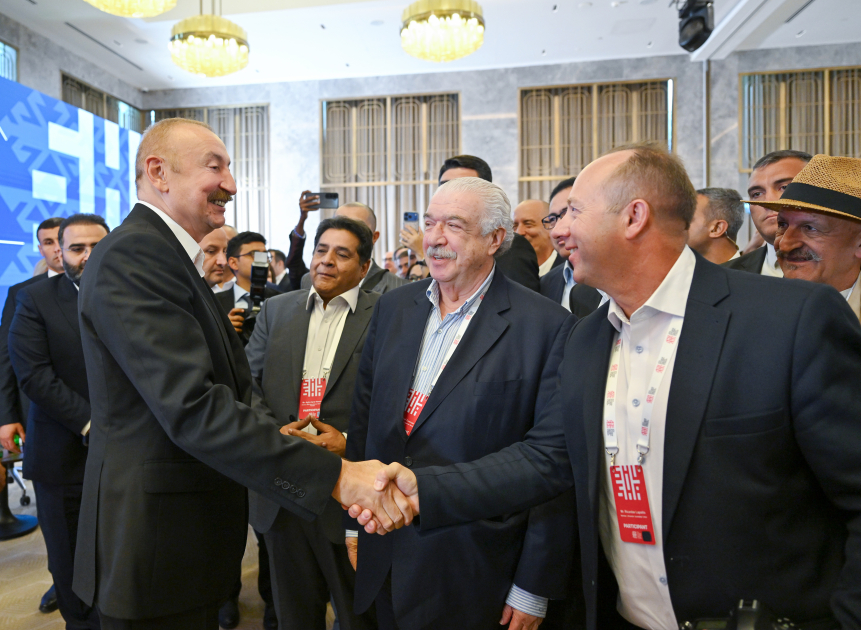
President Ilham Aliyev explained the background of Azerbaijan’s relations with United States and sanctions such as through US 907 amendment and then he described overall today’s relations with United States. He was of the view that 907 was a very unfair move by the United States Congress towards Azerbaijan back in 1992, when the Freedom Support Act was adopted by the U.S. Congress in order to support the newly emerged countries after the collapse of the Soviet Union by providing them with financial assistance, and Amendment 907 was introduced by pro-Armenian senators.
He said:
By the way, President Biden was one of them. He was a senator at the time, and probably this explains why we had so many difficulties with the Biden administration.
So that amendment prevented Azerbaijan from having access to America’s financial assistance. The reason for that, as it was described, was that Azerbaijan was blockading Armenia. First of all, it was not true. We were not blockading Armenia. It was Armenia that occupied our territory, and the occupied territories lay between Armenia and Azerbaijan. So if not for the occupation, there would have been no so-called blockade.
And second, it was, of course, very painful for us at that time because the country was very poor, and we were the only former Soviet Union republic that was discriminated against by the United States Congress. Today, this amendment is completely outdated. First, because Azerbaijan and Armenia initialed a peace agreement at the White House in the presence of President Trump.
Second, Azerbaijan unilaterally lifted all the transit restrictions for Armenia, and now, since we did it, more than 40,000 tons of different cargo have been transported to Armenia from Russia, from Kazakhstan, and from other destinations.
Moreover, Azerbaijan itself started to supply oil products to Armenia, and it’s already, as far as I remember, more than 10,000 tons. Especially now, when many countries are suffering from limited access to fuel, Armenia has a reliable source in Azerbaijan. If not for that, probably today they would have been looking for gasoline and diesel all over the world.
So this once again demonstrates that this amendment is completely outdated and should be repealed completely. But unfortunately, despite the firm position of President Trump—and by the way, during our meeting last August in Washington, at the White House, President Trump signed a waiver of this amendment in my presence for one year—and it doesn’t work now, its symbolic meaning, its political meaning, is still there.
And I think the sooner this amendment is totally repealed by Congress, the better for all of us: for Azerbaijan, because we will no longer be discriminated against, and for the U.S. Congress, which will demonstrate responsibility and the ability to admit its mistakes and also to act in accordance with the current geopolitical situation. So we hope that it will happen. But nevertheless, I can tell you that with today’s administration, Amendment 907 doesn’t play any negative role.
You asked about relations between the United States and Azerbaijan. I would say relations between the Trump administration and Azerbaijan are excellent, and we are very glad that these relations have been elevated to the level of a strategic partnership.
And my historic meeting with President Trump last August in Washington, and then our meeting in Davos in January this year, the invitation to Azerbaijan to be a founding member of the Board for Peace initiated by President Trump, the visit of Vice President JD Vance, the signing in Baku with the Vice President of the Joint Declaration on the Establishment of a Strategic Partnership, and many other factors demonstrate that our relations are now at their peak, at an unprecedented level, which we never had before. And today we are working actively to implement all the provisions of the Strategic Partnership Declaration.
Particularly, those working groups that have been established are working very actively on trade and investments, on digital transformation and AI, on energy security and connectivity, and on defense and defense sales. The United States lifted all the embargoes on the supply of weapons to Azerbaijan, and right after that, the same was done by the United Kingdom and by the members of the European Union. So this, I think, characterizes very well the spirit of our bilateral relations, the framework, and also the potential for the future.
With respect to your second question about a middle power, yes, I have read some analytical articles, and I am also aware of some experts’ opinions about Azerbaijan already becoming, or having already become, a middle power. Though I think a gathering like this can also help to identify exactly what the criteria are for a country to be considered a middle power. There can be various criteria, and a single criterion has not yet been elaborated. But to my mind, this terminology means recognition of a country’s potential, its ability to defend its national interests, regardless of what big powers think or do, its ability to resist with all its potential when someone wants to hurt it.
Definitely defense capability, and not only defense capability that is demonstrated at military parades, but on the battlefield. And, of course, one of the important factors, to my mind, is the ability to influence, with your only word or with your only statement, events that are happening beyond your boundaries, and Azerbaijan has demonstrated that on many occasions. And also I think one of the factors that can be applied to this terminology is responsibility: responsibility for what is happening inside your country, and responsibility, to a certain degree, for the whole region. And I think—and probably the team will also add to these criteria later—but I think all that I mentioned can be applied to Azerbaijan, and probably that’s why many experts call us a middle power, and I don’t mind, frankly speaking.
About the role of President Trump and his relations with Azerbaijan, President Ilham Aliyev shared his thoughts and said:
“There is a big difference between what President Trump has done and is doing and what his predecessors did. Because unfortunately, during the period of occupation, which lasted for almost 30 years, American administrations, along with the other co-chairs of the OSCE Minsk Group, were mainly pursuing the policy of freezing the conflict, not liberating Azerbaijani territory based on the resolutions of the Security Council of the United Nations, which they themselves adopted. But their goal was to freeze the situation and to use it as leverage over Azerbaijan and also, to a certain degree, over Armenia. All of them were working in a very synchronized way, and all the activity of the OSCE Minsk Group was aimed not at the resolution of the conflict but at making the occupation endless.
President Trump’s approach was quite different. He is a person who loves peace, a person who brings peace to many places. As he himself says, he brought peace to eight conflicts, and this is his character, this is his vision, and this is his policy.
So, in our case, his role was very important when Azerbaijan and Armenia were in the final stage of negotiations on a peace agreement. President Trump and his team stepped in, and they created such a framework that peace became possible.
They totally understood our concerns with respect to peace. They clearly understood the necessity of the Zangezur Corridor, which will connect Azerbaijan with its Nakhchivan exclave. And they worked very efficiently, also in order to persuade Armenia that they needed this peace as well. And at that historic meeting at the White House, the Armenian Prime Minister, President Trump, and I signed the Joint Declaration, and also, in the presence of President Trump, the ministers of foreign affairs of both countries initialed the peace agreement. As I said, President Trump, in my presence, signed a waiver of the restrictions and sanctions, and also we signed a document to establish a joint working group to prepare a Strategic Partnership Agreement within six months.
And exactly six months later, it was done. In my experience, this was the first time that American officials kept their word so strictly. So, from August to February, and then Vice President Vance came to Baku, and we signed the Strategic Partnership Declaration.
So, this is amazing. This is unbelievable. This is something that we could only dream about. We always wanted to have good relations with the United States, but because of the Armenian lobby and other stereotypes, because of the misperception of Azerbaijan and the underestimation of Azerbaijan and its capacity, it did not work.
And as I said, when President Biden was a senator, he was one of the initiators of sanctions against Azerbaijan, and that was his vision for the region: a region divided by conflicts and by confrontation, where it is always easier to achieve one’s goal. But President Trump is an absolutely different character, a different person. He wants peace, and he sees peace as an opportunity. And now, when peace is already established between Azerbaijan and Armenia, there are a lot of opportunities. Now, TRIPP—he gave his name to the corridor that connects Azerbaijan with its Nakhchivan exclave. And as far as we have information, practical work on the ground will start, hopefully, this year. So, this will completely change the connectivity map of the region. This will lead to security in the South Caucasus. We need that badly, and this will lead to cooperation in the South Caucasus in a good spirit. So, we are very grateful to President Trump himself personally, to his team, and to Steve Witkoff and Aryeh Lightstone, whom I particularly want to name because they played a crucial role, together with the President, in bringing Azerbaijan and Armenia to peace”.
Responding a question from a Jordanian journalist, President Ilham Aliyev on Azerbaijan’s relations with Jorden said that relations with His Majesty the King are brotherly relations, and relations between both countries also are very close.
While explaining latest bilateral relations with Jordan, President Ilham Aliyev commented:
“You probably know that just a couple of days ago, I hosted the Minister of Foreign Affairs, Deputy Prime Minister of Jordan, who had extensive talks with his colleague, and then we also exchanged views during our meeting about the future development of our relations and also regional security and regional challenges. So I’m sure that relations between Jordan and Azerbaijan will successfully continue in the future, because a great deal of work has already been done Next year we will host the Summit of the Organization of Islamic Cooperation. It’s a big responsibility for us, especially at these turbulent times. Azerbaijan has always strongly advocated solidarity among the Muslim countries, and numerous events held in Azerbaijan and numerous initiatives that we put forward have actually served the cause of solidarity, mutual understanding, and unity. We will see how things develop prior to the summit. But unfortunately, now we don’t see much solidarity. On the contrary, we see an aggravation of tensions, we see mutual accusations, and we see wars in different parts of the world, not only in the Middle East and the Gulf, and this is very disappointing. Because solidarity within the Organization of Islamic Cooperation, I think, is the main factor for security and stability. If there is more solidarity, more mutual understanding, there will be fewer difficult times. The role of Azerbaijan has always been highly appreciated, and we have played an important role at different times with different actors. And our role has always been constructive, result-oriented, and aimed at the reduction of tensions. We, by the way, demonstrated this capability during the times when we chaired the Non-Aligned Movement. As you know, members of the Organization of Islamic Cooperation are also members of the Non-Aligned Movement. The Movement’s 120 countries fully supported Azerbaijan’s chairmanship, and we were elected by the unanimous decision of all the countries. By the way, our chairmanship was even extended for one year, again by the unanimous decision of all the countries. So that was a recognition of our very positive role in bringing closer those who stand far away from each other. The same potential was very helpful when we had to agree on important decisions while chairing COP29. That was even more difficult because there were very contradictory views, opinions, and clashes. But again, it happened. So COP29’s legacy today is an important factor for all the future COPs and the green agenda. So, we will use all the capacity at our disposal during the time prior to the summit and at the summit to demonstrate this unity. We will do our best. To what degree we will succeed is difficult to say. And what the world and our region will look like next summer is also difficult to say. But hopefully, countries like Jordan, like Azerbaijan, and other like-minded countries whose agenda is peace, stability, and security, will join their efforts in order to achieve good results”.
President Ilham Aliyev while responding answer about providing oil and gas to Europe in emerging global situation said:
“We started to supply Germany and Austria this year, and this is a part of our overall strategy to expand our presence in the global and, particularly, the European gas markets. The European market is a premium market, the market with the best prices. Therefore, we are very interested in expanding our capacity. Yes, we supply gas to 16 countries by pipeline, and we are number one in the world in terms of the geography of pipeline gas supplies. And more is to come. We still are in negotiations with some members of the European Union, both to start supplying gas and to increase our supply. So we have both requests. And in today’s energy market situation, gas from a reliable source, from Azerbaijan, a predictable source and an alternative source, is more important than it was probably 10 years ago. We have the potential to increase our production and exports. Just a few months ago, we inaugurated production from the new gas field, ACG Deep Gas, as we call it. And production from existing fields will grow based on the working program and the investment portfolio. Plus, a lot is being done in the field of renewable energy, and renewables are already saving us a lot of gas and will save us even more. Because by 2032, we plan to have 8 gigawatts of capacity from renewable sources. And that will save us several billion cubic meters of gas, which today we use to produce electricity. So all that will also be available to our consumers. So, we have these two important factors: gas, with its production profile growing, and the market. So, we need to upgrade what is in between, particularly the transportation infrastructure. Our gas infrastructure was designed and built based on the scenario that existed before the 2022 Russian-Ukrainian war. And the capacity of the pipeline was built based on our production profile, the forecast profile, and our strategy for the rate at which to extract gas from the fields. Because it can be extracted in 10 years or in 100 years, and it depends on whether it is more beneficial for us to prolong the process and to have this curve relatively stable throughout decades, or just to invest and extract more. But when the Russia-Ukraine war started, the demand for Azerbaijani gas grew tremendously, and we’ve been approached by the European Commission to do the maximum we could in order to increase production rapidly, and we did it. And, by the way, these figures were announced during the visit of the President of the European Commission, that we increased gas supplies to the European Union by 65% since 2022, and this will grow. So, expansion of the existing transportation infrastructure is necessary, but the stumbling block is the European Green Agenda, and European banks are not eager to finance fossil fuel projects. Therefore, it’s a question of where to borrow funds in order to expand the capacity of the pipeline. And also another question, probably even more important, is long-term contracts. And that’s also what we discussed with Madame Ursula von der Leyen, that we need long-term contracts. Because in order to increase production dramatically, we need to invest heavily, and if at a certain point we are told, “Thank you, goodbye, we don’t need your gas any longer,” then what are we going to do?So these are two important factors, and also diversification. Because we started to supply gas to a market that we could not even foresee, namely Syria. And we can expand from Syria to neighboring countries, where there is a big demand. So for us, it is very important in relations with our European partners to have long-term contracts and also to work jointly on the expansion of the existing gas transportation system. And with respect to relations with the European Commission, I already spoke about that. We are very satisfied. And I think that this frequency of visits by high representatives and leaders of the European Commission is unprecedented, because from March to July, we had the President of the European Council, the President of the European Commission, and the head of European diplomacy. And all the visits went pretty well, with very good results and very detailed discussions, not only on our bilateral issues but also on what’s happening on the global agenda. Welcome back, Jane, to Garabagh”.
President Ilham Aliyev while praising his relations with Pakistan and the role of Pakistan as mediator between United States and Iran to cease the conflict in the region and his view on Middle East War said:
“We are situated right in the center of wars. We have one neighbor that is at war to the north, and one neighbor that is at war to the south. And we are just in between. And, of course, it’s a great concern to protect our country and to facilitate, if possible, the finding of a peace solution. Yes, we believe that peace is possible, and I think so do not only we, but also the mediators, the countries that are trying to do their best to stop this confrontation and bloodshed. Particularly, I would name Pakistan and my great friend Prime Minister Shehbaz Sharif and Field Marshal Asim Munir. They really did a great job mediating between the United States and Iran and achieved great success. Unfortunately, it did not last long. But I hope that this current eruption of conflict will not last long. So, I’m sure that peace is possible. Otherwise, it is very difficult to live when you don’t believe in that. I think what will be important is what the region will look like after peace is achieved. And here there are various scenarios and various options, and many countries are pursuing, of course, their strategic views. And as far as Azerbaijan is concerned, we only want peace beyond our borders, because when you have peace inside your country and conflict around the borders, you never feel safe. We have lived in peace in Azerbaijan for less than a year. We lived at war for 30 years. There was the First Garabagh War, then different types of confrontations during the so-called ceasefire period, and then different eruptions, and then the Second Garabagh War. So we could not imagine life without war. So only for less than one year have we lived in peace, and we see the benefits for development, for investments, for psychology, and for the mood of society. It has very many implications, and, of course, we would like to see peace to the south and to the north established as soon as possible. But peace must be just and fair and based on international law, and not based on someone’s ambitions and agenda. So international law is a universal platform for any peace. For instance, if we look back at our war with Armenia, we were always on the side of international law. We were defending ourselves. Our territory was occupied in the early 1990s, and then we tried to resolve the conflict peacefully. It did not work. Then we used force to restore our sovereignty. We did it, and we didn’t go further. We stopped, and this is very important. And I think one of the important moments after the hot period of confrontation is over is to stop. And this is not easy, and we understand it, and we lived with this wound in our heart for 30 years. But we stopped when it was necessary to stop. We stopped so as not to make the war endless. We could have had other options, but the responsibility and wisdom lay in stopping, because if we had not stopped, the war with Armenia would have continued. Maybe it would have become a kind of slow-moving process. At some point it would speed up, at some point it would slow down, and people would die. So the same should be done in the Middle East. When the hot period of confrontation is over, the members of the Gulf Cooperation Council and Iran should stop. Of course, we will never forget what the Armenians did to our people, how they destroyed our cities, how they killed innocent women and children, and how they committed genocide in Khojaly. We will never forget it. But at the same time, we understand that peace is the ultimate objective. So, I think there will be many implications: psychological, emotional, and attempts to fight back, to take revenge. My message to our neighbors is to be responsible and to stop as soon as possible and try to normalize relations, and not to escalate this process into a global conflict. This is a big danger, and I call for responsibility. And I hope that the mediation efforts of our friends in Pakistan again will result in the cessation of the confrontation”.
When asked by a Ukrainian regional expert to comment on Russia-Ukraine conflict, President Ilham Aliyev was of the view:
“I think neither the Ukrainian people nor the Ukrainian authorities needed my advice, but I would repeat it today as well: never agree to occupation. And that is exactly what Ukraine is doing — it does not agree to occupation. Although there were difficult moments during this year, and we saw, know, and heard about pressure from certain circles pushing for a cessation of hostilities that would essentially consolidate the occupation. But neither the people of Ukraine nor its leadership agreed to this. As for advice to the other side, if they ask me, of course I would give it. But right now, I think it would not be entirely appropriate to give such advice in response to your question. However, regarding my assessment of the situation and the prospects for continuing military hostilities, I think it does not differ much from yours. I believe that the understanding should have come long ago that this war must be stopped — and stopped immediately. This is Azerbaijan’s position, and it is my personal, purely human position — the position of a person who led and continues to lead a country that was occupied and has now liberated itself from occupation. I think this is quite a rare experience in history: the experience of both occupation and attempts to force us to agree to hand over, roughly speaking, Garabagh. As I have said many times, the Minsk Group, led by the United States, France, and Russia, only wanted to take Garabagh from us — and not only Garabagh within the former administrative borders of the Nagorno-Karabakh Autonomous Region, but also the entire territory of the Lachin and Kalbajar districts — and hand it over to Armenia, expecting us to agree. In return, they promised us the return of five districts located to the east of where we are now. But neither I nor anyone in Azerbaijan would ever have agreed to this. But this was the consolidated position of the three leading countries, at least given that they are the permanent members of the UN Security Council, and I use this term deliberately, of the world. Opposing that position was quite difficult. When the Second Garabagh War began, they all demanded that we stop immediately. They tried to intimidate us, threatened us, called us—some very insistently, others less so. But they all wanted us to stop so that everything would remain as it was. At one point, some of them told us: “All right, you have liberated Fuzuli, but stop there.” We had to employ various diplomatic mechanisms. I sent our foreign minister to numerous meetings in Moscow, Washington, and Europe. The goal was to prevent Azerbaijan from restoring its territorial integrity. But that goal was not achieved, because it is impossible to break the will of the people. It is impossible to defeat a nation that strives for independence and the preservation of its identity. It is impossible to subjugate such a people or impose someone else’s will upon them. This is something that those who still advocate the continuation of military hostilities should understand. I am aware of President Zelenskyy’s position. He has spoken about it publicly, and when he visited us in April, we discussed the matter in detail. His proposal was for an immediate cessation of hostilities along the line of contact. I do not know to what extent this proposal is still relevant—it is difficult for me to say—but, in any case, he has not publicly withdrawn it. Therefore, I believe that, in any case, Azerbaijan’s position remains unchanged. We have always supported, continue to support, and will continue to support Ukraine’s territorial integrity, its sovereignty, and the inviolability of its internationally recognized borders. The borders of no state should be changed by force or without the consent of that country’s people. In this regard, our position has been consistent and firm. As for the Ukrainian people, we are always ready to help in any way we can. I do not want to say much more on this subject. We are not doing this in order to talk about it. It simply comes from the heart. This applies not only to the state, but also to ordinary people and commercial companies. It is a shared desire to help those who are in need, those who have suffered, whose territorial integrity has been violated, and to assist them in whatever way we can”.
When asked about Azerbaijan’s current relations with Russia, President Ilham Aliyev commented as:
“Relations between our (Russia-Azerbaijan) countries are developing very positively. You (journalist) mentioned the difficulties. Yes, we all know about them. But what is important is that this period is now behind us. I would say that our relations have been fully normalized. Contacts are maintained at various levels—between governments, through members of government, the co-chairs of the intergovernmental commissions, the ministries of foreign affairs, and the Presidential Administration. So, in this regard, I believe everything is progressing well, and we are pleased about that. Relations between Russia and Azerbaijan are important both in the bilateral format and in a broader geographical context. They encompass traditional areas of cooperation as well as new ones that may emerge. Transport, of course, plays a very important role, as do trade and humanitarian cooperation. As for Russia’s role in the South Caucasus, it is difficult for me to speak about it, because that is a concept that Russia itself must formulate, if it has not already done so. The South Caucasus has changed fundamentally. In this context, one could say that the Second Garabagh War served as the catalyst, shifting many of the assumptions that had long been regarded as established and unchangeable. Subsequent developments in the South Caucasus—including the full restoration of Azerbaijan’s sovereignty, Armenia’s aspirations toward Europe, and everything connected with that process—make it necessary, in my view, for both analysts and statesmen to rethink the region as a whole. Without direct contacts and a proper understanding of developments on the ground, this will be very difficult, because the old approaches to perceiving the South Caucasus have become completely outdated. This is an entirely different region from what it was five years ago, with new centers of influence and, once again, differing aspirations. Perhaps these trends are now much more visible than before, although those who have long studied the region undoubtedly saw them emerging. Therefore, for any external actor, building relations with the South Caucasus as a whole is a very difficult task, because the region is not consolidated. It is not integrated politically, economically, or in terms of transport. We are still at an initial stage. These are the same messages I conveyed to my European colleagues when we observed a clear imbalance in the West’s approach toward Armenia. This raised questions for us because we know the geography, the economic potential, and everything else, and we also know our own value. Yet Armenia was being presented as almost the region’s main transport hub. Naturally, this raised serious questions. A country with virtually no experience as a transit state was suddenly being described as the principal hub. It was simply unclear what exactly was passing through it. That was the imbalance. You see, this imbalance was, naturally, driven by political considerations and attempts to draw Armenia to one side. Everyone needs to move away from this approach and stop viewing the South Caucasus as an arena for geopolitical competition. In any case, in Azerbaijan we have achieved this. We did not allow ourselves to be drawn into geopolitical intrigues, nor did we allow any external players to use us for their own purposes — whether against someone else or against who knows whom. Now, I think our neighbors need to do the same — not just in words, but in deeds. And all those who are truly interested in this region and want peace and cooperation here must build individual formats of cooperation with all the countries of the South Caucasus. Only when the normalization process with Armenia is completed, when direct transport links between Azerbaijan and Armenia are established — not as they are now, but genuinely direct ones, through the Zangezur corridor or other routes — and when the South Caucasus is politically ready for a trilateral format, then the situation will be different. Until then, a sober assessment of each country’s potential — economic, political, military, demographic, and others — is important so that proper emphasis is placed correctly and there are no later disappointments from having bet on the wrong side again. And most importantly, everyone who wants to cooperate should proceed first and foremost from the understanding that this must be a region of peace and interaction, completely free from geopolitical competition — to the extent that any region can be free from it”.
Responding a question from a Chinese journalist regarding Azerbaijan-China bilateral relations, President Ilham Aliyev said:
“Following my state visit to the People’s Republic of China last year and the signing of the Declaration on a Comprehensive Strategic Partnership, cooperation across all areas has intensified significantly—political, economic, transport, and others. We are very pleased with this development and attach great importance to it. Today, more Chinese companies are operating in Azerbaijan. Some have already made major investments, while others are participating in various infrastructure projects. During my state visit, I met with the executives of many of China’s leading companies, and I am pleased that their operations in Azerbaijan are already yielding results. They work very efficiently, quickly, and to a very high standard. We have also opened a new chapter in our cooperation—defense cooperation. Azerbaijan has already procured certain military products from China. Some of them were displayed during the parade marking the fifth anniversary of our Victory, some are still in transit, and others are currently under discussion. Therefore, we are very interested in expanding cooperation in the field of military-technical support. As for the Middle Corridor, cargo volumes from China transiting through Azerbaijan, as well as cargo destined for Azerbaijan, continue to grow. As I mentioned earlier, we are nearly doubling the capacity of our trade port, largely in anticipation of increased transport volumes from China as well as from the countries of Central Asia. There is already a strong track record of cooperation in this area, as well as multilateral collaboration with many of the countries located along the corridor. I should also note that Azerbaijan is implementing numerous solar energy projects. Although Chinese companies only recently began investing in this sector, all the solar panels installed in Azerbaijan under contracts with non-Chinese companies are of Chinese origin. In other words, every solar panel you see in Azerbaijan, regardless of which company invested in the project, was manufactured in China. At present, manufacturers from no other country can compete with Chinese producers in terms of both price and quality. It is therefore no coincidence that a major Chinese company is now implementing an investment project to build a solar panel manufacturing plant in Azerbaijan, which will also produce for export. Another important recent development in bilateral cooperation is the joint production of electric buses by BYD, which can now be seen on the streets of the city. We have buses in two colors: electric buses are green, while conventional buses are red. Naturally, the more green buses we have, the better. So, there are many projects underway. We are very pleased with the way our relations are developing, and we are also pleased that there is only a short interval between political decisions taken at the leadership level and the implementation of concrete projects. In this respect, Chinese companies stand out favorably compared with many others. With some companies, negotiations last for many months, if not years, and then the process of establishing production facilities is also delayed. In this case, everything proceeds exactly according to schedule. So I, as well as all the agencies cooperating with Chinese companies, are very satisfied”.
President Ilham Aliyev on his relations with Uzbekistan said:
“Friendly and brotherly relations lie at the foundation of Uzbekistan-Azerbaijan ties. Our personal friendship with the honorable President Shavkat Miromonovich has raised these relations to an even higher level. I must note that it was precisely the President of Uzbekistan who was the first to assist us in the restoration of Garabagh. A beautiful, large school named after Mirzo Ulugbek was built in the city of Fuzuli, and together with Shavkat Miromonovich, we celebrated the opening of that school. That is to say, other brotherly states later presented us with gifts as well—Kazakhstan, Kyrgyzstan, Turkmenistan—but the very first assistance came specifically from Uzbekistan. Every time I am in Uzbekistan, I am reassured of how close and connected our peoples are. When you see the written words, there is no need for any translation. Our languages are also very similar. Naturally, there is a slight difference in pronunciation, but in principle, everything is understood. We are united by very profound historical ties, and the development of relations with Uzbekistan is one of the top priorities for us. I should also mention that Uzbekistan did not conclude its brotherly mission solely with the school. The first major industrial enterprise in the city of Khankendi—a garment factory—was also opened through Uzbek investment, and once again, together with the honorable President Mirziyoyev, we visited that factory. Many economic and industrial projects are currently being implemented. Both Azerbaijani and Uzbek investments are being made. We established a joint investment fund valued at 500 million U.S. dollars. This investment fund is engaged in the implementation of various projects in both Uzbekistan and Azerbaijan. Today, Azerbaijan’s oil company, SOCAR, is investing in a very important exploration field in Uzbekistan, and I hope that in the near future it will bring us good tidings and glad news. This is because energy security issues, particularly gas supply, are vital for many countries today, and I hope that the exploration work at the Ustyurt field will conclude with positive results. As for the Azerbaijan-Central Asia format, President Mirziyoyev has exceptional merits and a special role here as well. Azerbaijan has already joined this Consultative Council as a full member. I had been invited to the summits twice as an honorary guest, but most recently, a unified Azerbaijan-Central Asia Consultative Council was established. This makes us very proud and very happy. I can say that this is a unique occurrence. Because from a geographical standpoint, we are, of course, located in the South Caucasus. However, the cultural, historical, and ethnic ties are so strong, and the political relations are so multifaceted, that the friendly Central Asian countries decided to accept us. Today, this will also have a positive impact on geopolitical and geo-economic relations. Because in this way, Central Asia and Azerbaijan are uniting into a single economic and political space. At the same time, this holds immense significance for the implementation of connectivity, transport, and logistics projects. Of course, I can say that the foresight and strategic vision of President Shavkat Mirziyoyev have played a very important role here. Taking this opportunity, I would like to congratulate our Uzbek brothers on all the achievements they have made. I visit Uzbekistan frequently, and I will probably visit this year as well. Every time I see the innovations there, I am deeply pleased. I know that under the leadership of President Mirziyoyev, the brotherly Uzbek people and state are moving forward successfully and confidently”.
On Azerbaijan’s relations with Kazakhstan, President Ilham Aliyev commented:
“I am very grateful to President Tokayev for his assistance in the restoration of Garabagh. The Children’s Creativity Center in Fuzuli is named after the great son of the Kazakh people, Kurmangazy. Together with Kassym-Jomart Kemelevich, we inaugurated this center, and we are very thankful for such support from the fraternal Kazakh people in rebuilding the liberated territories. Of course, our personal relations with President Tokayev are an important factor both in the bilateral format and in regional cooperation. We have a very broad agenda. We interact closely as two countries located on opposite shores of the Caspian Sea. In essence, without active cooperation between Kazakhstan and Azerbaijan, no major transport project in our region or in the Caspian region as a whole is possible. We are pleased with the parallel efforts being made to create and expand infrastructure. I have already spoken about Azerbaijan’s work in this area. I know that a great deal is also being done in Kazakhstan to expand port infrastructure. A joint cooperation format already exists between Kazakhstan, Azerbaijan, Georgia, and Türkiye, where very important issues are being discussed and resolved — including tariff policy, digitalization, simplification of customs administration procedures, and many others. In 2024, in Baku, we signed an agreement with the Presidents of Kazakhstan and Uzbekistan on the construction of an energy cable along the bed of the Caspian Sea. The feasibility study is currently being prepared. At the same time, on a bilateral basis with Kazakhstan, we are working on the construction of an optical fiber cable that will connect Kazakhstan and Azerbaijan. This cable will link a very extensive geography and will play a crucial role in the future in the development of digitalization, artificial intelligence, data centers, and other areas. Kazakh oil has begun to be transported in certain volumes through the territory of Azerbaijan. So, the two countries are closely cooperating in this region. We are also pleased with Kazakhstan’s successes under the leadership of its President — its dynamic development. Recently, I had the opportunity to visit the historic city of Turkistan and was deeply impressed by how carefully the historical heritage is preserved and how the memory of great ancestors is honored. I am very glad that our relations are developing so successfully, and I wish the fraternal people of Kazakhstan new achievements”.

