
Monitoring Desk
PETERSBURG, Russia: Pakistan’s Ambassador to Russia, Faisal Niaz Tirmizi, has said that Pakistan played a significant role in helping de-escalate tensions between Iran and the United States, contributing to efforts that prevented a potential military confrontation with far-reaching global consequences.
Speaking to Russian media on the sidelines of the St. Petersburg International Economic Forum (SPIEF), Ambassador Tirmizi said that a conflict between Iran and the United States could have escalated into a wider regional war, posing serious risks to global stability and the safety of millions of people living in the region.
The ambassador emphasized that Pakistan remains committed to promoting peace, dialogue, and diplomatic engagement in the region. He noted that Islamabad actively supports efforts aimed at reducing tensions and preventing conflicts that could threaten economic and human security.
Ambassador Tirmizi also underscored the importance Pakistan attaches to its relationship with Russia, describing bilateral ties as an important component of Pakistan’s foreign policy. He expressed Islamabad’s desire to further strengthen cooperation with Moscow in trade, investment, energy, and regional connectivity.
Commenting on the broader economic implications of recent tensions involving Iran, Ambassador Tirmizi said the crisis highlighted the global economy’s dependence on the Strait of Hormuz, one of the world’s most important maritime trade routes.
“The conflict demonstrated how vulnerable the global economy is to disruptions in the Strait of Hormuz,” he said, adding that instability in the region affects not only international oil and gas markets but also fertilizer supplies and global food security.
He stressed that any disruption to maritime traffic through the strategic waterway could have significant consequences for countries around the world, particularly those dependent on energy imports and agricultural commodities.
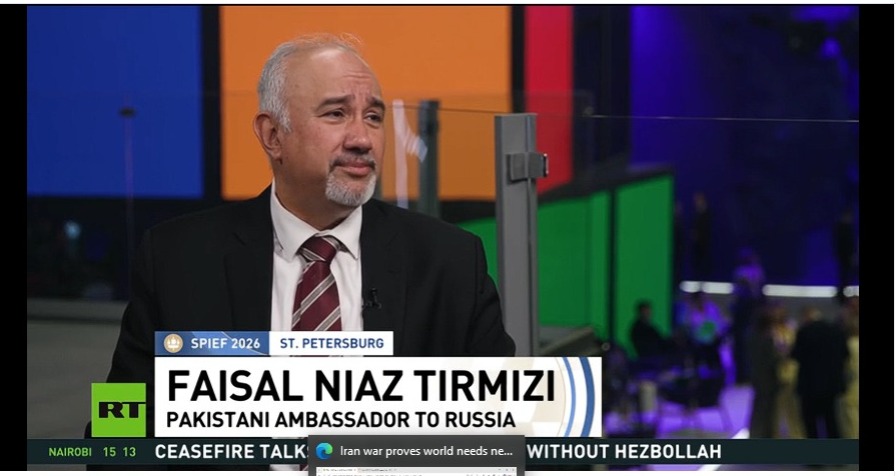
The ambassador’s remarks came during the St. Petersburg International Economic Forum, one of Russia’s premier economic events. Established in 1997, SPIEF has been held annually and, since 2006, has taken place under the patronage and with the participation of the President of the Russian Federation.
The forum serves as a major international platform for dialogue, business networking, and investment cooperation, bringing together government officials, business leaders, investors, and experts from around the world to discuss key economic and geopolitical issues.

