
For young developers, artificial intelligence can shorten the distance between an idea and a working prototype. But it can also deliver code faster than the judgement needed to assess it. That tension is central to software engineer Yousaf Fayyaz’s mentoring work.
Fayyaz works with younger developers on AI-assisted coding, prompting and agentic workflows. His focus is less on how quickly tools produce code than on what happens before and after generation: define the problem, provide the right context, then review the output before it enters a product.
Coding assistants can generate components, suggest implementations and troubleshoot errors. For early-career developers or small teams, that can speed up prototyping. Yet faster implementation does not remove the engineering decisions around requirements, architecture, security, testing and maintainability.
That is why verification is a recurring theme in Fayyaz’s mentoring. Developers are encouraged to understand what an AI system produced, test its assumptions and recognise when human review remains necessary. The aim is not only to make generated code run, but to decide whether it belongs in a reliable product.
The same distinction matters when developers use AI to build products of their own. Automation can accelerate an early prototype, but it cannot decide what should be built, who it is for or whether the technical foundations can support real users. Generating software and engineering a product remain different tasks.
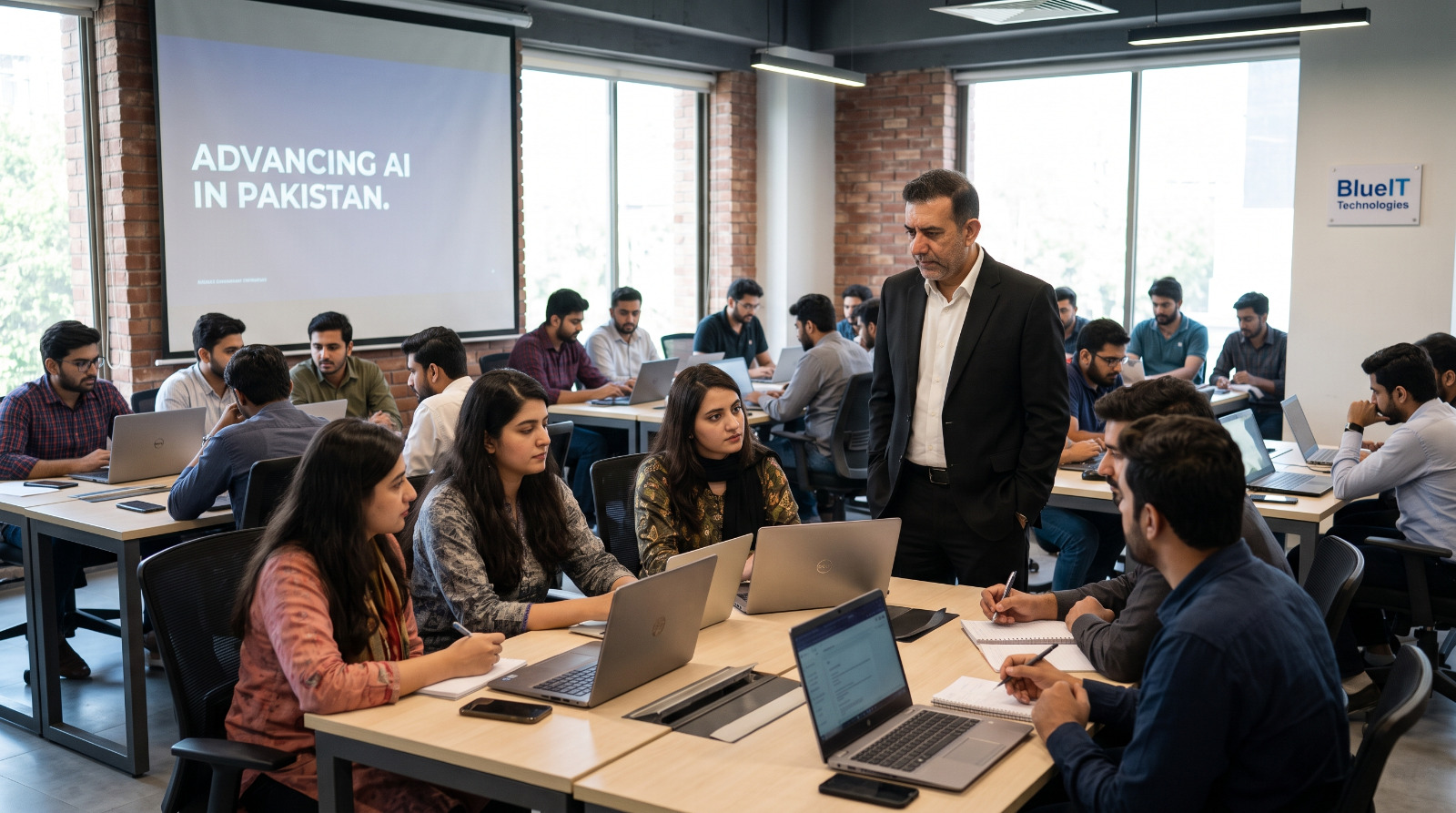
A workshop hosted by Lahore-based Blue IT Technologies was one setting for that mentoring. More broadly, it reflects the changing skill set young developers need as AI becomes part of everyday software development.
Fayyaz’s experience with changing development tools predates the current AI wave. In 2010, he was identified by Business Recorder, citing Associated Press of Pakistan, as one of the engineers behind BuddyFlick, a locally developed social-networking platform that emerged during Pakistan’s temporary Facebook ban. BuddyFlick was among several home-grown alternatives that drew coverage at the time, including from The New York Times and ProPakistani.
For developers entering the field with AI available from the outset, his message is not to avoid the tools, but to pair them with technical judgement: define the problem, review the result and take responsibility for the software that reaches users.
The challenge is no longer only how fast code can be generated, but whether developers can explain, evaluate and stand behind what they build.
