
DND Report
The date of December 16 is a painful reminder of the Fall of Dhaka in 1971 and the APS Peshawar massacre in 2014, and both agonizing events were glaring examples of Indian cross-border terrorism. A third event could have been May 9, 2023 that was too planned by India, but it was successfully averted by security forces under the guidance of military leadership.
December 16, 1971, and the averted mutiny of May 9, 2023, are reminders of what happens when personal ambitions are placed above the state, and how individuals such as Sheikh Mujeeb-ur-Rehman and Imran Khan deliberately positioned themselves over the interests of the state, polarizing the nation to serve their vested interests and the politics of hatred and division. One met his destiny on August 15, 1975, just four years after breaking Pakistan and the second individual is in jail, awaiting a similar end. Both thrived on the politics of hatred and division. Mujeeb played the card of regional grievance to weaken the federation, while Imran Niazi weaponized political victimhood, abuse of institutions, and street agitation to fracture society and pit Pakistanis against Pakistan.
National unity was never their priority. Mujeeb exploited the emotions of the people of former East Pakistan for personal power, while Imran Niazi relentlessly exploited ordinary Pakistanis as political cannon fodder to protect himself from accountability and corruption cases.
Like Mujeeb’s alignment with hostile narratives, Imran Khan echoes India’s propaganda line, with his sisters and close associates openly appearing on Indian channels and attacking Pakistan and its institutions, giving comfort to an adversary that has historically celebrated Pakistan’s internal discord. Mujeeb was blessed with full backing from Indian and Western media, just as Imran Khan is enjoying today. Imran Khan Niazi systematically tried to damage Pakistan’s international standing through reckless protests, threats, boycotts, and calls for instability. He actively attempted to sabotage international financial assistance, economic recovery, and diplomatic engagement, mirroring how Mujeeb’s actions isolated Pakistan globally in 1971.
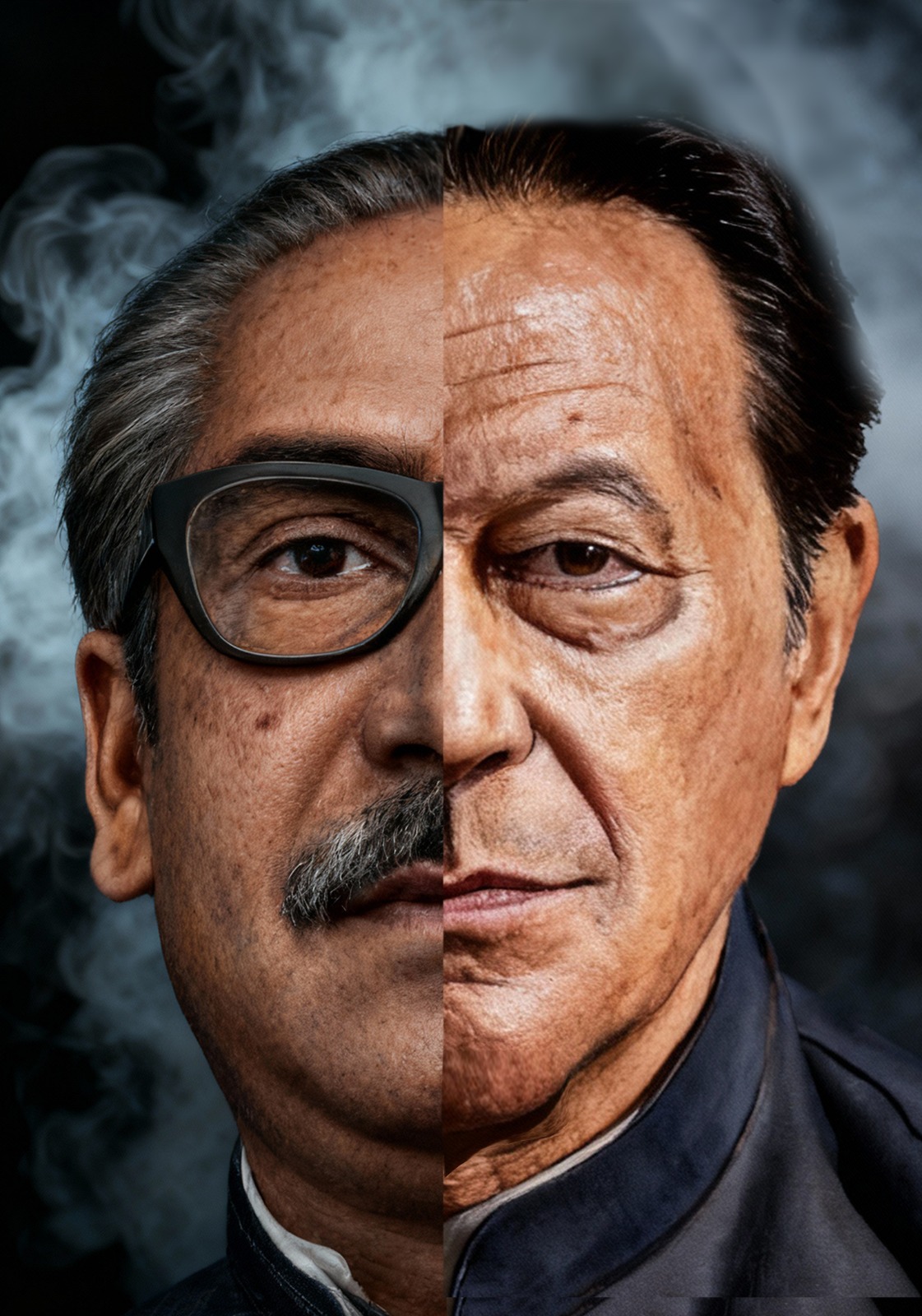
Both figures undermined state authority to create chaos. Mujeeb challenged the writ of the state to force his narrative; Imran openly incited lawlessness, attacked constitutional offices, and encouraged defiance of the state when it no longer served his personal interests. History records such figures not as heroes, but as warnings. December 16 reminds Pakistan that leaders who prioritize ego, vengeance, and division over unity and stability ultimately weaken the nation and leave scars that last generations. Both are textbook examples of how narcissistic politics, fueled by hate and foreign patronage, can endanger the very existence and stability of the state.
Even before the February 2024 general elections, Imran Khan started comparing himself with Sheikh Mujibur Rahman, who beyond any iota of doubt had been working for India since the mid-1960s to break Pakistan into two pieces. Imran Khan claimed before the 2024 general elections that the then military establishment of Pakistan did everything against Sheikh Mujibur Rahman, yet he won 162 seats and that he (PTI) would also win. Tagging the Pakistan Army with Mir Jaffar and tagging himself with Sheikh Mujibur Rahman indicated that Imran Khan was no different from those who thoroughly planned the disintegration of Pakistan in the 1970s and those who are again attempting the same today.
The PTI campaigns portraying Sheikh Mujibur Rahman as a hero and the Pakistan Army as a villain exposed what had been known to many for years: that Imran Khan is a foot soldier of those who wish to harm Pakistan. President Asif Ali Zardari years ago claimed that the House of Goldsmith was investing in Imran Khan. These claims were rejected by Jemima Khan, the first wife of Imran Khan.
In 1971, foreign media was actively spewing poison against Pakistan, and today many European media houses are publishing whatever Imran Khan says against the Pakistan Army without taking comments from the other party that is the Pakistan Army. The question arises as to why Imran Khan and his party are invoking the East Pakistan tragedy to target the Pakistan Army. The answer could be that the international lobby behind Imran Khan seeks to disintegrate Pakistan, as it did in 1971, which is why similarities between 1971 and today are being portrayed through massive media management.
PTI has been directly targeting the sovereignty of the country and fanning hatred against the Pakistan Army. PTI hired US lobbying firms to manage its media narrative in North America and Europe. The party has openly admitted to having foreign funds and contacts with foreign think tanks and media houses. It may be recalled that a resolution against Pakistan was submitted in the US House of Representatives by a member of Congress who is pro-India and Israel. This lobby has long been engaged in creating an anti-Pakistan narrative.
Some journalistic circles in Islamabad claim that there is no iota of doubt left that targeting the Pakistan Army through articles published in American and Western media is part of the PTI plan to discredit Pakistan and portray the country as a “non-functional state.” These circles believe that “Operation Discredit Pakistan” is part of “Operation Goldsmith.” Anyone reading Western media content about Pakistan can observe striking similarities, suggesting a single source and a clear framework to establish the idea that “Pakistan is a corrupt country.” This same style sheet was used by Western and Indian media to favor and promote Mujeeb-ur-Rehman.
It is a proven fact that for any event to become “news,” in western media, it must align with broader Western agendas and “Western needs.” One must ask: what are those “Western needs” that justify the publication and broadcast of so much similar material against Pakistan? In a recently published article, the writer attempts to answer this question, claiming that Imran Khan is a Western-infested leader whose real agenda is to damage Pakistan while pretending to be “anti-West,” but in reality working at Western bidding.
During his previous regime, Imran Khan halted the Chinese CPEC and ruined Pakistan’s foreign relations with Russia by mocking the gas pipeline; with Turkey through the public half-nude parading of Turkish company officials; with Saudi Arabia by insulting the host who lent him his aircraft to fly to the US; with Iran by allowing Taliban-backed terrorists to attack Iran; and with Qatar by alleging corruption in the Pak-Qatar LNG deal and using the diction of the “Qatari Shahzada letter.” In a nutshell, Imran Khan sabotaged everything for or in favor of the Global South.
The question is: how long will the state of Pakistan sit and watch this circus? Pakistan must not have any doubt that an information war has been waged against it. There is a pressing need to take strict action against such individuals and make an example of them, so others understand the consequences of going against the state. The question remains: were the undercurrents of May 9 deeper than acknowledged? Who benefits from weakening Pakistan, as seen in Iraq, Afghanistan, Libya, or Haiti?
It is worth remembering that on May 8, a day before his arrest at the Islamabad Judicial Complex, Khan released a video instructing his followers to react if he were taken into custody. The May 9 violence did not erupt spontaneously—it was the product of careful planning designed to exploit the fault line between the state and its citizens, just as the Mukti Bahini once did in East Pakistan before India’s official intervention.
Today, however, Imran Khan stands exposed. His politics of hatred, venom, and victimhood have lost public appeal, leaving him increasingly isolated. What remains is not leadership, but the legacy of a conspiracy against the state.
References
Hamoodur Rahman Commission Report (1974)
Government of Pakistan – Official findings on the 1971 crisis.
Sisson, R., & Rose, L. (1990). War and Secession: Pakistan, India, and the Creation of Bangladesh.
University of California Press.
Rounaq Jahan (1972). Pakistan: Failure in National Integration.
Columbia University Press.
Stanley Wolpert (2009). Shameful Flight: The Last Years of the British Empire in India.
Oxford University Press.
Inter-Services Public Relations (ISPR) Press Releases (2014–2015)
Official briefings on APS Peshawar attack and Indian-sponsored terrorism narratives.
National Action Plan (NAP) Documents – Government of Pakistan
ISPR Press Briefings (May–June 2023)
Official account of May 9 incidents and security response.
Supreme Court of Pakistan – Proceedings and Orders related to May 9, 2023
Interior Ministry Statements on May 9 Violence
European Parliament Resolution on Pakistan (2024)
US House of Representatives Records (2023–2024) – Pakistan-related motions
Foreign Agents Registration Act (FARA) Filings – US Department of Justice
Records of lobbying firms engaged by PTI-linked entities.
RAND Corporation – Studies on Hybrid Warfare and Information Operations
Mudde, C. (2004). The Populist Zeitgeist. Government and Opposition Journal.
Levitsky, S., & Ziblatt, D. (2018). How Democracies Die.
Crown Publishing Group.
Hassan Abbas (2015). Pakistan’s Drift into Extremism.
Shuja Nawaz (2008). Crossed Swords: Pakistan, Its Army, and the Wars Within.
Pakistan Ministry of Planning – CPEC Framework Documents
Chinese Ministry of Foreign Affairs Statements on CPEC Delays
Pak-Russia Gas Pipeline Agreements & Public Statements (2019–2022)
Edward Herman & Noam Chomsky (1988). Manufacturing Consent.
Reuters, BBC, The Guardian, The Economist – Comparative coverage studies on Pakistan
Dawn, The News, Express Tribune – Domestic counter-narratives and editorials

