
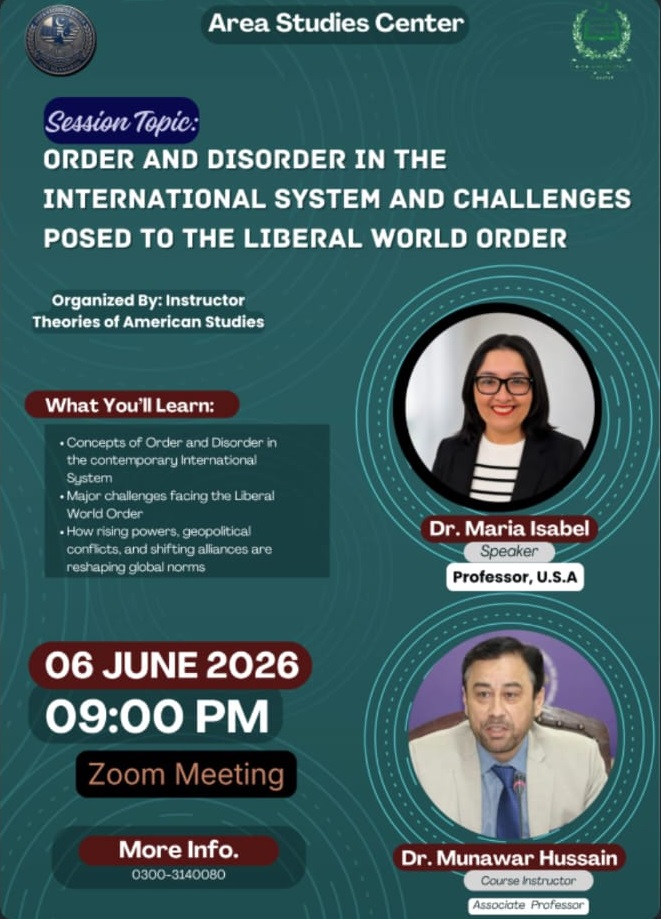
Press Release: As part of the Course on Theories of American Studies instructed by Dr. Munawar Hussain at the Area Studies Center, Quaid-e-Azam University Islamabad, a webinar was organized.
The session featured Dr. Maria Isabel, Professor from a U.S. university, and Dr. Munawar Hussain, Associate Professor, QAU Islamabad. The discussion centered on a pressing question: Who bears responsibility for the current disorder?
On the United States, Dr. Maria shared her insights. Once the principal architect of the liberal world order, the U.S. was described as having become a spoiler through selective enforcement of international law (e.g., Iraq 2003, drone warfare). She noted that under Trump, the Republican Party has shifted toward nationalism, unilateralism, and sovereigntism. As scholar Haass put it: “America’s decision to abandon the role it has played for 70 years marks a turning point.”
Participants highlighted that the liberal order was always asymmetric. The Washington Consensus, structural adjustment policies, and the UN Security Council’s veto architecture excluded the majority. As Goddard et al. argued, critics were dismissed as “irrational” — and this suppression of contestation made the order brittle.
A Critical Distinction Made During the Session: The speakers distinguished between creating an alternative order versus disrupting the existing system while still operating within its classical definition. This nuance sparked significant debate.
Participant Questions:
- Dr. Shafqat Rasool asked: Why does the US need to attack Iran and Venezuela, and why is it keen to capture Greenland and Canada? Is the USA destroying its own rule-based world order?
- Basit Pervez (MPhil Scholar) and Muhammad Dilawar (PhD scholar) questioned whether a more equitable world order is possible without fundamental structural reform.
- Additional data from the discussion noted that anti-liberal rhetoric from leaders like Orbán and Bolsonaro, combined with media censorship and repression, further complicates the liberal order’s future.

The webinar concluded that the international system stands at a crossroads, either toward meaningful reform or further fragmentation. Both speakers and participants agreed that critical engagement from the Global South is no longer marginal but essential to any future world order.

