
Monitoring Desk: Circumstantial evidence suggests that US did not ‘abandon’ weapons in Afghanistan but handed them over to Taliban through the Doha Peace Accord.
The Doha Peace Accord may have resulted in a strategic outcome that effectively transferred large quantities of advanced military equipment to the Afghan Taliban, and this hardware is being used against Pakistan and can be used against Iran anytime wherever it would be needed.
Critics argue that the process amounted to a form of betrayal toward Pakistan, as none of the parties to the Accord reportedly informed Islamabad that the United States would not remove significant quantities of state-of-the-art military hardware from Afghanistan. Instead, these weapons ultimately fell under Taliban control following the collapse of the Afghan Republic in August 2021.
Since Islamabad has long been considered one of Washington’s security partners in the region, Pakistani officials have largely avoided publicly framing the development as a betrayal. Instead, the dominant narrative has been that the United States “left” weapons behind during its hurried withdrawal, rather than acknowledging the broader reality that these weapons were originally supplied to Afghan government forces and ultimately ended up in Taliban hands following the implementation of the peace agreement and the rapid collapse of Afghan institutions.
The U.S. narrative often suggested that military hardware was abandoned in the chaos of the withdrawal. However, observers and regional analysts point out that several questions remain unanswered. For instance, why were certain operational aircraft not flown out of Afghanistan prior to the withdrawal deadline of 31 August 2021? Aircraft such as MD-530 light attack helicopters and A-29 Super Tucano aircraft could theoretically have been relocated to neighboring countries or flown to U.S. bases abroad. In fact, Washington had prior arrangements with some regional states, including Uzbekistan and Tajikistan, where a number of Afghan Air Force aircraft eventually fled with pilots during the Taliban takeover.
Flying platforms such as helicopters and fixed-wing aircraft are typically among the most recoverable assets in a withdrawal scenario. Yet many remained in Afghanistan and were later displayed by Taliban forces as captured equipment. Some Taliban commanders have privately claimed in discussions with regional interlocutors that much of this equipment effectively came into their possession as part of the political and military transition that followed the Doha Accord rather than through battlefield capture alone.
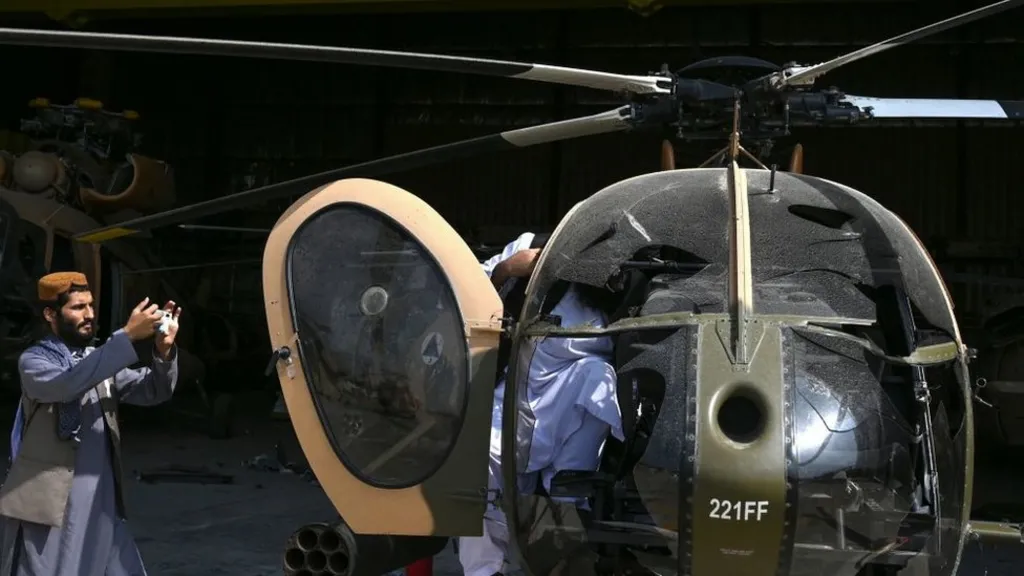
According to available information, some of the military equipment originally provided by the United States to Afghan government forces has since been observed in use by Taliban units. Pakistani security officials have repeatedly expressed concern that some of this equipment has also appeared in the hands of militant groups operating along the Afghanistan–Pakistan border region, posing new security challenges.
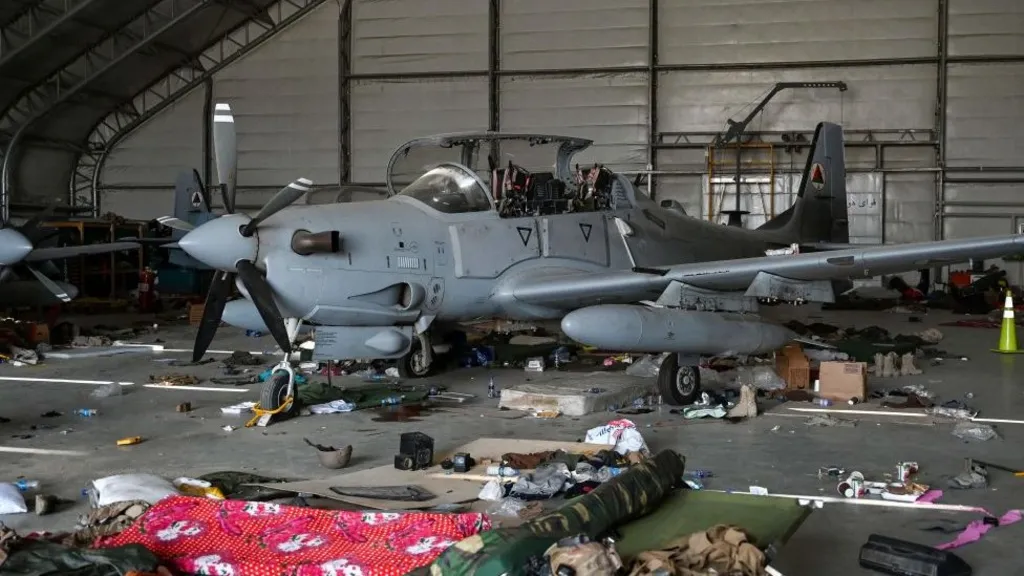
Aircraft and Aviation Assets
Various estimates indicate that over 150 aircraft belonging to the former Afghan Air Force were present in Afghanistan at the time of the Taliban takeover. These included:
- MD-530 light attack helicopters used for reconnaissance and close air support
- A-29 Super Tucano light attack aircraft
- UH-60 Black Hawk helicopters
- Mi-17 transport helicopters previously supplied through U.S. programs
Reports suggested that approximately 167 aircraft existed in the Afghan Air Force inventory before the fall of Kabul. According to reports a number were flown to Uzbekistan and Tajikistan by Afghan pilots fleeing the Taliban, but others remained inside Afghanistan. Some assessments suggest that dozens of helicopters and aircraft eventually fell under Taliban control.
The unit cost of an A-29 Super Tucano has been estimated at over $10 million, while the UH-60 Black Hawk costs significantly more depending on configuration.
Armored Vehicles and Ground Equipment
- Ground equipment supplied to Afghan forces over two decades was extensive. Available data suggests that the Taliban gained access to:
- Mine-Resistant Ambush Protected vehicles (MRAPs) – at least 70 units, with each costing between $500,000 and $1 million
- Humvee (HMMWV) military vehicles – thousands supplied to Afghan forces
Armored personnel carriers and tactical vehicles
According to the U.S. Special Inspector General for Afghanistan Reconstruction (SIGAR), the United States provided more than 2,500 Humvees between December 2017 and April 2020 alone. The estimated unit cost of a Humvee is over $250,000, depending on configuration.
Other Military Hardware
Large quantities of additional equipment supplied to Afghan forces also remained in the country after the government’s collapse. These reportedly included:
Counter-rocket and artillery defense equipment
- Small arms and ammunition
- Night-vision devices and thermal optics
- Communications and surveillance equipment
Experts note that such equipment can significantly enhance the operational capability of irregular forces. For example, the United States supplied around 16,000 night-vision goggles to Afghan forces between 2003 and 2021, greatly improving nighttime combat capability.
Strategic Questions
The final disposition of U.S.-supplied military equipment in Afghanistan continues to raise strategic questions across the region. While Washington maintains that most equipment was originally transferred to the Afghan National Defense and Security Forces (ANDSF), the rapid collapse of those forces allowed the Taliban to seize or inherit a large share of that arsenal.
For neighboring countries—particularly Pakistan, Iran and Central Asian states, the presence of advanced military equipment in Taliban hands remains a significant security concern, especially amid reports that some weapons have appeared in regional militant networks.

