
DND Special Report
Chandigarh, Indian Punjab: In the so-called democratic India, the movie Satluj that is also known as “Punjab 95” was banned just in two days after release that took three years to clear from Indian Censor Board that demanded 127 censor cuts and then allowed the film to be released and this film took three years to go through censor process.
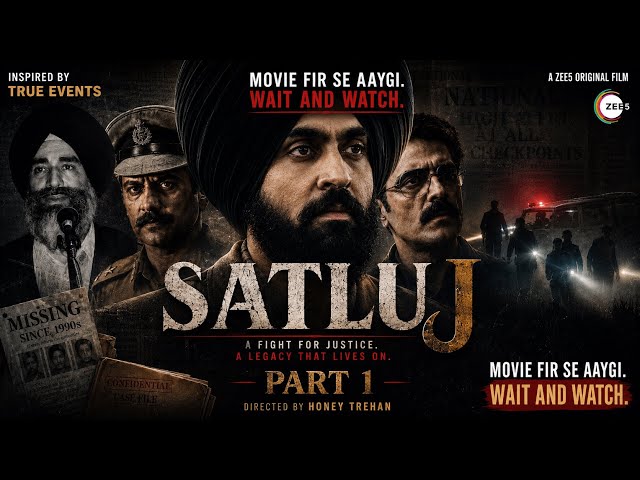
This movie received this treatment from Indian government because it is all about Sikh purged that started in 1984 from Delhi.
The film was eventually released on the streaming platform ZEE5 on July 3, 2026. However, citing “current developments,” ZEE5 abruptly removed the film from its platform in India just two days later, though it remains available internationally.
Satluj (originally titled Punjab ’95) is based on the true story of human rights activist Jaswant Singh Khalra, who investigated state-sanctioned extrajudicial killings and secret cremations of thousands of Sikhs in Punjab during 1984-95. His work indicated that there could have been over 25,000 Sikhs illegally killed and cremated by the state during 1984-95 only in Indian Punjab. To date, families of those who “disappeared” during the insurgency are awaiting confirmation of the fate of their missing loved ones.
Since movie exposed Sikh purge in Indian Punjab the censor board demanded 127 cuts at one point. The makers tried to release the movie outside India, but that move was also blocked by Indian government. They tried to give the movie a premiere at the 2023 Toronto International Film Festival, but diplomatic pressure blocked it again. Finally, after so many hurdles, the movie was released as a direct OTT release on ZEE5, and on July 5th ZEE5 downed the movie from streaming platform.
This movie is based on a true story of Jaswant Singh Khalra. The first half of film documents the events that led Jaswant Singh Khalra, to do this activism for his people.
For Sikhs, Satluj aka Punjab ’95 is not a movie but an attempt to show atrociousness faced by Sikhs during 1984-95. Even though it is a story set in a time when a different regime was in power, the questions it raises will disturb those who rule India under the façade of democracy.
Jaswant Singh Khalra (1952–1995) was an Indian Sikh human rights activist who indicated that not only 25,000 innocent civilians Sikhs were killed in Indian Punjab rather about 2,000 police officers who refused to cooperate to kill Sikhs were also killed by the state intelligence agencies.
Khalra, a banker by profession, was last seen in September 1995. Six Punjab police officials were later convicted and sentenced to life imprisonment for Khalra’s abduction and murder.
Jaswant Singh Khalra was the director of a bank in the city of Amritsar in Punjab during the militancy period in Punjab. Following Operation Blue Star, the assassination of Indira Gandhi, and the 1984 Anti-Sikh riots, the police were empowered to detain suspects for any reason, ostensibly as suspected terrorists. The police were accused of killing unarmed suspects in staged shootouts and burning thousands of dead bodies to cover up the murders.
Khalra was investigating four major cases at one time and continued to collect evidence and witnesses. These cases included the custodial killing of Behla, the human-shield case concerning the death of seven civilians, the cremation of 25,000 unidentified bodies in Punjab, and that police had killed about 2,000 police officers not collaborating in counter-terror operations. The Central Bureau of Investigation, a Union Government agency, concluded that police had unlawfully cremated 2,097 people in Tarn Taran district alone.
While searching for some colleagues who went missing, Khalra discovered files from the municipal corporation of Amritsar which contained the names, ages, and addresses of those who had been killed and later burned by the police. Further research revealed cases in 3 other districts in Punjab, increasing the list by thousands. The National Human Rights Commission released a list of some of the identified bodies that were cremated by the police in the Police Districts of Amritsar, Majitha, and Tarn Taran between June 1984 and December 1994. The Supreme Court of India and the National Human Rights Commission of India have certified the validity of this data.
Khalra belonged to a family of activists and his grandfather, Harnam Singh was also one of 376 passengers of the ship, Komagata Maru which famously sailed from British Hong Kong, via Shanghai, China, and Yokohama, Japan, to Vancouver, British Columbia, Canada, in 1914, carrying 376 passengers from Punjab, British India. Of them, 24 were admitted to Canada, but the other 352 passengers were not allowed to disembark in Canada, and the ship was forced to return to India. Harnam Singh, among others, was arrested upon their arrival and was tried in the Lahore conspiracy case against the British Empire and was later imprisoned in Lahore jail.
On 6 September 1995, while Khalra was washing his car in front of his house, he was abducted by personnel of Punjab Police and taken to Jhabal Police Station. Although witnesses gave statements implicating the police, and named Director General of the Punjab Police, Kanwar Pal Singh Gill as a conspirator, police have denied ever arresting or detaining Khalra. Further, the police have claimed to have had no knowledge of his whereabouts.
In 1996, the Central Bureau of Investigation found evidence that he was held at a police station in Tarn Taran and recommended the prosecution of nine Punjab police officials for murder and kidnapping.
The Preface of the Sikh Massacre:
The eight-day-long Operation Blue Star (OBS), which started on June 1, 1984, was followed by the Sikh Genocide of October–November 1984, which still haunts the Sikh community although 41 years have passed. The OBS attack started on June 1, 1984, and continued until the night of June 8. It was the first of a series of actions against the Sikh community that was planned allegedly by the Hindu-dominated establishment of the Indian Army. Thousands of young Sikhs are still documented as “missing,” while over 100,000 Sikhs (mostly youth) were killed in the next four years (till 1988), while over 25,000 victims were left crippled for the whole of their lives. Sikhs living in North America and Europe claim that over 5,000 Sikh women and girls were raped by the Indian Army, with no traces of cases against them. Over 20,000 Sikh families migrated out of India (mostly to Canada, the United States, and the United Kingdom) after these events, during which even the house of legendary singer Prakash Kaur was burned down in Delhi. She is the same Prakash Kaur who sang the song “Mava Tay Dehya Ral Bathia Nay Mai,” and her only son left India after this event because Sikhs felt India did not own them and that they were aliens in their own country.
Sikh revolutionaries living abroad claim that the Indian government produced a cooked, fictional, concocted, and fabricated “White Paper” on Operation Blue Star, but no one believed it. The then Prime Minister of India, Indira Gandhi, contemptuously dismissed it in Parliament as “the handiwork of bureaucrats.” What she said in Parliament in defence of Operation Blue Star, however, was equally unbelievable, at least to those who dared to doubt the official version. OBS resulted in the assassination of Indira Gandhi, which also looked like a handiwork of the Indian establishment. After her murder, a series of organized, violent purges of Sikhs started across India, primarily in New Delhi.
The massacre started on the night of October 31, 1984, when Gandhi was assassinated by her two Sikh bodyguards, and continued until November 4 officially, but several interviews of victims claimed rapes of Sikh women and their abductions continued until November 7 because, after killing male members of families, the next target of extremist Hindus was Sikh women, who were left unguarded, and several of them were raped either by Hindu policemen or in front of police.
According to newspaper reports, the Sikh massacre, also known as the Sikh genocide, began within hours of the announcement of Indira Gandhi’s death in states like Uttar Pradesh, Madhya Pradesh, and Haryana, but the capital city of Delhi was the epicentre of the killing spree of Sikhs.
Multiple official commissions, unbiased investigations, and newspaper reports suggest that violence against Sikhs was not a spontaneous public outburst, but a well-organized pogrom planned by extremist Hindus who had already targeted residences, shops, businesses, and properties of Sikhs well before October 31, 1984—the date of Gandhi’s killing. Hindu goons had documents such as voter lists, school registration forms, and property records to identify Sikh homes and businesses. They were also supplied with weapons such as iron rods, knives, and combustible materials. The primary targets were Sikh men. They were dragged out of their homes, pulled from buses and trains, and brutally murdered, often by being beaten, stabbed, or burned alive. Many were killed in front of their families, and female family members were raped in front of male members before those male members were killed. Burning of Sikh-owned homes, shops, and Gurdwaras (Sikh temples) was reported by foreign as well as Indian media. Widespread looting of Sikh properties accompanied the violence.
Eyewitness accounts attest to the complicity and active collusion of the police and local political leaders. The police were often seen standing by passively or, in some cases, actively assisting the mobs by disarming Sikhs or providing them with lists. The administration delayed calling in the army, which was stationed on the outskirts of Delhi, for a critical 48 hours.
The Indian government initially stated that about 2,800 Sikhs were killed in Delhi and 3,350 nationwide, but independent organizations, human rights groups, and journalists estimate the number of deaths in Delhi alone to be between 12,000 and 17,000. The true figure likely lies in the higher range of these estimates because thousands of young male and female Sikhs are still documented as “missing.” In New Delhi alone, over 50,000 Sikhs were displaced, and countless homes, businesses, and Gurdwaras were destroyed.
The Second Purge:
Sikhs could not imagine that more was waiting for them, but Operation Black Thunder started within the next two years. The first Operation Black Thunder took place on April 30, 1986, and was carried out by Black Cat commandos of National Security Guards (NSG) to remove Sikh militants from the Golden Temple. The second Operation Black Thunder began on May 9, 1988, and both operations cost the disappearance of over 7,000 young Sikhs and the killing of over 3,500 undocumented youth from Indian Punjab. Indian Army used tanks, artillery, helicopters, and armored vehicles in this Operation.
Retired Sikh bureaucrats claimed that Intelligence Units working in universities all over India were keeping eyes on Sikh students almost two years before Operation Blue Star and their (students) data had been compiled with details.
Indian Army simultaneously attacked over 45 gurdwaras in Punjab and did massacre all over Punjab which was not confined only to Amritsar.
Over 50,000 Sikhs were killed within the first three weeks of Operation and businesses and shops belonging to Sikhs were looted by Indian Army and Hindu mobs. Thousands of Sikh girls and women were raped by soldiers of the Indian Army and Hindu policemen who were sent from Delhi.
The Purge Continues:
Even after Operations Thunders, Sikhs were not left in peace and Sutlaj movie exposed that had been continued till 1995—the year when human rights activist Jaswant Singh Khalra had disappeared and his body was not given to his family. Nobody know where and when he was killed and his body was thrown?

