
DND Special Report
Lt Gen Dhiraj Seth has been appointed as the next Chief of the Indian Army. Earlier, Lt Gen (Retd) Raja Subramani was appointed as the new Chief of Defence Staff (CDS). Both are considered close to National Security Advisor Ajit Doval and are regarded as RSS ideologically committed officers within the Indian military establishment.
The incumbent Army Chief, General Upendra Dwivedi, is scheduled to retire on the same day. An alumnus of the National Defence Academy (NDA), Khadakwasla, Lt Gen Seth was commissioned into the Armoured Corps of the Indian Army in December 1986.
Some independent media outlets and opposition voices view these appointments as part of a broader effort by the Bharatiya Janata Party (BJP), the Rashtriya Swayamsevak Sangh (RSS), and Indian Prime Minister Narendra Modi to exercise greater influence over the armed forces. Critics argue that dissenting voices within the military establishment are being sidelined and that political considerations increasingly influence postings, transfers, promotions, and senior appointments in the Army, Navy, and Air Force.
An examination of these claims suggests that significant changes are taking place within India’s military structure and it can be said that Indian Army is being transformed from a professional military institution into an organisation increasingly influenced by Hindu nationalist ideology and aligned with RSS objectives.
Opposition leaders in India claim that, even before India’s May 2025 defeat against Pakistan, strategic and military decisions were increasingly being directed by National Security Advisor Ajit Doval rather than by the military leadership itself. They point to changes involving senior military officials, including Air Marshal S.P. Dharkar, Vice Chief of the Indian Air Force, and Northern Army Commander Lt Gen M.V. Suchendra Kumar, as examples of efforts to tighten political control over the armed forces. Critics argue that such moves discourage professional independence and place ideologically aligned individuals in key positions. To understand the ideological transformation of the Indian Army, two major developments are frequently cited: the Agnipath recruitment scheme and the restructuring of the Sainik School system.
According to available information, Agniveers are recruited into the Indian Army under the Agnipath scheme for an initial four-year term, with a portion of them eligible for continued service for up to 15 additional years. The recruitment age ranges from 17.5 to 21 years, while legal adulthood in India begins at 18 years of age. Agniveers receive a financial package, including a lump-sum payment upon completion of service, but are not entitled to pensions.
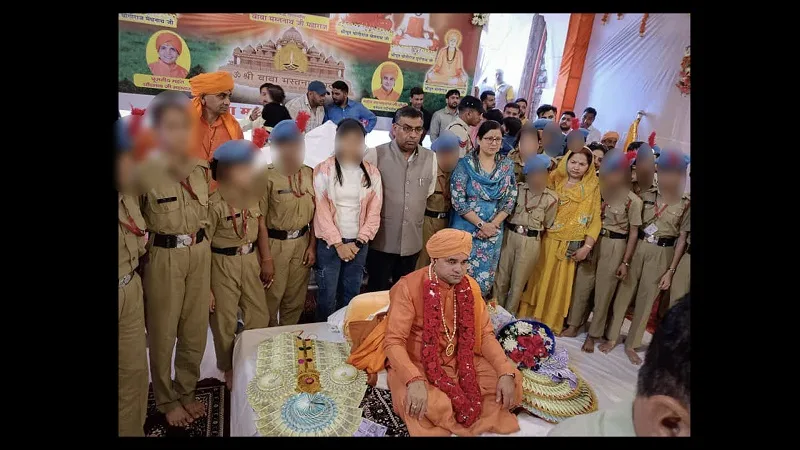
Related Story: Modi destroyed the Indian Army
Critics of the scheme allege that it disproportionately benefits recruits from institutions associated with the RSS. They note that Prime Minister Narendra Modi’s government expanded military-style training initiatives in schools affiliated with Vidya Bharati, the educational wing of the RSS. Vidya Bharati oversees approximately 12,000 schools serving millions of students across India. Some retired Indian military officers have claimed that graduates of these institutions receive preference in Agniveer recruitment, although the government rejects such allegations.
The story does not end here, and the controversy extends beyond the Agnipath scheme.
In April 2024, Indian media platform The Reporters’ Collective published an investigative report examining the growing role of RSS-linked organisations in India’s military educational system.
The report alleged that Sainik Schools, which operate under the guidance of the Ministry of Defence and serve as an important pathway into the armed forces, were increasingly being transferred to organisations and individuals associated with the RSS under a Public-Private Partnership (PPP) model.
Journalist Astha Savyasachi reported that hundreds of Memoranda of Agreement (MoAs) had been signed between the Sainik Schools Society (SSS), an autonomous body under the Ministry of Defence, and private entities seeking to operate Sainik Schools. Astha Savyasachi is an investigative journalist. Her reporting has appeared in leading publications, including Al Jazeera, TRT World, The Wire, The Reporters Collective, and Scroll. Her articles sparked widespread public discourse, including debates in the Indian Parliament.
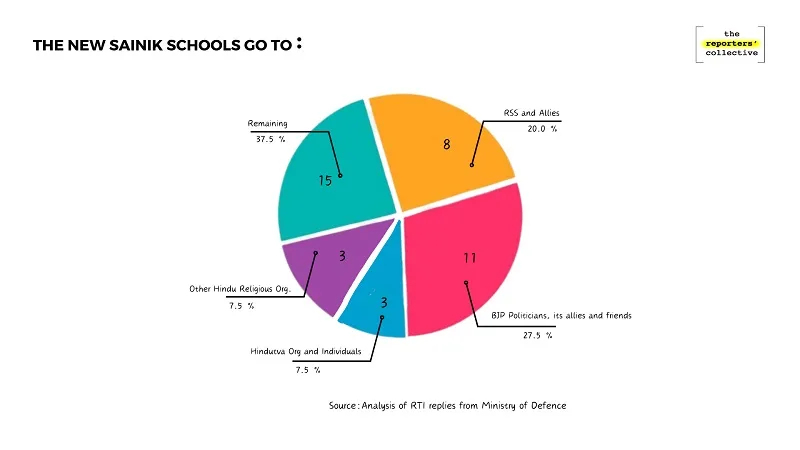
Critics describe this development as a new phase in the saffronisation of India’s educational and military institutions. They argue that introducing organisations affiliated with the Sangh Parivar into military preparatory schools could lead to the infusion of Hindutva ideology into institutions traditionally regarded as secular.
Previously, the autonomous Sainik Schools Society managed 33 Sainik Schools with approximately 16,000 students. Between 25 and 30 percent of these students proceeded to military academies and training institutions. Defence Minister Rajnath Singh stated that Sainik Schools had contributed more than 7,000 officers to India’s armed forces.
Journalist Rashme Sehgal, writing in National Herald India in an article titled “A Sangh Takeover of Our Armed Forces,“ argued that the transfer of Sainik Schools to Sangh-affiliated organisations represented a dangerous shift. According to Sehgal, the move risks introducing Hindutva ideology into military educational institutions that have historically served as feeder schools for the armed forces.
Related Story: A Sangh takeover of our armed forces
In 2021, the Indian government opened the door for private entities to operate Sainik Schools. The Union Budget announced plans to establish 100 new Sainik Schools across the country.
Under the new framework, any school meeting specified infrastructure requirements—including land, buildings, information technology facilities, financial resources, and staffing standards—could apply for approval. Critics argue that the criteria focused almost exclusively on infrastructure and did not adequately consider ideological affiliations, thereby enabling organisations linked to the Sangh Parivar to participate.
This marked the first time private institutions were permitted to affiliate with the Sainik Schools Society, receive financial support, and operate Sainik School branches. On October 12, 2021, Prime Minister Narendra Modi chaired a Cabinet meeting that approved the proposal, describing the new schools as a separate and distinct vertical from the existing Ministry of Defence-run Sainik Schools.
According to information compiled from government press releases and Right to Information (RTI) responses, The Reporters’ Collective concluded that, as of 2024, a significant proportion of approved Sainik School agreements involved institutions linked to the RSS, BJP politicians, their allies, Hindutva organisations, and Hindu religious trusts.
The policy provides financial assistance through the Sainik Schools Society, including annual fee support for eligible students and grants linked to academic performance. Critics argue that public funds are therefore supporting institutions with strong ideological affiliations.
The question of who will run the new Sainik Schools remains central to the debate.
Before the policy change, the Sainik Schools Society oversaw 33 schools housing approximately 16,000 cadets. Multiple parliamentary and government reports have highlighted the role of these institutions in preparing students for admission to the National Defence Academy (NDA), Indian Naval Academy, and other military training establishments.
According to RTI responses cited in 2024, at least 40 schools signed agreements with the Sainik Schools Society between May 2022 and December 2023. The Reporters’ Collective reported that several of these schools were owned by BJP politicians, managed by trusts chaired by BJP leaders, operated by RSS-affiliated organisations, or linked to Hindutva groups and Hindu religious institutions.
The report further noted that none of the approved schools were operated by Christian, Muslim, or other religious minority organisations. It should be noted that these figures reflected the situation as reported in April 2024.
According to the investigation, many of the newly approved Sainik Schools across states ranging from Gujarat to Arunachal Pradesh involved direct participation by BJP leaders or trusts associated with them.
The report also cited cases in which Sainik School affiliations were granted to institutions linked to RSS and BJP figures, as well as to organisations associated with major business groups perceived to be close to the ruling party.
The investigation further stated that several Hindu religious trusts, including some founded by prominent Hindutva activists, received approval to operate Sainik Schools. Among the examples cited were institutions associated with Sadhvi Ritambhara, a controversial figure known for speeches made during the Ram Janmabhoomi movement that preceded the demolition of the Babri Masjid in December 1992.
Historian Tanika Sarkar described Ritambhara’s speeches as a powerful factor in mobilising anti-Muslim sentiment during that period. The Liberhan Commission, which investigated the Babri Masjid demolition, named Ritambhara among individuals whose actions contributed to communal tensions. She continues to hold influence within the Sangh Parivar and maintains close ties with several BJP leaders.
The above-mentioned information confirms that Saffronisation of the Indian Army continues as Lt Gen Dhiraj Seth is appointed New Army Chief and India no more has an Indian Army rather a RSS militia that would work only for RSS extremist policies.

