
Monitoring Desk: Prime Minister Muhammad Shehbaz Sharif has reaffirmed his resolve to eradicate poverty and unemployment from the country, free Pakistan from debt, and uproot terrorism completely. He said that national unity and solidarity are needed today more than ever before. Terrorism has once again raised its head in the country; there is an unholy nexus between the Khawarij, the TTP, and the TTA, and they are being provided resources through Pakistan’s enemies.
He declared that terrorism would be lifted from Pakistan’s borders and drowned in the Indian Ocean. He emphasized that followers of all religions have the full right to worship and celebrate their festivals according to their beliefs. Allah Almighty has blessed Pakistan with resources that few countries in the world possess; if these resources are utilized properly, all of our problems can be resolved. He said that in Ma‘raka-e-Haq, the Armed Forces of Pakistan taught the enemy a lesson it will never forget.
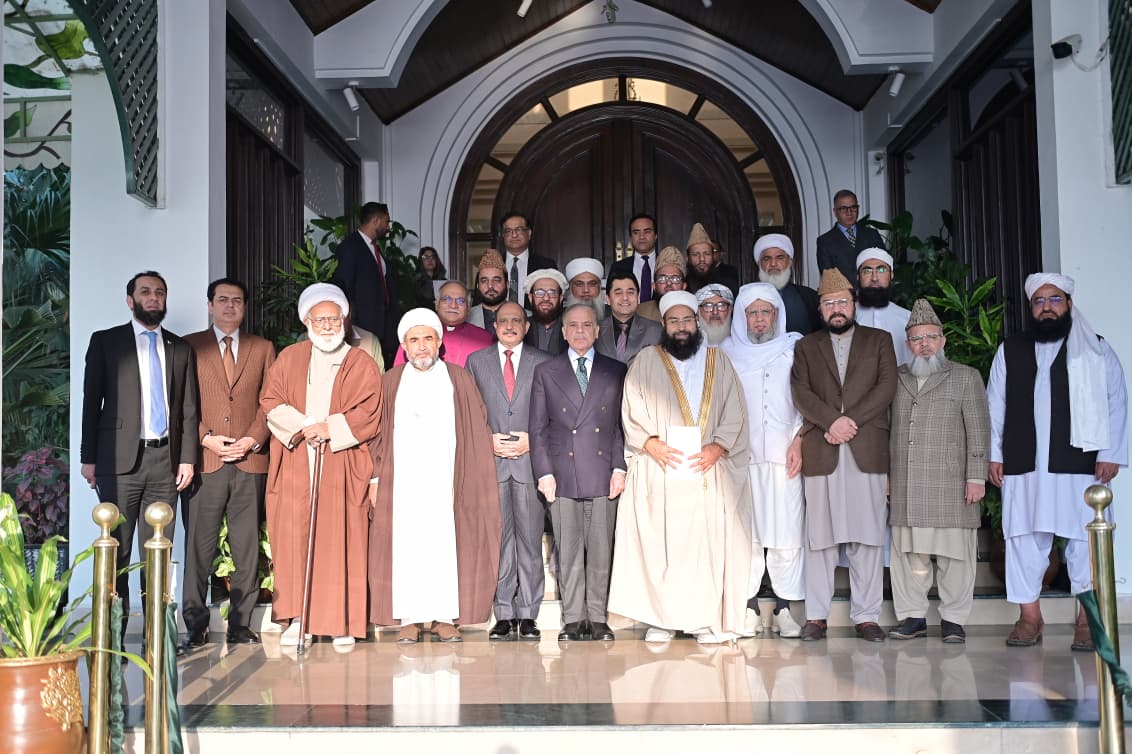
He expressed these views on Friday while speaking to members of the National Peace Message Committee here. On the occasion, Federal Minister for Information and Broadcasting Attaullah Tarar, Minister of State for Interior Talal Chaudhry, and other officials were also present.
The Prime Minister warmly welcomed the members of the National Peace Message Committee, saying it was highly encouraging that the committee was about to play a role that is critically needed at this time. He said that the Islamic Republic of Pakistan came into being as a result of the great struggle led by the Founder of Pakistan, Quaid-e-Azam Muhammad Ali Jinnah, after the sacrifices of millions of Muslims. In the Pakistan Movement, millions of Muslims from all walks of life, along with members of minority communities, played a vital role. He highlighted the services of Cecil Chaudhry, former Supreme Court Judge Rana Bhagwandas, and other members of minority communities in Pakistan’s development and prosperity.
He said the objective of creating Pakistan was to establish a region where Islamic values would prevail, while ensuring that followers of all religions in Pakistan enjoy the right to worship and celebrate their festivals freely. Every Pakistani, he added, has the right to progress and earn a respectable place in society through hard work and competence.
The Prime Minister stated that Pakistan is today moving steadily toward progress and prosperity. Religious scholars also played a very important role in the creation of Pakistan. Allah Almighty has endowed Pakistan with immense natural resources—worth trillions of dollars—which, if properly utilized, can resolve all national challenges. He said Pakistan would be transformed into a true welfare state; the country must break free from debt and eliminate poverty and unemployment. Though this task is difficult, it is not impossible, and it requires adopting the principles and path for which Pakistan was created.
Referring to Ma‘raka-e-Haq in May 2025, the Prime Minister said the Armed Forces of Pakistan inflicted a decisive defeat on India and taught it a lesson it will never forget. This victory, he said, was the result of Allah Almighty’s help and blessings, the courage, highest-level training, advanced technology of the Armed Forces, and the prayers of 240 million Pakistanis. Under the leadership of Field Marshal Syed Asim Munir, Allah Almighty granted Pakistan victory, for which no amount of gratitude is sufficient.
He said that terrorism is the biggest challenge today. In the war against terrorism, around 100,000 Pakistanis have been martyred, including civilians—mothers, sisters, children, doctors, engineers, traders—as well as people from all four provinces. They watered the soil of the nation with their blood. Thousands of officers and personnel of the Pakistan Armed Forces, police, Rangers, and other law-enforcement agencies have also embraced martyrdom. Through their sacrifices, they not only curbed terrorism in Pakistan but also protected other countries. Terrorism has once again re-emerged; there is a nexus of the Khawarij, TTP, and TTA, and they are being supplied with all kinds of resources by Pakistan’s enemies. Just as terrorism was completely eliminated in 2018, he expressed full confidence that it would be crushed again, and terrorism would be driven out of Pakistan and drowned in the Indian Ocean.
The Prime Minister said that the National Peace Message Committee comprises religious scholars from all schools of thought. He prayed for the committee’s success and urged it to spread Islam’s noble and elevated message across the provinces, advancing matters with wisdom, insight, patience, and tolerance. Issues must be resolved through dialogue and collective consultation.
Convener of the National Peace Message Committee, Maulana Tahir Ashrafi, said they would strive to live up to the confidence expressed by the Prime Minister. After a detailed meeting with the Governor of Khyber Pakhtunkhwa in Peshawar, it was decided to convene a two-day conference of religious scholars and spiritual leaders from across the province, where decisions would be made through consultation and all concerns addressed. Committee members will visit all areas of the province, spend time with Pakistan Army soldiers and security institutions, and play a frontline role in the battle of narratives.
He said that the stance of Prime Minister Muhammad Shehbaz Sharif and Field Marshal Syed Asim Munir is clear: Pakistan’s peace is dearer than anything else. Eleven out of fifteen boards of madrasas are represented in the committee. Given the circumstances in which the Peace Message Committee was formed, it is believed it will strengthen efforts for peace in Pakistan. The role of scholars and thinkers is of immense importance; scholars are strengthening the ideological front. He recalled that the Pakistan Muslim League (N) government had launched Paigham-e-Pakistan in 2018, which is now being carried forward. He expressed hope that efforts to establish peace would succeed. Minority communities have also been given representation in the National Peace Message Committee.
Jamia Rasheed’s Mohtamim, Maulana Mufti Abdul Rahim, said that a strong national narrative from the state and government must reach the people, and all forms of facilitation—whether political, religious, or educational—that aid extremism must be eliminated. Removing doubts and misconceptions is essential, and the Peace Committee will carry the message of peace everywhere.
Allama Arif Hussain Wahidi said the formation of the committee is of great importance for spreading the message of peace and love. Pakistan is a gift from Allah Almighty, and mischief-makers and negative-minded elements will never be able to harm it. The Khawarij have no connection with Islam nor are they well-wishers of Pakistan; they are destroying the country’s peace and playing into the hands of the enemy. He said all efforts are being made collectively for Muslim unity, and together they will stand against all internal and external conspiracies, supporting the government to make Pakistan a cradle of peace.
Allama Muhammad Hussain Akbar said the committee would work vigorously to foil the conspiracies of Fitna al-Khawarij and Fitna al-Hindustan. The committee includes representatives of all religions and is a symbol of national unity. He suggested that Paigham-e-Pakistan should be made part of the curriculum.
Allama Syed Ziaullah Shah Bukhari said Pakistan is currently standing at one of the highest points in its history. The political and military leadership share a unified stance on national development, and a clear message has been conveyed that Pakistan’s religious scholars stand with the government to rid the country of terrorism.
Allama Raghib Naeemi said religious scholars view the sacrifices of the Pakistan Army with great respect and will support the government in establishing peace and promoting national unity.
Maulana Zubair Faheem said that when political, religious, and military leadership work together, the country will become a cradle of peace.
Mufti Muhammad Yusuf Khan said Allah Almighty has granted Pakistan great successes in Ma‘raka-e-Haq, and the National Peace Message Committee will fulfill its responsibilities.
Allama Muhammad Asif Akbar said the biggest challenge today is confronting ideological terrorism. Religious scholars stand shoulder to shoulder with political and military leadership for Pakistan’s peace, and Paigham-e-Pakistan is being taught as part of the curriculum in madrasas.
Maulana Muhammad Adil Attari said they stand united with the Prime Minister and will support the government in eradicating terrorism. After Ma‘raka-e-Haq, Pakistan’s stature in the world has risen, and the establishment of the Peace Committee has discouraged extremist elements.
Representing the Hindu community, Rajesh Kumar said the Hindu community in Pakistan is living with happiness and prosperity and pledged that they would spare no sacrifice to protect the motherland and promote tolerance, peace, and harmony. The Hindu community stands with the Pakistan Armed Forces for national defense and with the government to make Pakistan a cradle of peace.
Representing the Christian community, Bishop Azad Marshall said they would succeed in shaping a narrative that spreads the message of peace.
Maulana Tayyab Panj Piri said the Prime Minister has played an important role in the country’s economic development, and they stand with him in efforts for peace.
Maulana Muhammad Taqeer Abbas said religious scholars stand with the government to safeguard national security. Security institutions are protecting the country’s physical borders, while safeguarding ideological borders is the responsibility of scholars. This committee will protect ideological frontiers and thwart elements spreading terrorism.
Director General Religious Education Dr. Ghulam Qamar said there are 36,000 madrasas in the country. Along with religious education, registered madrasas also provide modern education, technical and vocational training so that students can access good employment opportunities after graduation. Teachers are also being trained along modern lines. He rejected propaganda suggesting that the Dars-e-Nizami curriculum is being undermined, stating that neither is this being done nor will it be done in the future.

