
By Agha Iqrar Haroon
The 272nd Corps Commanders’ Conference (CCC) was held on Wednesday at General Headquarters (GHQ), Rawalpindi, presided over by Field Marshal Syed Asim Munir, Chief of Army Staff (COAS). The conference observed that the existing nexus between terrorism and crime with vested political patronage is gravely hurting the interests of the state and the security of its people, and will not be allowed to continue any longer, come what may.
The word ‘crime’ also carries economic connotations such as smuggling and economic terrorism. The history of criminology indicates that terrorism has been globally sponsored and funded by illegal businesses such as smuggling, abduction for ransom, gun running, extortion, prostitution, and illegal occupation of property (Qabza). Domestic media have been reporting for the last 10 years that qabza groups and property cartels, including owners of known housing societies across the country, particularly in Rawalpindi and Islamabad, maintain armies of armed Afghans equipped with the latest weapons. They freely roam around in their SUVs, seizing lands from powerless citizens, while civil administration and security agencies are well aware of their activities. The land mafia not only hires Afghans but also provides chanda (charity) and protection money to cartels that are components of the TTP (officially called as Fitna al Khawarij) and other extremist or radical groups. These are known facts, not mere news. It has also been reported that the mushroom growth of religious schools in the past was linked to such chanda coming from cartels. A top land mafia developer was once one of the biggest fund providers to Lal Masjid, Islamabad; an entity that has long been involved in hate-mongering against the Pakistan Army. Yet such activities have not been fully purged.
The second most critical issue is the political patronage of terrorists, which is also widely known. PTI, which has been heading the Khyber Pakhtunkhwa (KP) government for years, has openly supports terrorists and frequently creates hurdles whenever the state takes action against radicals, extremists, and militants. Some religious parties have also been openly supporting the TTP (officially called as Fitna al Khawarij) and other terrorist groups, both in the past and even now, maintaining links with them. Rarely do these religious or politico-religious parties (mostly based in Balochistan and KP) condemn terrorist attacks or honour the sacrifices of security personnel. However, they start protesting whenever security forces take action in areas such as Bajaur and demand Jirgas before such operations. These Jirgas often provide terrorists the time and resources to regroup and enhance their weapon stockpiles.
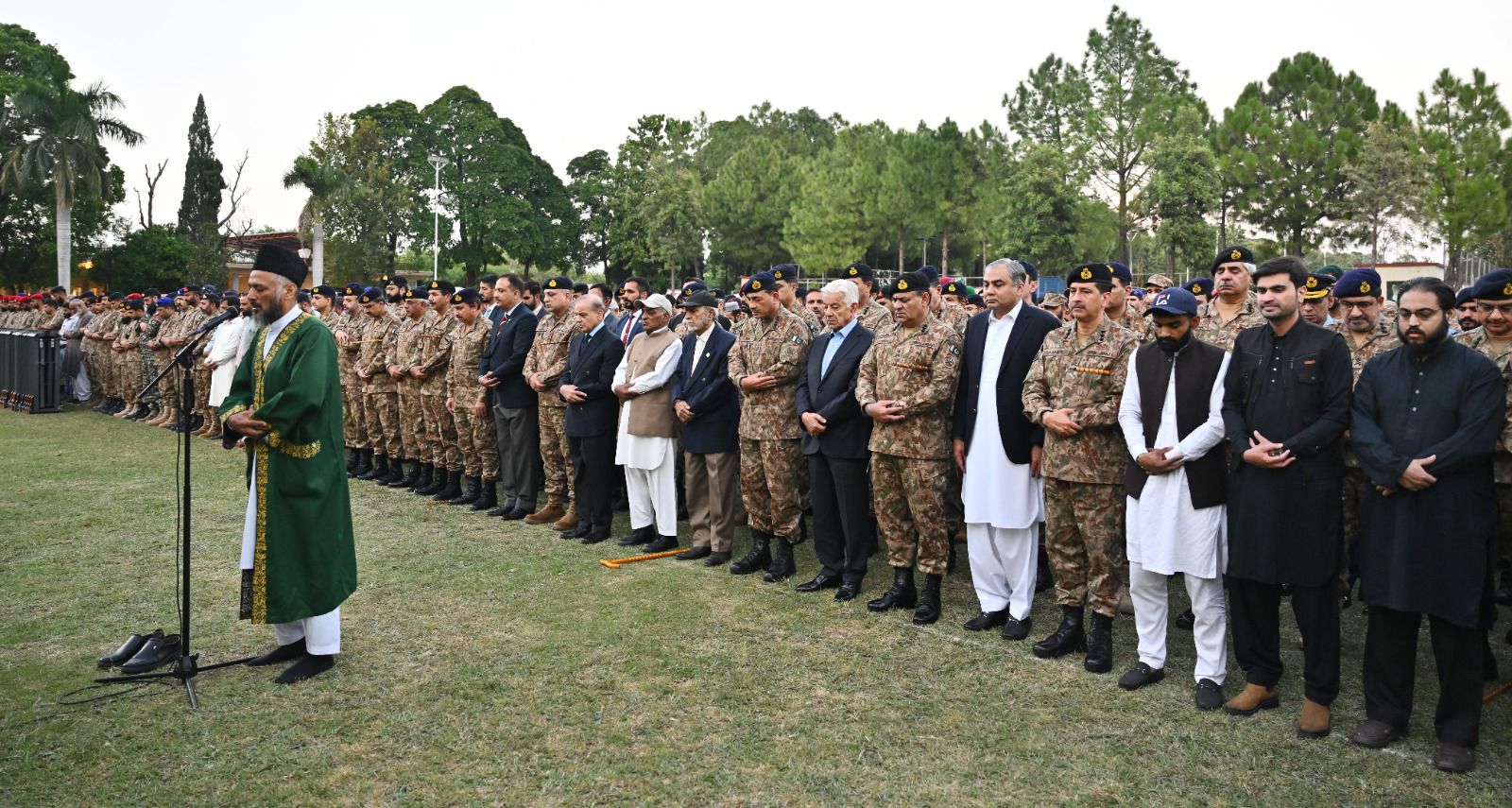
Prime Minister of Pakistan, Muhammad Shehbaz Sharif, Field Marshal Syed Asim Munir, Chief of Army Staff, Federal Ministers, military and civil officers and public attended the funeral.
There are multiple reasons behind the overt support of politicians and political parties for terrorists: fear of being targeted, preservation of their vote banks, and the financial benefits derived from the grey economy linked with terrorism. The Afghanistan Transit Trade Agreement (ATTA) serves as a major vehicle for such activities. Not only politicians but also bureaucrats benefit from ATTA, which provides official cover for large-scale smuggling, estimated at around Rs 3,600 billion annually. Businessmen, industrialists and traders always raise concerns about the abuse of ATTA. However, successive governments in Pakistan have paid little attention to their concerns over massive losses caused by ATTA abuse. They had been suggesting denying transit access to industrial inputs for which there is no manufacturing capacity in Afghanistan and, for those products where such capacity exists, allowing only quantities proportional to a verified record of production.
According to published reports, illegal business through the Pak-Afghan border amounts to over Rs 10–12 billion per day. Taking Rs 10 billion as a conservative estimate, monthly smuggling reaches Rs 300 billion and annually exceeds Rs 3,600 billion. These figures likely underestimate the real volume of this shadow economy, as they exclude narcotics, household items, and weapon smuggling. A retired Customs Department official confirmed that the estimated figure of Rs 10 billion per day is not exaggerated. He noted that Pakistan uses about 1.4 million tires per year, of which only 15 percent are officially imported and 10 percent locally manufactured, while the remaining 75 percent enter through illegal channels. Such large-scale smuggling discourages investors and industrialists from expanding local manufacturing. Smugglers make Rs 13,000–15,000 per tire, earning over Rs 19.2 billion annually just from tire smuggling.
Non-custom-paid (NCP) vehicles—estimated at over 800,000 with engine power above 1,500cc—are plying the roads of KP and Balochistan. Each vehicle with less than 1,500cc engine capacity costs about Rs 2.5 million less than a custom-paid equivalent. It is evident that mafias running a Rs 10 billion per day business would never want a stable or peaceful Pak-Afghan border. They prefer to keep security forces engaged in combat with terrorists to divert attention from smuggling. In September 2023, Pakistan began focusing on controlling the smuggling of petrol, cooking oil, edibles, US currency, and other items through the Pak-Afghan border. Almost immediately, all major political parties from KP began demanding that smuggling be allowed to continue. Since then, attacks on security forces have intensified, making the situation increasingly critical. Since the Afghan Jihad of the 1980s, smuggling and terrorism have been bleeding Pakistan’s economy. Now that state authorities are finally challenging these mafias, the latter are injecting unprecedented sums into politicians, media persons, writers, anchors, and journalists to oppose any measures that could make the Pak-Afghan border a hard boundary. Given their massive earnings, spending even Rs 1 billion per day to buy bureaucratic, political, or media support is no burden for them. Background discussions with serving and retired officials from law enforcement, customs, anti-narcotics, and immigration agencies reveal that fragmented administrative divisions among multiple departments help smugglers and terrorists alike. Experts suggest that all key departments responsible for controlling smuggling, undocumented border crossings, weapons and narcotics trafficking should be unified under a single authority, similar to models in Eastern Europe and Central Asia. This authority should be empowered to monitor all border control points (airports, seaports, and land crossings) to effectively curb smuggling.
Another grave issue is Afghans living in Pakistan. Pakistan had set a deadline of October 31, 2023, for all illegally residing foreigners to leave the country. However, this deadline has repeatedly been extended due to pressure from certain friendly countries, politicians, international bodies, and civil society organizations.
This scenario gives readers a sense of the multifaceted threats Pakistan faces. The question remains: can a politically divided state fight back against smugglers and their proxies among politicians, NGOs, and journalists?
Empirical evidence suggests that politicians often avoid making unpopular decisions, and their populist choices can wreak havoc on national interests. The PTI government’s decision in early 2022 to invite and resettle terrorists from Afghanistan in KP primarily to safeguard its vote bank in the province and undermined security and strengthened smuggling networks. The challenges are far greater than the state can publicly share. The campaign against Pakistan is planned, funded, and supported by foreign adversaries; particularly by India that is using Afghan soil to destabilize Pakistan. Yet Islamabad cannot sever ties with Kabul, and the Afghan government refuses to acknowledge or act upon credible evidence that its territory is being used for cross-border terrorism against Pakistan. Moreover, certain political figures and parties; especially some religious groups, PTI leaders, and personalities like Mahmood Khan Achakzai and Aimal Wali Khan are seen as promoting Afghanistan’s narrative rather than Pakistan’s.
Disclaimer:
The views and opinions expressed in this article/Opinion/Comment are those of the author and do not necessarily reflect the official policy or position of the DND Thought Center and Dispatch News Desk (DND). Assumptions made within the analysis are not reflective of the position of the DND Thought Center and Dispatch News Desk.

