
By Dr. Shazia Anwer Cheema
“Freedom will never be obtained through crying and lamenting; it will only come through hard work… No nation has ever secured it overnight; a sensible man will not despair, but work even harder,” said Karel Havlicek, who was a politician and writer and a member of the Czech delegation in 1848 which hoped to establish a provisional government for Bohemia under a federal Austria.
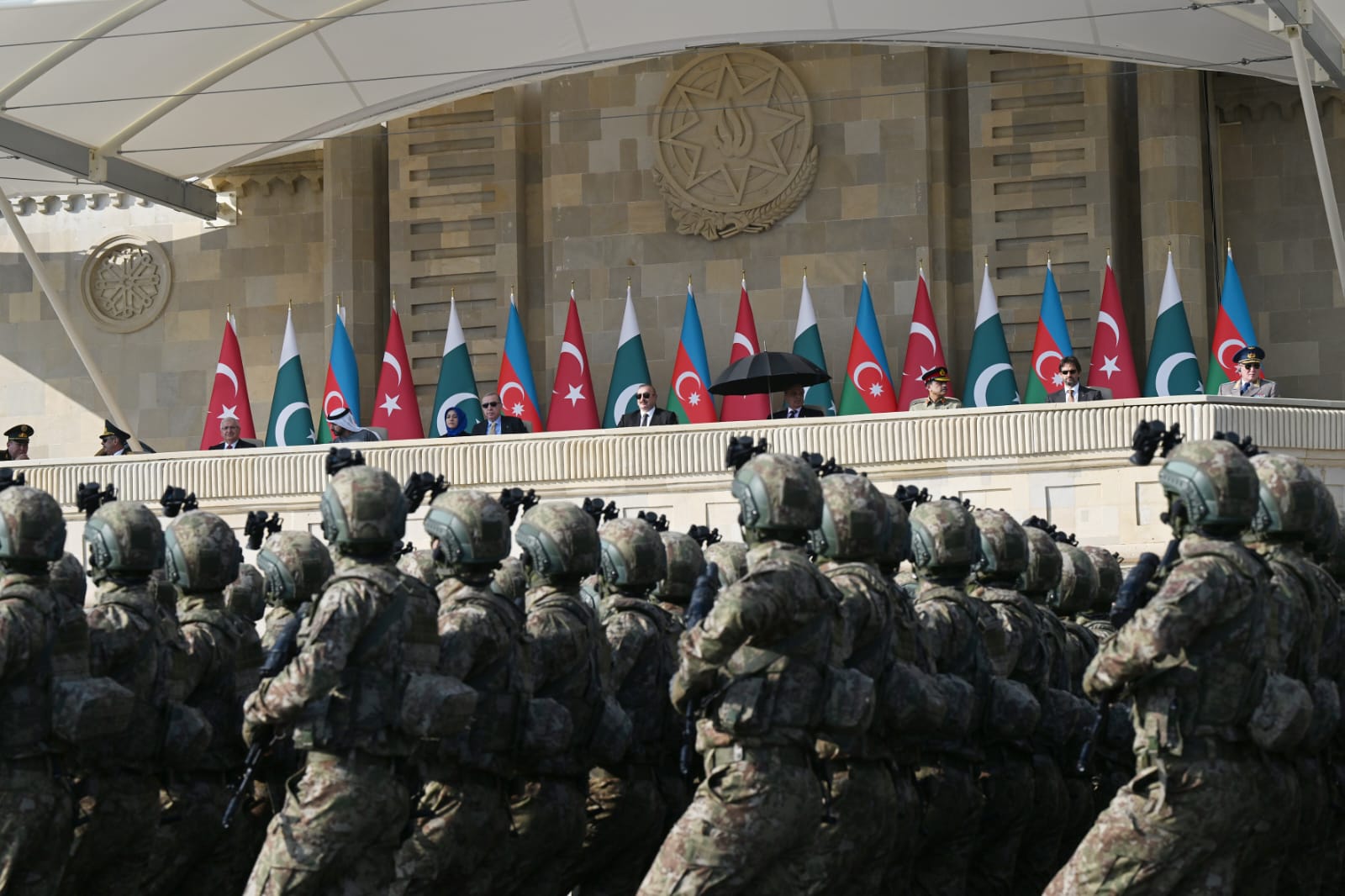
Today Azerbaijan is celebrating the 5th anniversary of “Victory” globally, as the day marks the historic event when Azerbaijan regained control of multiple territories, including Jabrayil, Fuzuli, Zangilan, Gubadli, and Shusha.
Shusha’s capture is regarded as the decisive moment leading to Armenia’s acceptance of the Russian-brokered ceasefire on November 10, 2020. It is pertinent to mention that Azerbaijan’s 2023 military operation in Karabakh (September 19–20) further consolidated full control over the region, ending the illegal occupation of Armenian administration completely.
The Azerbaijani “Victory” (Zəfər) restored territorial control per international law (UN resolutions had recognized these areas as Azerbaijani) and ended nearly 30 years of Armenian illegal occupation over Azerbaijani lands.
This historic victory boosted national pride and military confidence; therefore, “Victory Day,” marked annually on 8 November. This year, it was a huge celebration that included military parades and ceremonies, a special Presidential address, events honoring soldiers and war veterans, cultural exhibitions in liberated cities (especially Shusha), and memorial visits to martyrs’ cemeteries (Şəhidlər Xiyabanı). Pakistan’s Prime Minister Muhammad Shehbaz Sharif also attended events along with several heads of states who arrived in Azerbaijan to celebrate its victory along with President İlham Aliyev.
In the last five years, the President, along with his team, is focusing on reconstruction projects in Karabakh, the return of internally displaced persons (IDPs), restoration of historical and religious sites, and constructing Shusha as a Cultural Capital. Since its recapture, Shusha has been promoted as the “Cultural Capital of Azerbaijan” and has been hosting major cultural events such as Vaqif Poetry Days, Khari Bulbul Festival, Global Media Forum, etc.
According to available official data, reconstruction and infrastructure development are key themes in the 5th-anniversary narrative.
Azerbaijan’s victories in the military field placed Azerbaijan at a higher global pedestal, and its post-war diplomacy has made Azerbaijan a “conflict resolution hub,” and countries are looking at Baku to help resolve their conflicts. I consider this development as a fruit of the victory of the Patriotic War under the leadership of the Supreme Commander-in-Chief of the Armed Forces of the Republic of Azerbaijan, President İlham Aliyev. During the 3rd Shusha Global Media Forum, the President expressed his view while responding to a question regarding Baku’s role in international mediation in the recent past. He stated that Azerbaijan in the past was focused on resolving the Karabakh conflict that kept Baku busy in the endless negotiations, so it had no time, and even did not have the potential, to focus on other matters. He stated that Azerbaijan’s foreign policy was aimed at the restoration of territorial integrity, and now that it had been accomplished, Azerbaijan has become much more active on the international stage.
Recently, I was invited to share my opinion about what changes took place and would take place in the Caucasus after the Azerbaijani victory, my answer was that Azerbaijan’s victory in the Second Karabakh War ended three decades of occupation and paved the way for an era of peace, energy cooperation, and regional integration, and Armenia can get benefit out of these dividends if Yerevan will behave decently. For example, the Zangezur Corridor project has the potential to be a key element of the new architecture of the South Caucasus. The corridor will connect Azerbaijan’s mainland with the Nakhchivan Autonomous Republic, Türkiye, and Europe, becoming a strategic transport and energy artery between the Caspian and Mediterranean seas, and Armenia now should choose the path of cooperation instead of a troublemaker to get fruit of such initiatives.
To my understanding, Azerbaijan’s victory was not only a military success but also the beginning of a new era in the region where Armenia can behave as a partner, not as an adversary.
The Zangezur Corridor is a proposed transport route connecting Azerbaijan’s mainland with its Nakhchivan exclave by passing through Armenia’s Syunik Province. Backed by Azerbaijan and Turkey, it is seen by its proponents as a major infrastructure project that would boost regional connectivity and trade. However, it is strongly opposed by Iran due to concerns over sovereignty and economic implications. The project aims to create a direct land link between mainland Azerbaijan and Nakhchivan through Armenia. It is envisioned as a multimodal artery for trade, energy, and data.
In my opinion, it represents another victory for Azerbaijan following the liberation of Karabakh. Under President Ilham Aliyev’s leadership—marked by immense strategic patience—Azerbaijan has achieved a resolution to a long-standing dispute. Armenia’s agreement to become part of this futuristic project is a clear sign of Azerbaijan’s diplomatic success. Since the project is fundamentally about trade, connectivity, and commerce, neither Azerbaijan nor Türkiye can materialize this proposal until hostility from every direction is eliminated. By “eliminated,” I mean that this project could be a winning opportunity for all neighbors to become partners in a venture that could open pathways. The future of the Global South does not lie in border skirmishes or in sabotaging economic development through political or national resentments. Such conflicts only create a vacuum for hostile non-state actors, serving as proxies for short-term interests.
Therefore, I do not foresee any deadlock in the region that needs to be resolved militarily or through proxy militias. The region has a clear understanding of the motives of the Global North. In this case, the optics may suggest the involvement of numerous external actors, but the real stakeholders remain those whose borders are directly connected. That connection is the prerequisite for their shared future. And that is the reality of our time.
 Dr. Shazia Anwer Cheema is a foreign affairs expert, cognitive semiotician, author, and columnist who earned her PhD in the Philosophy of Communication from Charles University, Prague, Czech Republic.

