
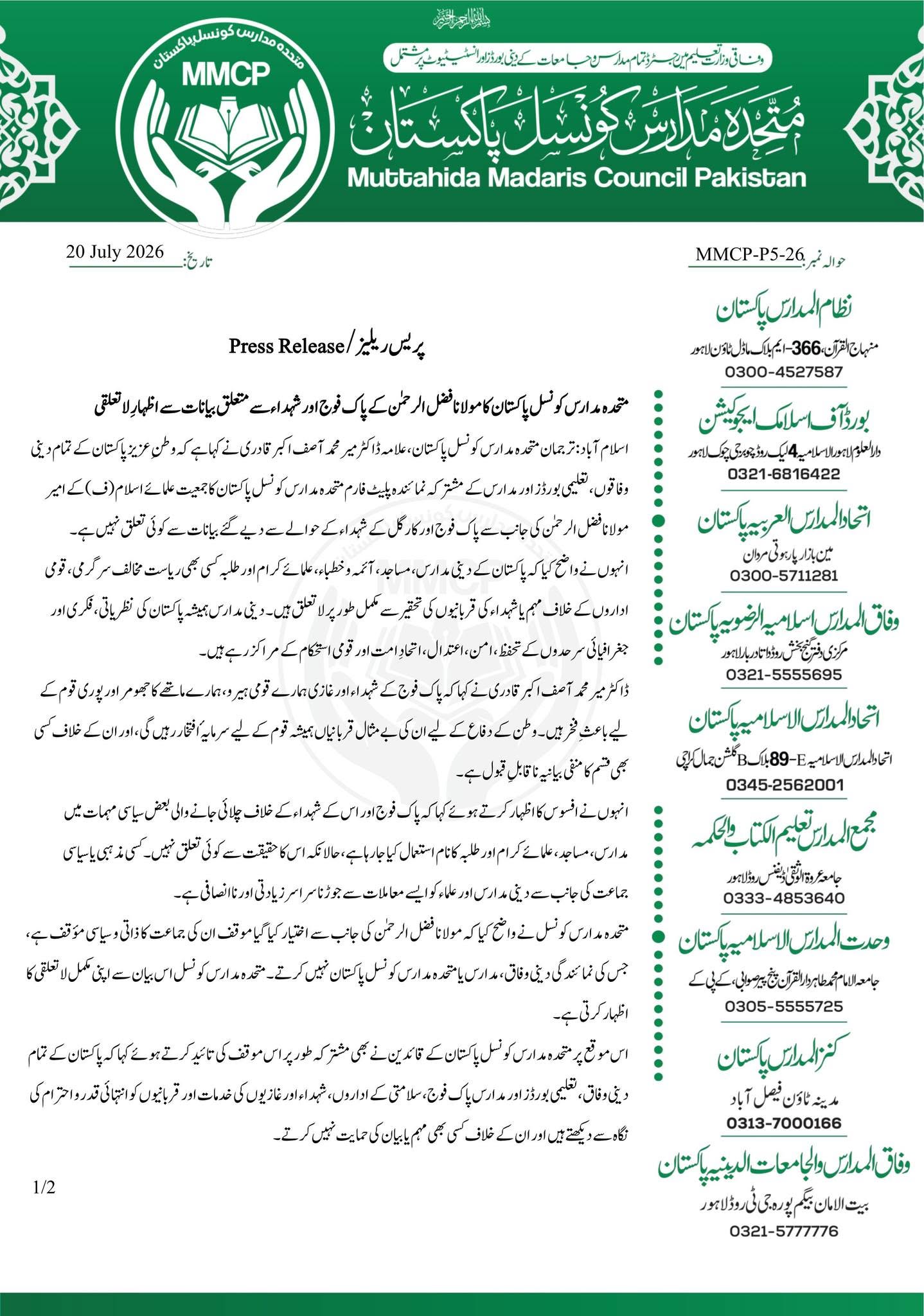
Lahore, Pakistan: Muttahida Madaris Council Pakistan, in a statement, has distanced itself from recent remarks made by Jamiat Ulema-e-Islam (F) chief Fazal ur Rehman regarding the Pakistan Army and the nation’s martyrs.
The spokesperson for Muttahida Madaris Council Pakistan, Allama Dr. Mir Asif Qadri, stated that the council, which serves as the joint representative platform for Pakistan’s religious educational boards (Wafaqs), organizations, and seminaries, has no connection with the statements made by Fazal ur Rehman regarding the Pakistan Army and the country’s martyrs.
He emphasized that Pakistan’s religious seminaries, scholars, and students have always stood with the state. Religious seminaries have consistently played a significant role in safeguarding Pakistan’s ideological, intellectual, and geographical frontiers while promoting peace, moderation, unity, and national stability.
He further stated that the Pakistan Armed Forces and the nation’s martyrs are a source of pride for the entire country. Their sacrifices in defense of the homeland are a matter of national honor, and any derogatory remarks against them are unacceptable.
He added that if any individual issues statements against the Pakistan Army or the nation’s martyrs, such views should not be attributed to Muttahida Madaris Council Pakistan or the country’s religious educational federations.
He reiterated that religious seminaries and scholars have always supported unity, peace, national solidarity, and the rule of the Constitution and the law.
In conclusion, he appealed to all religious educational boards, seminaries, scholars, and students to continue contributing to Pakistan’s unity, stability, and peace.
The signatories stated that religious seminaries are guardians of the ideological foundations of both Islam and Pakistan.
They said that Pakistan’s religious seminaries serve as centers for promoting peace, moderation, unity, and patriotism and have always stood for the country’s security, stability, and progress.
They called upon the government to stop what they described as baseless propaganda against religious seminaries and to recognize and appreciate their positive role in society.
They further stated that religious seminaries and Islamic scholars will continue to play their part in promoting peace and stability throughout the country.
It is pertinent to mention that Muttahida Madaris Council Pakistan has deep roots, particularly in Khyber Pakhtunkhwa (KP) and Balochistan. The organization’s decision to distance itself from Fazal ur Rehman has sent a strong message to religious scholars and students that he is serving neither the interests of the country nor those of Pakistan’s religious educational boards (Wafaqs). According to this view, the time has come to leave him isolated in what they describe as his designs to create anarchy in the country.
In Pakistan, an estimated 35,000 to 40,000 registered and unregistered religious seminaries (Deeni Madaris) operate. These institutions are affiliated with the five major religious educational boards (Wafaqs) that function under the umbrella of Ittehad-e-Tanzeemat-e-Madaris Pakistan (ITMP). To integrate these institutions into the formal education system, the Government of Pakistan established the Directorate General of Religious Education (DGRE). Through this initiative, the state has formally registered more than 5,000 seminaries to standardize the curriculum while bridging the gap between religious and modern education.
More than 65 percent of religious educational institutions are affiliated with Wifaq-ul-Madaris Al-Arabia, which, according to an article, is still not fully complying with certain government regulations. The article further states that this board is associated with JUI-F and JUI-S.
In the past, Muttahida Madaris Council Pakistan also expressed dissatisfaction, stating that its affiliated religious institutions were already registering themselves under the 2024 religious education laws, while seminaries run by JUI were not fully complying with government instructions. The council further alleged that, because of its close ties with the government, Wifaq-ul-Madaris Al-Arabia considers itself above the law of the land.
Muttahida Madaris Council Pakistan has maintained that it has consistently followed the regulations governing religious schools in the country. According to the article, distancing itself from Fazal ur Rehman could provide the council with an opportunity to receive equal treatment from the government rather than seeing preference given only to Wifaq-ul-Madaris Al-Arabia.

