
Monitoring Desk:
Now Bangladesh has joined the long list of countries that have shown concerns and raise warnings that Afghan Taliban regime in promoting terrorism, radical thoughts and they have again become a threat for global peace.
The return of the Afghan Taliban under the Doha Peace Accord was presented as a transition toward moderation an assurance of inclusive governance, respect for human rights, and a commitment that Afghan soil would not be used for terrorism. Nearly five years on, that promise stands widely questioned.
A growing list of countries including the United States, United Kingdom, European Union, Russia, China, Iran, Pakistan, Canada, Australia, and now Bangladesh has raised serious concerns about the Taliban’s policies. These concerns converge around three core issues: terrorism, systematic suppression of women, and the marginalization of minorities.
At the same time, internal pressures are mounting and belly of Pushtun population living both sides of Pak-Afghan border has been hit due to closure of business activities such as trans-border trade between Pakistan and “Afghanistan. Economic decline worsened by the closure of the Pakistan-Afghanistan border has severely impacted trade and livelihoods, particularly among Pashtun communities on both sides, commented a senior journalist from Peshawar with the condition of not citing her name in the news. She believes that this situation has begun to erode traditional support bases, exposing the regime to both economic and social strain.
The international community’s concerns are not abstract they are grounded in repeated, explicit warnings:
The U.S. has warned that Afghanistan must not again become a “safe haven for terrorist organizations,” particularly after the killing of Al-Qaeda leader Ayman al-Zawahiri in Kabul in 2022.
On women’s rights, Secretary of State Antony Blinken stated:
“The Taliban’s actions toward women and girls are unconscionable and place them outside the international community.”
The UK has described Taliban policies as “institutionalized discrimination against women and girls.”
At the United Nations, it stated:
“No country can prosper while erasing half its population from public life.”
The EU has called the situation a “severe violation of fundamental rights,” emphasizing inclusive governance.
It noted:
“The situation of women and girls in Afghanistan is one of the worst human rights crises in the world.”
Russia has warned of extremist spillover, particularly ISIS-K.
Officials noted:
“The threat of terrorism emanating from Afghanistan remains serious.”
China has urged the Taliban to sever ties with militant groups, especially ETIM:
“Afghanistan should not become a gathering place for terrorist organizations.”
Iran has raised concerns over the treatment of Shia Muslims, especially Hazaras:
“The rights of all ethnic and religious groups must be respected.”
Pakistan has consistently warned against the use of Afghan soil by TTP:
“Afghan soil must not be used against Pakistan.”
It has also highlighted a rise in cross-border attacks.
The UN has described Taliban policies toward women as:
“Unprecedented, systematic, and institutionalized discrimination.”
It has also warned:
“Terrorist groups continue to operate in Afghanistan under Taliban rule.”
Canada has condemned Taliban rule as “gross violations of human rights,” stating:
“The Taliban’s actions have erased decades of progress for women and girls.”
Australia has termed Taliban policies “gender-based persecution” and supports accountability under international law.
Recent commentary from Bangladeshi media reflects similar concerns. According to The Muslim Times, Afghanistan has once again become a safe haven for terrorist groups affecting regional stability, particularly in South and Central Asia. The publication also highlights that diplomatic efforts by regional actors failed due to the Taliban’s non-cooperative posture, forcing countries like Pakistan to take security measures.
Experts increasingly argue that cross-border attacks from Afghan soil demonstrate the persistence of an enabling environment for militant groups. Pakistan’s security operations targeting terrorist hideouts have reportedly reduced infiltration, yet the broader concern remains unresolved: the Taliban’s unwillingness to fully sever ties with such networks.
Meanwhile, the economic fallout is becoming harder to ignore. The closure of key trade routes, especially along the Pakistan-Afghanistan border, has intensified hardship. Alternative trade corridors are proving economically unviable, while internal resistance groups such as the National Resistance Front are gradually gaining momentum. This combination of economic stress and political fragmentation is steadily weakening the regime’s control.
Frustration is also rising among Pashtun populations, whose cross-border social and economic ties have been disrupted. What was once a natural support base is now showing visible signs of discontent.
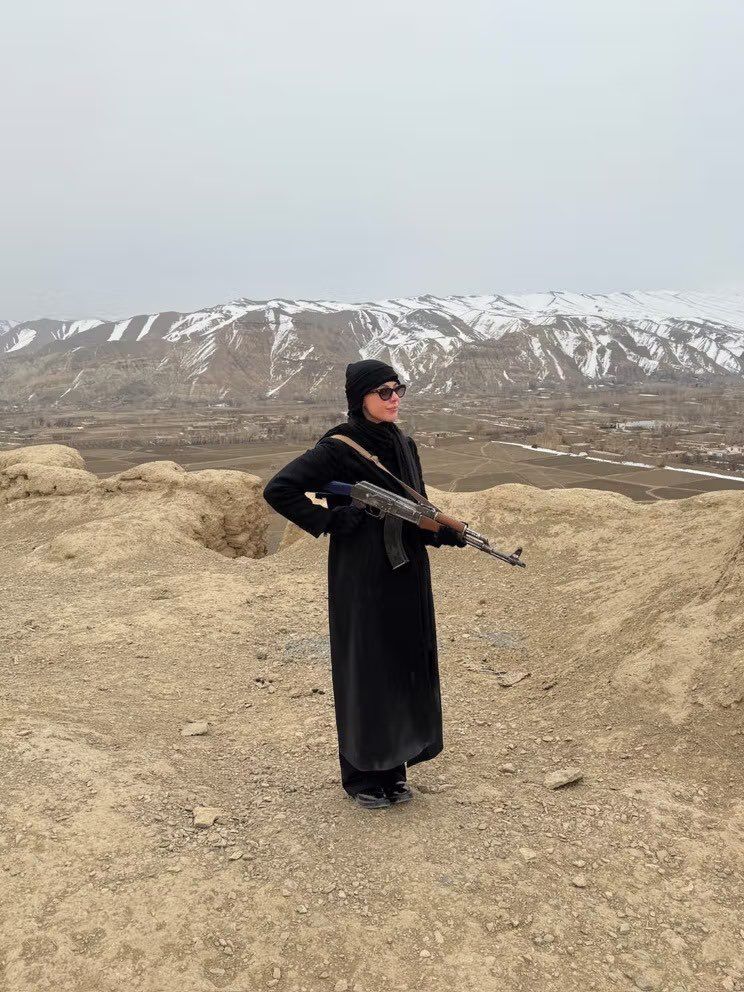
Despite early claims of adhering to Islamic norms and modern governance principles, the Taliban’s actions continue to generate contradictions that undermine their credibility internationally. One of the examples has been cited by experts that US porn star Whitney Wright received state protocol from Afghan Taliban on her visit to Kabul. The gap between commitments made in Doha and present-day realities has become the central issue shaping global perception.
A retired diplomat who served in United Nations while talking to DND News Agency said:
There is now a broad international consensus even among countries maintaining diplomatic engagement that three conditions remain non-negotiable:
- Afghanistan must not serve as a hub for terrorism
- Women’s fundamental rights must be restored
- Minority protections and inclusive governance must be ensured
Until these benchmarks are met, the Afghan Taliban will remain under sustained global scrutiny. What was once framed as a new beginning is increasingly viewed as a continuation of old patterns—only now with deeper regional and international consequences.

