
Islamabad, Pakistan: For over two decades, Pakistan has been engaged in a war against terrorism, a struggle in which both the state and its people have made immense sacrifices. Now every passing day, Pakistan is achieving successes by busting and exposing Afghan Taliban linked terror networks.
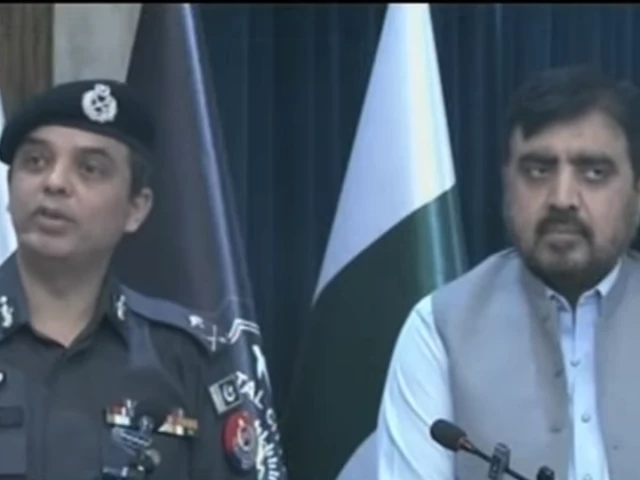
On November 11, during a press briefing, Additional Inspector General (Police) Khyber Pakhtunkhwa Abbas Ahsan and Information Secretary of the Area Development Secretariat (ADS) Mahmood Jan Babar revealed startling details regarding the arrest of Hikmatullah, a former Afghan soldier and member of a Khariji (TTP terrorist) group, in the Tirah Valley, as well as cross-border links facilitating terrorism in Pakistan.
On November 7, 2026, security forces apprehended Hikmatullah, an Afghan national and former member of the Afghan National Army (ANA), during an intelligence-based operation in the Tirah Valley. He had undergone three months of general military training followed by three months of commando training in the Afghan Army. He was affiliated with the banned Hafiz Gul Bahadur (TTP) group and had previously served as a personal armed bodyguard to one of its commanders, Mansoor.
According to his confession, Hikmatullah admitted to preparing his protégé, Akrama, for a suicide attack, crossing the border from Afghanistan into the Tirah Valley, and participating in planning an assault on a military outpost. However, security forces took timely action and thwarted his nefarious designs.
The arrest of Hikmatullah provides another example of infiltration and cross-border links originating from Afghanistan to facilitate terrorism inside Pakistan. Another Afghan national, Qari Waqas, alias Quddus, was arrested in Upper Kurram. He reportedly confessed to entering Pakistan specifically to join the Khariji Kazim group.
Similarly, Ahmad, alias Qari Abdullah Abu Zar, a Khariji militant who carried out a suicide attack on Malangi Post in Bajaur on February 16, 2026, hailed from Afghanistan’s Balkh province and had previously served in the Afghan Taliban’s special forces. Eleven security personnel and two civilians were martyred in the attack. Furthermore, evidence has emerged indicating that the bomber responsible for the February 6, 2026 attack in Tarlai, Islamabad, had received terrorist training in Afghanistan.
Evidence has also surfaced linking Afghanistan-based terrorists to attacks on the Islamabad Judicial Complex, the Frontier Corps (FC) Headquarters in Peshawar, and Cadet College Wana, which took place in November 2025.
Niamatullah, a suicide bomber arrested on October 19, 2025, hailed from Kandahar. The attack on Bannu Cantonment on March 4, 2025, was reportedly planned in Afghanistan, and six of the 17 Kharijis involved were Afghan nationals.
Badruddin, alias Yusuf, a Khariji militant killed in Dera Ismail Khan on January 31, 2025, was the son of the deputy governor of Afghanistan’s Badghis province and had served as a trainer at an Afghan Taliban training centre.
Additionally, all three Khariji militants killed on November 3, 2026, in the Sardi Khel area of Bannu, including a commander named Anas, were from Kandahar.
Details of Hikmatullah’s Confession
During the November 11, 2026 press conference, officials screened a recorded confession video in which Hikmatullah, alias Hamza, detailed his military background, militant training activities, and infiltration route into Pakistan.
According to his recorded statement, he made several key admissions:
- Former Military Service: Hikmatullah confirmed that he had served in the former Afghan National Army (ANA). He completed three months of standard military training followed by three months of specialised commando training before the force was dissolved.
- Training Suicide Bombers: After the ANA was disbanded, he allegedly used his military skills at various seminaries (madrasas) in Afghanistan to train recruits and prepare suicide bombers. Officials specifically referred to his activities at the Khalid bin Waleed madrasa near Jalalabad, where he allegedly trained a student named Akrama for a suicide attack.
- Association with the Hafiz Gul Bahadur Group: He admitted to working with the banned Hafiz Gul Bahadur group and serving as a personal bodyguard to one of its commanders, Mansoor.
- Infiltration into Pakistan: Hikmatullah described crossing from Afghanistan into Pakistan and passing through several areas before reaching the outskirts of Peshawar. He also recounted an exchange of fire at a security checkpoint during his infiltration.
- Realisation and Fear: In the video, he stated that he had initially joined the network believing he was participating in jihad but later realised that he was on the wrong path. He also expressed fear that the Afghan Taliban would kill him if they learned that he had made the statement to Pakistani authorities.
Sustained Counterterrorism Operations in Tirah Valley
Throughout 2026, Pakistan’s security forces and Khyber Pakhtunkhwa (KP) Police have maintained sustained counterterrorism pressure in the Tirah Valley of Khyber District, a strategically important mountainous region bordering Afghanistan. Rather than launching a large-scale conventional military offensive, authorities have relied heavily on targeted Intelligence-Based Operations (IBOs) to dismantle militant hideouts and cross-border infiltration networks.
Recent developments and tactical shifts in late 2026 include:
- Joint IBOs and Arrests: Alongside the November 7, 2026 arrest of Afghan militant Hikmatullah, police and security forces have conducted continuous intelligence-led raids. KP Police and the Counter Terrorism Department (CTD) carried out more than 2,000 IBOs across the province during the first half of 2026 alone, neutralising 182 militants and arresting more than 500 suspects.
- Drone and Surveillance Operations: Security operations in Tirah have increasingly incorporated aerial surveillance and precision drone strikes. In mid-October 2026, for instance, KP Police targeted a militant hideout in the valley using a drone, killing four terrorists and injuring three others during a follow-up search operation. Security forces have also deployed anti-drone technology to counter quadcopter attacks by militants.
- Targeted Raids Instead of a Full-Scale Offensive: Federal officials, including Defence Minister Khawaja Asif, have repeatedly maintained that the military is conducting limited, intelligence-driven operations against Tehrik-e-Taliban Pakistan (TTP) and affiliated networks rather than launching a sweeping ground offensive.
Growing Diplomatic Pressure on the Afghan Taliban
The Afghan Taliban are facing growing diplomatic pressure as regional partners increasingly question their claims of non-involvement in cross-border terrorism against Pakistan.
According to available information, Pakistan has established a near-daily intelligence-sharing mechanism to provide countries such as China, Russia, Qatar, Saudi Arabia, and Türkiye with verified information about Afghan-backed terrorists arrested or killed inside Pakistan.
These developments point to the existence of networks, training centres, and links to terrorist leadership allegedly based in Afghanistan that support elements carrying out terrorist activities inside Pakistan.
The State of Pakistan has made it clear that it will not compromise on its sovereignty or national security. Security operations will continue until external elements and their facilitators are eliminated, and every possible measure will be taken to protect the country’s people. Official circles are of the view that in line with the clear policy of the Government of Pakistan, operations are underway against Fitna-ul-Khawarij (the TTP terrorist network) and its facilitators, with all state resources being utilized to eradicate terrorism and unrest from the country.

