
Comment
The Pakistan Tehreek-e-Insaf (PTI) has portrayed the administrative change in Khyber Pakhtunkhwa as a politically motivated move. However, the central question is whether the province’s deteriorating security situation, persistent governance failures, and growing public concerns could be ignored indefinitely in the name of political considerations. The circumstances surrounding this transition point towards a broader imperative: restoring effective governance, strengthening counter-terrorism efforts, and safeguarding Pakistan at a time when the state is fighting hard to eliminate terrorism.
The return of terrorism to Pakistan has become one of the country’s most serious security challenges. The PTI-led government in Islamabad in 2021 pursued a policy of allowing the return and resettlement of TTP terrorists from Afghanistan, a decision that has since become a major reason for resurgence of terrorism. Against this background, the provincial administration’s ability to confront terrorism effectively has assumed critical importance. The issue is no longer merely one of provincial governance or political rivalry; it concerns the security of citizens and the stability of Pakistan.
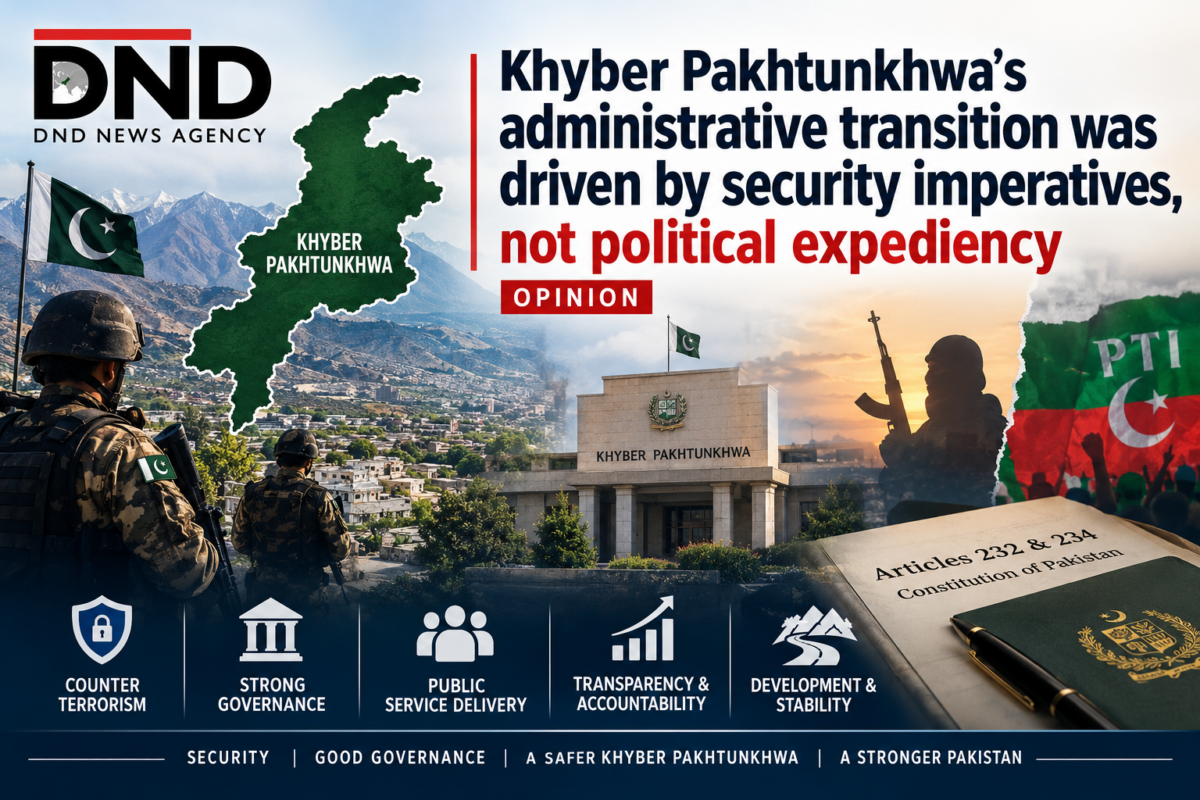
On October 11, the federal government facilitated an administrative transition in Khyber Pakhtunkhwa through a process undertaken under Articles 232 and 234 of the Constitution. The move replaced the existing provincial administrative arrangement with a technocrat-led setup. Given the extraordinary nature of this development, it is essential to understand the circumstances that necessitated such a measure and the responsibilities now confronting the new administration. The precise constitutional basis and procedures governing the transition must, of course, be assessed against the applicable legal provisions and official notifications.
The new administration cannot afford a slow start. Khyber Pakhtunkhwa faces serious challenges involving terrorism, administrative weaknesses, questions of transparency, and public dissatisfaction over service delivery. After years of political confrontation and governance controversies, the province needs an administration that prioritises measurable outcomes over political interests. Its legitimacy and effectiveness will ultimately depend not on the circumstances of its appointment but on its ability to deliver tangible improvements in security, governance, health, education, and other essential public services.
“An equally important challenge is public perception. Counter-terrorism operations cannot achieve their full potential if political narratives undermine public confidence in state institutions or obscure the threat posed by terrorist organisations”
For this reason, clear performance benchmarks, transparent procedures, and effective accountability mechanisms are indispensable. The new setup must be evaluated against verifiable results rather than political declarations. Public money must be spent responsibly, administrative decisions must be open to scrutiny, and the delivery of services must be measured against established standards. Without these safeguards, even a technocrat-led administration risks reproducing the shortcomings it was expected to address.
“Public trust cannot be imposed through official statements; it must be earned through consistent performance, accountability, and the protection of civilian lives”
Counter-terrorism must be the administration’s foremost priority. The police and the Counter-Terrorism Department (CTD) require adequate resources, modern equipment, effective intelligence coordination, and institutional support to confront an evolving security threat. The protection of police personnel and other security officials must also receive urgent attention, particularly in areas where terrorist attacks have placed extraordinary pressure on law-enforcement institutions. Strengthening these institutions is not simply an administrative task; it is a prerequisite for restoring public confidence and ensuring that the state can exercise its authority effectively.
Developments reported during the first 48 hours of the transition have offered some encouraging indications of the direction in which the administration intends to move. These include the Governor’s announcement of measures to enhance police and CTD capacity, special packages and land plots for the families of martyrs, and an effort to bring the provincial government’s position on the war against terrorism into alignment with the state’s official stance. These initiatives must now translate into practical improvements. Announcements alone cannot defeat terrorism; sustained implementation, institutional coordination, and demonstrable results are what matter.
An equally important challenge is public perception. Counter-terrorism operations cannot achieve their full potential if political narratives undermine public confidence in state institutions or obscure the threat posed by terrorist organisations. The administration must therefore communicate clearly with citizens, explain its security policies, counter misinformation with verifiable facts, and demonstrate through its conduct that the fight against terrorism is intended to protect the public. Public trust cannot be imposed through official statements; it must be earned through consistent performance, accountability, and the protection of civilian lives.
The administrative culture inherited by the new setup also requires close examination. Over the past 13 years, successive PTI-led administrations have exercised considerable influence over provincial governance. Concerns have repeatedly been raised about politicisation, corruption, administrative inefficiency, and the use of public institutions to advance partisan interests. Where officials have been found to have prioritised political loyalty over professional responsibilities, corrective action is necessary. However, personnel changes must be based on competence, integrity, and documented performance rather than political affiliation. Replacing one form of political patronage with another would defeat the very purpose of administrative reform.
“The ultimate measure of this transition will not be whether PTI or its political opponents emerge victorious in the debate. It will be whether the people of Khyber Pakhtunkhwa become safer, whether terrorism is effectively countered, and whether the state delivers the governance and public services that citizens have every right to expect”
The new administration must also address longstanding development concerns, particularly in the merged districts. The selection of members for the proposed Area Representative and Development Council is reportedly progressing and is expected to be completed within the next two to three days. Operating under the administrative framework of the Area Development Secretariat and the designated administrator, with the patronage of the Prime Minister, the council is expected to facilitate development decisions and expedite the delivery of relief to local communities. Its effectiveness will depend on clear responsibilities, transparent allocation of funds, meaningful local representation, and a mechanism for monitoring implementation.
The people of the merged districts have endured years of insecurity, disruption, and uneven development. Their needs cannot be addressed through announcements or temporary relief measures alone. Roads, schools, healthcare facilities, employment opportunities, and functioning local institutions are essential to rebuilding confidence in the state. Development must proceed alongside security measures so that communities affected by terrorism are not left vulnerable to renewed instability.
Ultimately, the administrative transition in Khyber Pakhtunkhwa should not be judged exclusively through the political arguments advanced by its supporters or opponents. Its real test lies in whether it can reduce the terrorist threat, improve policing, strengthen accountability, eliminate administrative inefficiency, and deliver visible benefits to ordinary citizens. If the new setup is to justify the extraordinary nature of the change, it must demonstrate that governance can be separated from partisan considerations and directed towards the public interest.
There is no room for complacency. Pakistan is confronting a persistent security challenge, and Khyber Pakhtunkhwa remains central to that struggle. The province needs an administration that treats counter-terrorism as an immediate responsibility, public service as its principal obligation, and transparency as a non-negotiable standard. The federal authorities must ensure rigorous oversight, while the technocratic administration must accept responsibility for its performance.
The ultimate measure of this transition will not be whether PTI or its political opponents emerge victorious in the debate. It will be whether the people of Khyber Pakhtunkhwa become safer, whether terrorism is effectively countered, and whether the state delivers the governance and public services that citizens have every right to expect.

