
DND News
Islamabad, Pakistan: Since Chief of JUI-F Fazlur Rehman is in the news everywhere in Pakistan, journalists are trying to figure out what would be next. Will he be held accountable for the derogatory mockery he expressed about national martyrs, or will he again be untouchable as he has been?
A senior politician of the ruling party, PMLN, speaking on the condition of anonymity, said that he believed Fazlur Rehman got the message that the time of blackmail is over as the time of public accountability starts. When asked why Prime Minister Shehbaz Sharif has still not released any statement over the derogatory remarks of Fazlur Rehman against national martyrs, the politician was of the view that the entire PMLN cabinet is criticizing Fazlur Rehman, so there is no need yet for a PM statement on this issue.
He was of the view that the latest angry outburst (of Fazlur Rehman) is telling that he is in serious trouble; otherwise, a hypocrite keeps a calm composure. So what has happened that he appears to have totally lost his marbles? Because his entire business empire is collapsing. He was of the view that Fazlur Rehman has, for quite some time, been very angry over Pakistan’s clear-headed policy against the Taliban and the Afghan regime sponsoring terror inside Pakistan. His seminaries, donations, armed bodyguards, and lots of illegal trade are financed with money from Afghanistan-related networking, and he is ideologically a veritable arm of the Afghan Taliban regime. Fazlur Rehman, according to the PMLN politician, has to be answerable now for the business empire he has developed with (alleged) ill-gotten money, and the government is not going to spare him this time.
Journalists who cover religious parties also expressed the same opinion and were of the view that it looks that the time of blackmail is over and now Fazlur Rehman has to answer his political allies’ questions about his assets, and his alignment with Afghan Taliban Ameer Haibuttalah.
One journalist from Peshawar was so blunt that he claimed Fazlur Rehman takes instructions from the Afghan Taliban to sow divisions among Pakistanis and spread confusion over the war against terrorism. He was of the view that it looks like, for the first time in Pakistan, the government has followed a zero-tolerance policy not only against the Afghan Taliban but also against all those who collaborate with the Afghan Taliban to establish a pro-Afghan Taliban narrative in Pakistan.
The claim of a “Haibuttalah-Fazlur Rehman connection” is not unfounded if history is the litmus test.
JUI (all factions) has ideological and historical connections with the Afghan Taliban. Their relationship is rooted in shared religious traditions, historical circumstances, and regional geopolitics rather than a simple political alliance. Understanding this history is essential for separating facts from political rhetoric.
The origins of the relationship date back to the Afghan jihad against the Soviet Union during the 1980s. As millions of Afghan refugees crossed into Pakistan, many settled in Khyber Pakhtunkhwa (former N.W.F.P) and Balochistan. During this period, JUI-affiliated Deobandi madrassas educated millions of Afghan refugee students. Many future Taliban leaders, including members of the movement’s early leadership, studied in these seminaries before returning to Afghanistan during the country’s civil war in the 1990s. The Taliban itself emerged from JUI (all factions) religious schools in 1994 amid Afghanistan’s post-Soviet chaos. Promising to restore order after years of conflict among rival mujahideen factions, the movement rapidly expanded and eventually captured Kabul in 1996. Because many of its members had studied in Deobandi seminaries in Pakistan, ideological and personal links naturally existed with religious scholars associated with JUI. Over the years, JUI leaders—particularly Fazlur Rehman—have advocated dialogue with the Afghan Taliban, although the Afghan Taliban are directly involved in funding and hosting terrorist organizations such as TTP and BLA, and both terrorist organizations have their headquarters inside Taliban-ruled Afghanistan.
International writers who worked in Afghanistan, academicians, and former American and ISAF military personnel have been writing that JUI and the Afghan Taliban collaborate since first rule from 1996 to 2001, and that their (JUI-F and Afghan Taliban) objectives and organizational structures remained fundamentally similar, as both have a one-point agenda: grabbing power from modern state by using the religious dictions.
Journalists who follow Afghan-Pakistan relations are of the view that the Government of Pakistan had no issue with JUI in the past, and this party had been enjoying power at the provincial and national levels. However, the situation changed after the Taliban’s return to power in Kabul in August 2021 and the open support of the Afghan Taliban to TTP and other terrorist groups that are attacking Pakistan regularly. Pakistan has experienced a deterioration in security, with Islamabad repeatedly asking the Afghan Taliban to stop terrorist groups operating across the border. Kabul has followed the policy of turning a deaf ear to Pakistan, but JUI has continually maintained close relations with Kabul. The situation became worse for JUI and the Afghan Taliban when Pakistan closed down the Afghan Transit Trade and the Pak-Afghan border, through which smuggling worth Rs. 3,600 billion per year had been operating. This situation was a direct hit on the economic interests of JUI as well as the leadership of the Afghan Taliban. Now both are in a rage against Pakistan—Kabul intensified terror attacks in Pakistan, while JUI intensified verbal attacks against the Pakistan Army because borders were closed on the recommendations of security forces through which thousands of terrorists had been entering Pakistan on daily basis in the guise of traders, laborers, businessmen, students, etc. JUI kept pushing the government to open the Pak-Afghan border, start trade with Afghanistan, and stop sending illegal Afghans back to Afghanistan, but the federal government this time refused to accept these demands that JUI submitted to the government on the alleged instructions of Taliban Ameer Haibuttalah.
A journalist who performed duties for several years inside Afghanistan claimed that the relationship between JUI and the Afghan Taliban should be viewed through a nuanced lens. Their relationship has been shaped by shared business models (smuggling and Pak-Afghan transit trade), religious traditions, refugee networks, and decades of collaboration in running religious schools within Pakistan and Afghanistan. He shared the shocking information that the syllabus taught in religious schools in Afghanistan is the same as that taught in JUI-run religious schools in Pakistan, and that thousands of JUI-run schools’ teachers are still teaching inside Afghanistan.
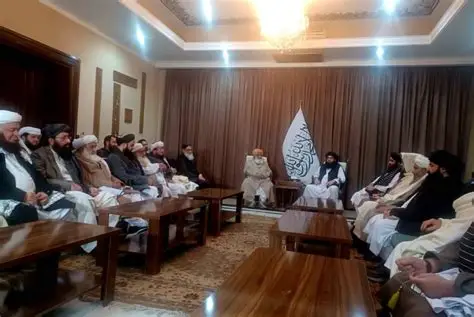
He was of the view that the Pakistan government tried at least 12 times to change the syllabus of JUI religious schools under the National Action Plan (NAP), but JUI refused to change the syllabus, and governments had to succumb to JUI’s political blackmailing, sometimes for constitutional amendments and sometimes to run interim setups. History reminds us that the JUI-Taliban connection is no exception, but Pakistan’s governments, for political reasons, kept their eyes closed until now, when JUI has become a mouthpiece of the Afghan Taliban and is attacking Pakistan’s core narrative behind eliminating terrorism in the country.

