
DND REPORT
An emerging body of open-source analysis is raising questions about a cluster of influential social media accounts that present themselves as anti-Western, anti-U.S., and pro-BRICS but may in fact be advancing narratives that run counter to the very countries they appear to support.
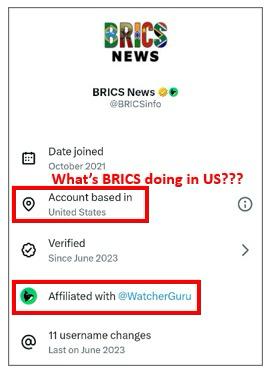
Analysts suggest that some of these accounts, rather than serving as authentic voices of a multipolar world, could be part of a more complex information ecosystem, one that, intentionally or otherwise, aligns with Israeli strategic communication interests.
At the center of this scrutiny is the X (formerly Twitter) account BRICS News (@BRICSinfo), a high-visibility handle that claims to provide “unparalleled coverage of all-things geopolitics & BRICS News in real-time.” While the account explicitly states it is not affiliated with any government, its branding, tone, and naming convention often give casual users the impression that it is an official or semi-official BRICS communication channel.
While @BRICSinfo presents itself as a champion of multipolarity and an emerging global order, its content raises important questions about authenticity, intent, and impact. Whether driven by opportunism, ideology, or more coordinated efforts, the account exemplifies how digital platforms can be used to project influence in ways that are not always transparent.
Impersonation or Influence?
Digital analysts argue that @BRICSinfo operates in a gray zone between independent commentary and implicit impersonation. Despite disclaimers in its bio, the account’s presentation mimics institutional authority, potentially undermining the credibility of BRICS as a formal multilateral platform.
Compounding these concerns is the account’s pattern of frequent rebranding. It has reportedly changed its name multiple times over the past three years, raising questions about continuity, intent, and audience targeting.
Questionable Affiliations
Open-source intelligence (OSINT) tracing suggests a link between @BRICSinfo and another prominent account, @WatcherGuru, a cryptocurrency-focused media platform covering blockchain, DeFi, and financial markets. While such a connection may appear benign on the surface, analysts point to the blending of financial speculation with geopolitical messaging as a potential red flag in influence operations.
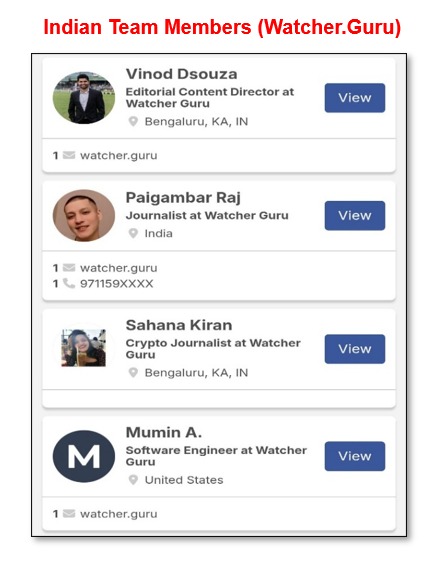
The reported Indian origin of Watcher Guru’s team has also been cited in some analyses as a factor contributing to the account’s opaque identity though no direct evidence has been publicly established linking it to any state-backed activity.
Narrative Patterns During Conflict
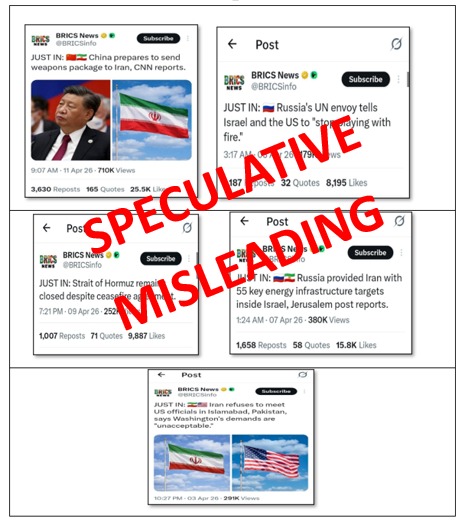
The account’s behavior during periods of geopolitical tensions, particularly the recent U.S.-Iran crisis has drawn sharper criticism. Analysts note that @BRICSinfo repeatedly circulated unverified or speculative claims, often invoking China and Russia in ways that could escalate tensions or distort diplomatic realities.
Examples cited include:
- Claims that Russia supplied tactical weapons to Iran
- Assertions that China was directly arming Tehran
- Reports suggesting multiple countries were covertly backing Iran militarily
Such narratives risk portraying Iran as dependent on external military support while simultaneously implicating China and Russia in direct confrontation with the United States, an outcome that could damage all three countries diplomatically.
A Contradictory Messaging Strategy
What makes @BRICSinfo particularly notable is the apparent contradiction at the heart of its content. On one hand, it promotes a multipolar worldview, emphasizing the decline of U.S. dominance, the rise of BRICS, and the push for de-dollarization. On the other hand, its more sensational or speculative posts may inadvertently—or deliberately—undermine the strategic positions of key BRICS members.
For instance, by overstating military cooperation or framing geopolitical developments in alarmist terms, the account may:
- Increase perceptions of instability within BRICS-aligned regions
- Fuel narratives that justify Western security responses
- Complicate diplomatic efforts by introducing misinformation into public discourse
This duality has led some analysts to conclude that the account’s output aligns less with BRICS’ stated goals and more with narratives that could benefit third-party strategic interests.
The Israeli Angle: Evidence and Caution
The most contentious aspect of the analysis is the suggestion that such accounts may be indirectly aligned with Israeli information operations. Proponents of this view argue that amplifying divisive or misleading narratives about Iran, China, and Russia ultimately serves Israeli strategic interests by:
- Isolating Iran diplomatically
- Straining China-Russia relations with other global actors
- Reinforcing perceptions of instability among U.S. adversaries
Targeting the Global South
@BRICSinfo’s messaging appears carefully calibrated for audiences in the Global South regions where skepticism toward Western policies and interest in alternative power structures are already high. By combining real policy developments (such as BRICS expansion or currency diversification) with assertive or sometimes exaggerated framing, the account achieves high engagement and virality.
Its use of concise, dramatic language such as —“game changer,” “historic shift,” “breaking”—further amplifies its reach, even when underlying claims lack full context or verification.
A Broader Trend in Digital Influence
The case of @BRICSinfo highlights a growing trend in the digital information space: the rise of hybrid narrative platforms that blur the line between journalism, advocacy, and influence operations. These accounts often:
- Operate without clear institutional backing
- Mix factual reporting with selective framing
- Build credibility through volume and speed rather than verification
Such platforms can shape public perception at scale, particularly during fast-moving geopolitical events where information gaps are common.
Calls for Scrutiny
Given the potential implications, some analysts argue that BRICS member states, particularly China, Russia, and Brazil along with the BRICS Secretariat, should examine accounts that appear to speak in their name without authorization. There are also calls for platform-level review by X to assess whether such accounts violate impersonation or misinformation policies.
In an era where information itself is a strategic asset, distinguishing between genuine narratives and engineered ones is becoming increasingly difficult and increasingly necessary.

