
By Agha Iqrar Haroon
The operationalization of the Gabd Border Terminal and the launch of a transit trade corridor through Iran mark more than just a logistical upgrade for Pakistan. These developments signal a quiet but significant correction of a long-standing strategic miscalculation in regional connectivity.
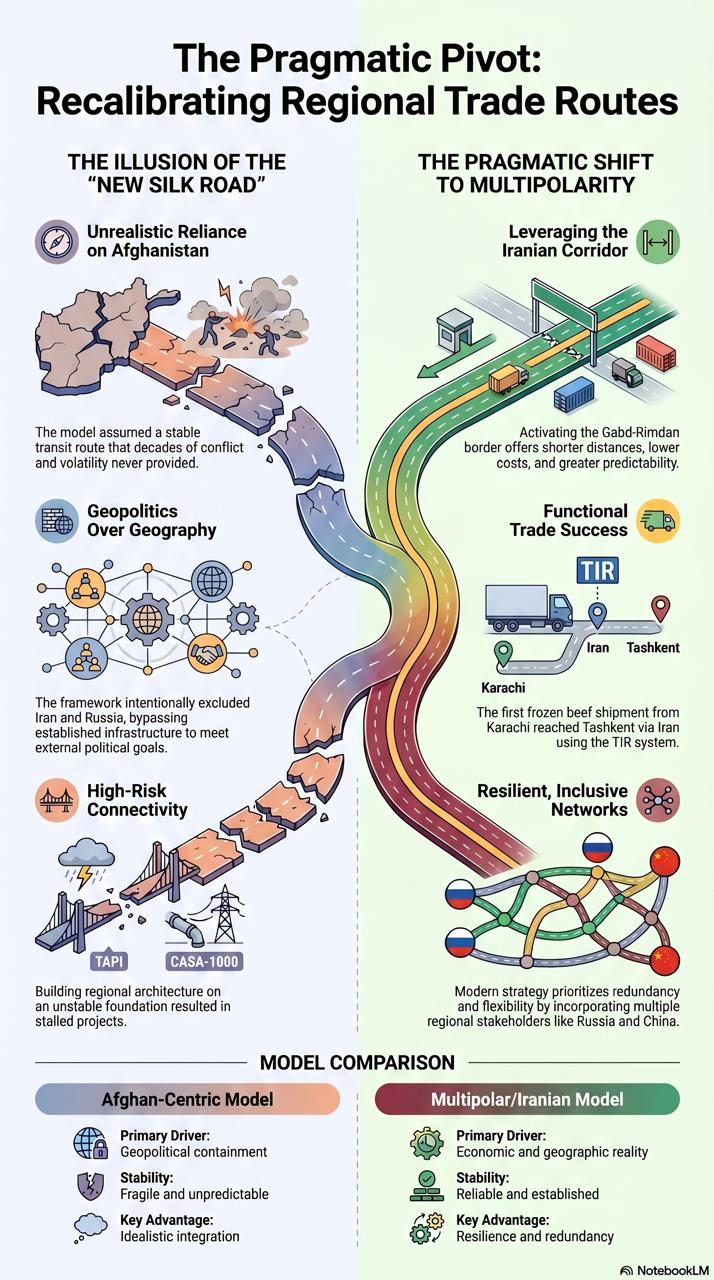
For years, the idea of a “New Silk Road,” popularized during the early 2010s, placed Afghanistan at the center of regional trade, envisioning it as a land bridge linking South Asia with Central Asia. While attractive on paper, this model rested on a fragile assumption: that Afghanistan could provide a stable, secure, and reliable transit route. Reality has consistently contradicted this premise. Decades of conflict, recurring border disruptions, and political volatility have made Afghanistan an uncertain corridor for sustained economic integration. The CASA-1000 and TAPI projects were designed to financially support Afghanistan during the U.S.-backed era, while the Iran-Pakistan gas pipeline was abandoned due to U.S. sanctions on Iran. Those first two decades were critical for Pakistan in terms of energy demand, yet the Iran-Pakistan gas pipeline was avoided for strategic reasons.
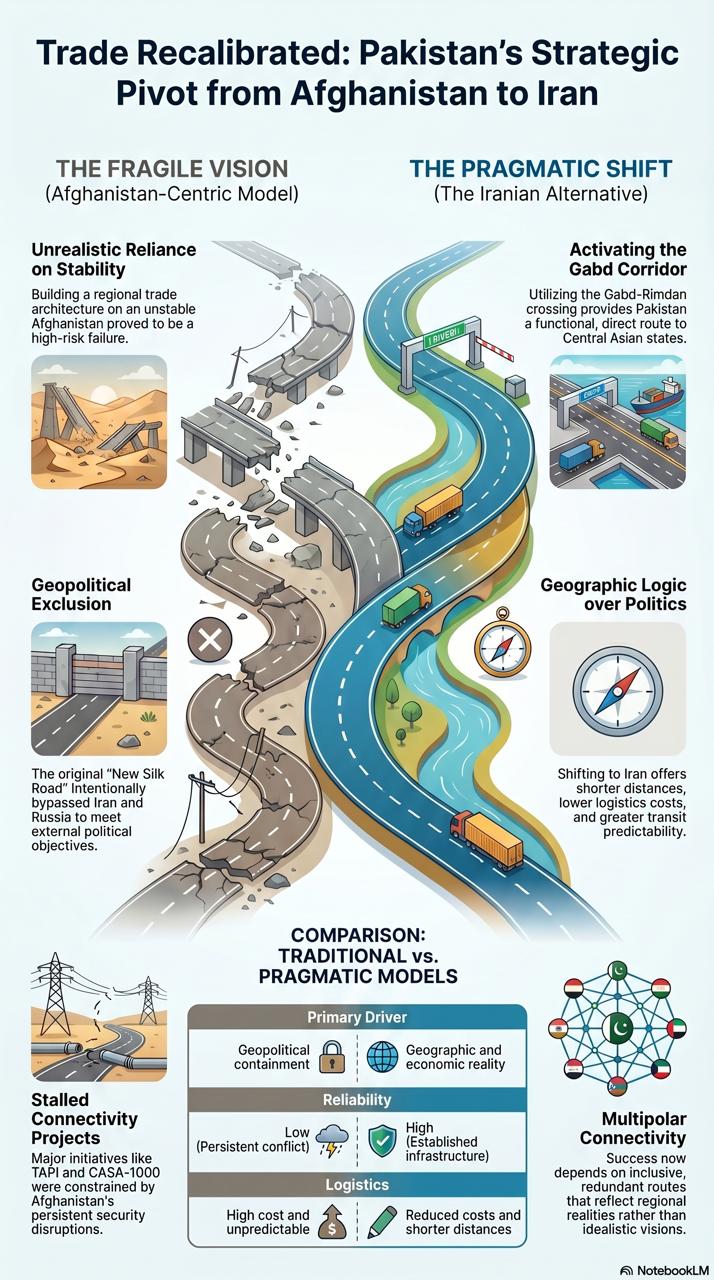
In contrast, Pakistan’s decision to activate the Gabd-Rimdan border crossing and operationalize trade through Iran reflects a more grounded and pragmatic approach. The successful dispatch of the first commercial shipment of frozen beef from Karachi to Tashkent via Iran under the TIR system demonstrates that viable alternatives not only exist but are already functional. This route offers shorter distances, reduced logistics costs, and greater predictability compared to the traditional Afghan corridor.
More importantly, this shift underscores the importance of geography over geopolitics. Earlier connectivity frameworks often downplayed or excluded key regional players like Iran, despite its strategic location and established infrastructure linking Central Asia to global markets. By leveraging Iran as a transit partner, Pakistan is aligning its trade strategy with regional realities rather than external political preferences.
The implications of this development are far-reaching. Enhanced connectivity through Iran opens up direct access to Central Asian markets, strengthens Pakistan-Iran economic ties, and positions Pakistan as a more credible regional trade hub. Infrastructure like the Gabd Border Terminal, developed by the National Logistics Corporation, along with expanding corridor networks to China and Central Asia, indicates a broader shift toward diversified and resilient trade routes.
At a strategic level, this evolution also reflects a transition from idealistic, single-route visions to multipolar connectivity frameworks. Successful regional integration depends on inclusivity, redundancy, and flexibility—principles that are increasingly evident in emerging trade networks across Eurasia. For all practical purposes, Pakistan no longer needs to wait for peace in Afghanistan; rather, Afghanistan now needs Pakistan to connect with Central Asian states.
“Bypassing key regional powers like Iran and Russia while placing heavy reliance on Afghanistan as a stable transit hub has proven deeply unrealistic”
In essence, the activation of the Gabd corridor is not just about a new road; it is about abandoning the illusion that one unstable corridor can anchor regional trade. By reducing dependence on Afghanistan and embracing alternative routes through Iran, Pakistan is recalibrating its connectivity strategy in line with practical realities. This may well prove to be a defining step toward sustainable regional integration and economic growth.
The idea often referred to as the “New Silk Road” gained prominence during Hillary Clinton’s tenure as U.S. Secretary of State around 2011, though its intellectual roots go back to earlier policy thinking in the 2000s. The concept envisioned Afghanistan as a central land bridge connecting South Asia with Central Asia, promoting trade, energy flows, and regional integration. However, the model implicitly minimized or bypassed key regional powers like Iran and Russia while placing heavy reliance on Afghanistan as a stable transit hub an assumption has proven deeply unrealistic and impractical.
At its core, the New Silk Road initiative was shaped by geopolitical considerations as much as economic logic. By excluding Iran and limiting Russia’s role, the framework aligned with broader U.S. strategic objectives of containing these actors’ regional influence. Instead, it sought to anchor connectivity through Afghanistan, linking countries like Pakistan, India, and the Central Asian republics via infrastructure, trade corridors, and energy projects such as TAPI (Turkmenistan-Afghanistan-Pakistan-India pipeline). On paper, this vision promised mutual economic interdependence and, by extension, political stability.
“Russia has long-standing infrastructure networks and influence in Central Asia that cannot simply be replaced. Excluding these countries did not eliminate their relevance; instead, it limited the practicality and inclusiveness of the New Silk Road vision”
However, the central flaw in this approach was its overestimation of Afghanistan’s capacity to serve as a reliable corridor. Afghanistan has not experienced sustained peace for decades, and despite massive international investment, its security environment remained fragile even during periods of relative stability. The U.S. withdrawal in 2021 and the subsequent political transition further underscored how uncertain and volatile the Afghan landscape remains. Building a regional connectivity architecture on such an unstable foundation was always a high-risk proposition.
Moreover, bypassing Iran and Russia ignored geographic and economic realities. Iran, for instance, offers some of the most direct and historically established trade routes linking Central Asia to global markets through its ports, such as Chabahar. Similarly, Russia has long-standing infrastructure networks and influence in Central Asia that cannot simply be replaced. Excluding these countries did not eliminate their relevance; instead, it limited the practicality and inclusiveness of the New Silk Road vision.
In contrast, alternative connectivity models such as China’s Belt and Road Initiative (BRI) have taken a more inclusive approach, incorporating multiple routes and stakeholders, including Iran and Russia. This multipolar connectivity framework has arguably gained more traction because it reflects regional realities rather than attempting to reshape them according to geopolitical preferences.
I believe Afghanistan never being “normal and peaceful” is central to understanding why the New Silk Road concept struggled to materialize. Connectivity projects require predictability, security, and long-term investment confidence—conditions that Afghanistan has been unable to consistently provide. As a result, many of the proposed projects under this initiative either stalled or failed to reach their full potential.
In conclusion, while the New Silk Road concept was ambitious and strategically appealing, it was ultimately constrained by its geopolitical exclusions and its reliance on an unstable Afghanistan for regional connectivity. Pakistan has now adopted a more pragmatic approach by recognizing the importance of inclusive regional cooperation and leveraging all viable routes, including those through Iran and Russia, rather than attempting to build a connectivity framework around political preferences that do not align with ground realities.

